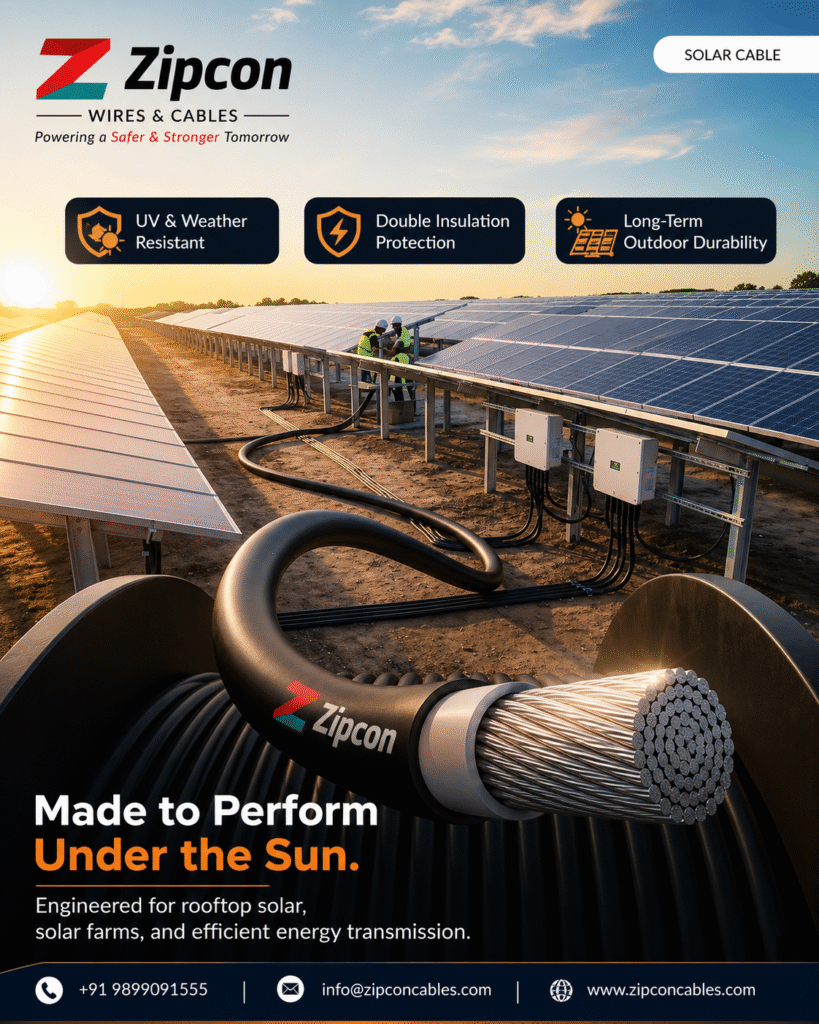
solar cable in Kozhikode is essential for maintaining safe, efficient, and reliable solar power transmission. Solar cables connect photovoltaic panels with other components of a solar system and remain exposed to outdoor conditions such as heat, moisture, sunlight, and temperature variations.
A standard electrical cable may not be designed for continuous outdoor photovoltaic applications. Solar cables are specifically developed for solar installations, with insulation and sheath properties intended to withstand demanding environmental conditions.
For residential rooftops, commercial solar systems, agricultural installations, and solar pumping applications, Zipcon Cables can be considered for dependable solar cable solutions designed around the requirements of modern photovoltaic systems.
Contact us today:- https://zipconcables.com/contact-us/
What Is a Solar Cable?
A solar cable is an electrical cable specifically designed for photovoltaic power systems. It is used to transmit DC electricity generated by solar panels to components such as junction boxes, charge controllers, inverters, and other parts of the solar installation.
Unlike conventional indoor wiring, solar cables are required to operate outdoors for extended periods. Their construction therefore needs to account for UV exposure, temperature changes, moisture, mechanical stress, and continuous electrical loading.
The correct solar cable should be selected according to system voltage, current, cable length, installation environment, and the manufacturer’s technical specifications.
Why Solar Cable Quality Matters in Kozhikode
Kozhikode’s coastal and tropical environment can expose solar installations to moisture, strong sunlight, heat, and seasonal weather changes. These conditions make cable construction an important part of overall system reliability.
A cable with unsuitable insulation may deteriorate faster when continuously exposed to outdoor conditions. Damage to insulation can create electrical safety risks and may reduce system reliability.
Using a purpose-designed solar photovoltaic cable with suitable insulation and sheath characteristics helps provide more dependable power transmission throughout the installation’s operating life.
Key Features of a Reliable Solar Cable
1. UV Resistance
Solar cables are typically routed outdoors and may remain exposed to sunlight for many years. UV-resistant insulation and sheath materials help reduce premature deterioration caused by prolonged solar radiation.
This is particularly important for rooftop and ground-mounted solar systems where cable exposure cannot always be avoided.
2. Temperature Resistance
Solar cables may experience significant temperature changes during daily operation. The cable should have an appropriate temperature rating for the installation environment and expected operating conditions.
Proper temperature performance helps the insulation maintain its electrical and mechanical properties over time.
3. Moisture Resistance
Outdoor solar systems can be exposed to rain, humidity, condensation, and other sources of moisture. Suitable solar cable construction helps protect the electrical conductors from environmental exposure.
Proper connectors, cable routing, and installation practices are equally important because cable performance depends on the complete electrical system.
4. Durable Insulation
The insulation surrounding the conductor provides electrical separation and environmental protection. High-quality insulation helps reduce the risk of leakage, short circuits, and premature cable degradation.
The insulation material should be appropriate for the DC voltage and operating conditions of the solar installation.
5. Flexible Construction
Solar cables often need to be routed around panels, mounting structures, junction boxes, and other equipment. Adequate flexibility can make installation easier while reducing unnecessary mechanical stress.
However, excessive bending should still be avoided, and the manufacturer’s minimum bending radius should be followed.
Solar DC Cable vs Conventional Electrical Cable
A common mistake is assuming that any electrical cable can be used for a solar installation.
| Feature | Solar DC Cable | Conventional Electrical Cable |
|---|---|---|
| Primary Application | Photovoltaic systems | General electrical installations |
| Outdoor Exposure | Designed for solar environments | Depends on cable type |
| UV Resistance | Typically required for exposed PV applications | Not always suitable |
| DC System Use | Specifically designed for PV applications | Depends on specification |
| Temperature Requirements | Designed for demanding outdoor conditions | Varies |
| Solar Installation | Preferred where specified | Should not be substituted without verification |
The important point is not simply the cable name. The selected product must meet the electrical and environmental requirements of the specific solar installation.
How to Choose the Right Solar Cable in Kozhikode
Check System Voltage
Determine the maximum system voltage before selecting the cable. The cable’s voltage rating must be appropriate for the photovoltaic system.
For DC solar systems, voltage specifications should be checked carefully because PV strings can operate at substantial DC voltages.
Check Current Capacity
Cable size must be suitable for the expected current. The conductor should be capable of carrying the required current under the actual installation conditions.
Cable grouping, ambient temperature, installation method, and other factors can affect current-carrying capacity.
Consider Cable Length
Longer cable runs can increase voltage drop and power losses. If the cable distance is significant, conductor size should be evaluated accordingly.
A properly sized solar cable can help reduce unnecessary electrical losses between system components.
Consider Installation Conditions
Determine whether the cable will be installed on a rooftop, inside conduit, underground, along a solar mounting structure, or in another environment.
The cable’s insulation and sheath characteristics should match the installation conditions.
Choose the Correct Cable Connector
Cable quality alone is not enough. Solar connectors and terminations should also be compatible with the cable and installed correctly.
Poor connections can introduce resistance, heating, and reliability issues.
Common Solar Cable Sizes
Solar cables are available in different conductor sizes, with 4 sq mm solar cable and 6 sq mm solar cable being common choices in many photovoltaic applications.
However, there is no universal cable size for every solar system. The correct size depends on current, cable length, system configuration, voltage drop, installation conditions, and applicable electrical requirements.
For example, a short rooftop connection may require a different conductor size from a long cable run between a solar array and inverter.
Solar Cable Applications in Kozhikode
Residential Rooftop Solar
Homeowners installing rooftop photovoltaic systems need cables capable of handling outdoor exposure and continuous DC power transmission.
A properly specified solar cable can help maintain reliable connections between PV modules and the inverter system.
Commercial Solar Installations
Commercial rooftops often contain larger arrays with longer cable routes. Cable sizing and routing become increasingly important as system capacity increases.
Properly selected solar DC cables can support organized installation and efficient electrical transmission.
Agricultural Solar Systems
Agricultural solar installations may power irrigation systems, pumps, and other equipment. These systems can be exposed to dust, moisture, heat, and mechanical conditions.
The solar cable should be selected for the complete environment rather than only the electrical load.
Solar Water Pump Systems
Solar-powered borewell and irrigation pumps require cables suitable for the electrical configuration and installation environment.
Where cables are used with submersible solar pumps, the cable construction must also be appropriate for the specific underwater application rather than using a standard rooftop PV cable without verification.
Examples of Solar Cable Selection
Example 1: Residential Rooftop
A homeowner installs a rooftop solar system with a short distance between the solar panels and inverter. The cable must still be rated for the system’s DC voltage and current and suitable for outdoor exposure.
A properly specified solar cable can provide reliable electrical transmission while handling rooftop environmental conditions.
Example 2: Long Commercial Cable Run
A commercial installation may have a longer distance between the PV array and inverter. In this case, voltage drop becomes more important.
The installer should evaluate conductor size based on current, cable length, permissible voltage drop, installation method, and applicable design requirements.
Example 3: Agricultural Solar Pump
A solar pump installation may involve both outdoor PV wiring and cables connected to the pump. Each section requires the cable type appropriate for its environment.
The outdoor PV section should use a suitable solar DC cable, while any underwater section should use a purpose-designed submersible pump cable according to the pump manufacturer’s requirements.
Why Choose Zipcon Cables for Solar Applications?
Zipcon Cables can be considered when sourcing solar cable solutions for residential, commercial, agricultural, and other photovoltaic applications.
A suitable Zipcon solar cable should be selected according to the system’s voltage, current, conductor size, installation length, and environmental requirements. This ensures the product specification matches the actual solar application.
For customers looking for a solar cable in Kozhikode, focusing on technical suitability, insulation quality, durability, and correct sizing is more important than choosing a cable based only on price.
Expert Tips for Buying Solar Cable
- Use a cable designed for photovoltaic applications. Do not automatically substitute ordinary electrical wiring.
- Check maximum system voltage. The cable rating must match the PV system requirements.
- Calculate current capacity correctly. Consider actual operating conditions rather than relying only on nominal panel ratings.
- Account for voltage drop. Long cable runs may require a larger conductor.
- Consider outdoor exposure. UV, heat, rain, and humidity should be part of the selection process.
- Use compatible connectors. Cable and connector specifications should be matched.
- Avoid unnecessary cable length. Efficient routing can reduce voltage drop and material requirements.
- Follow proper installation practices. Avoid sharp bends, loose connections, unsupported cable runs, and contact with sharp metal edges.
- Check manufacturer specifications. Technical data should be verified before bulk procurement.
Common Mistakes When Choosing Solar Cable
Using Ordinary House Wire
A standard house wire may not have the environmental characteristics required for exposed photovoltaic installations. Always verify that the cable is specifically suitable for the intended solar application.
Selecting Cable Size Only by Panel Wattage
Panel wattage alone does not determine cable size. Current, voltage, cable length, installation conditions, and system configuration also matter.
Ignoring Voltage Drop
Long cable runs can result in significant voltage drop. Ignoring this factor can increase losses and affect overall system efficiency.
Poor Cable Routing
Cables left loosely on rooftops or exposed to sharp edges can experience unnecessary mechanical damage. Proper clips, supports, conduits, and routing practices should be used where required.
Mixing Incompatible Connectors
Using connectors that are not properly compatible can increase contact resistance and create heating points. Compatible components and correct crimping or termination methods are essential.
Ignoring Local Environmental Conditions
A cable suitable for a controlled indoor environment may not be appropriate for a hot, humid, outdoor rooftop. Environmental exposure should always be considered.
Solar Cable Maintenance Tips
Solar cables generally require limited routine maintenance when correctly installed, but periodic visual inspection is useful.
Look for cracked insulation, loose connections, damaged cable clips, abrasion, exposed conductors, excessive bending, or signs of overheating. Any damaged cable should be evaluated and replaced by a qualified professional.
Keeping cables properly supported and away from sharp edges, standing water, and unnecessary mechanical stress can help preserve their service condition.
Conclusion
Choosing a top-rated solar cable in Kozhikode is an important step toward building a safe and efficient photovoltaic installation. Solar cables must handle DC electrical loads while remaining exposed to sunlight, heat, moisture, and changing outdoor conditions.
The right cable should be selected based on system voltage, current, conductor size, cable length, voltage drop, installation method, and environmental exposure. Proper connectors and professional installation are equally important for long-term reliability.
For solar installations in Kozhikode, Zipcon Cables is a brand worth considering for dependable solar cable solutions. Select the appropriate Zipcon specification for your system and combine it with correct sizing, routing, termination, and installation practices.
Top 5 FAQs
1. Which solar cable is best for solar installations in Kozhikode?
The best solar cable depends on the system voltage, current, cable length, installation environment, and required conductor size. A purpose-designed photovoltaic cable with suitable insulation and environmental resistance should be selected.
2. Can I use normal electrical wire for solar panels?
Ordinary electrical wire should not automatically be used for exposed solar installations. Solar PV cables are specifically designed for the electrical and environmental conditions associated with photovoltaic systems.
3. What size solar cable is commonly used?
Common solar cable sizes include 4 sq mm and 6 sq mm, but the correct size depends on current, cable length, voltage drop, installation conditions, and system design. Cable size should be calculated rather than selected only by convention.
4. Why is UV resistance important in solar cables?
Solar cables can remain exposed to sunlight for many years. UV-resistant insulation and sheath materials help reduce deterioration caused by prolonged exposure to ultraviolet radiation.
5. Is Zipcon Cables suitable for solar applications?
Zipcon Cables can be considered for solar cable requirements. The specific Zipcon solar cable should be selected according to the photovoltaic system’s voltage, current, cable size, length, and installation environment.