

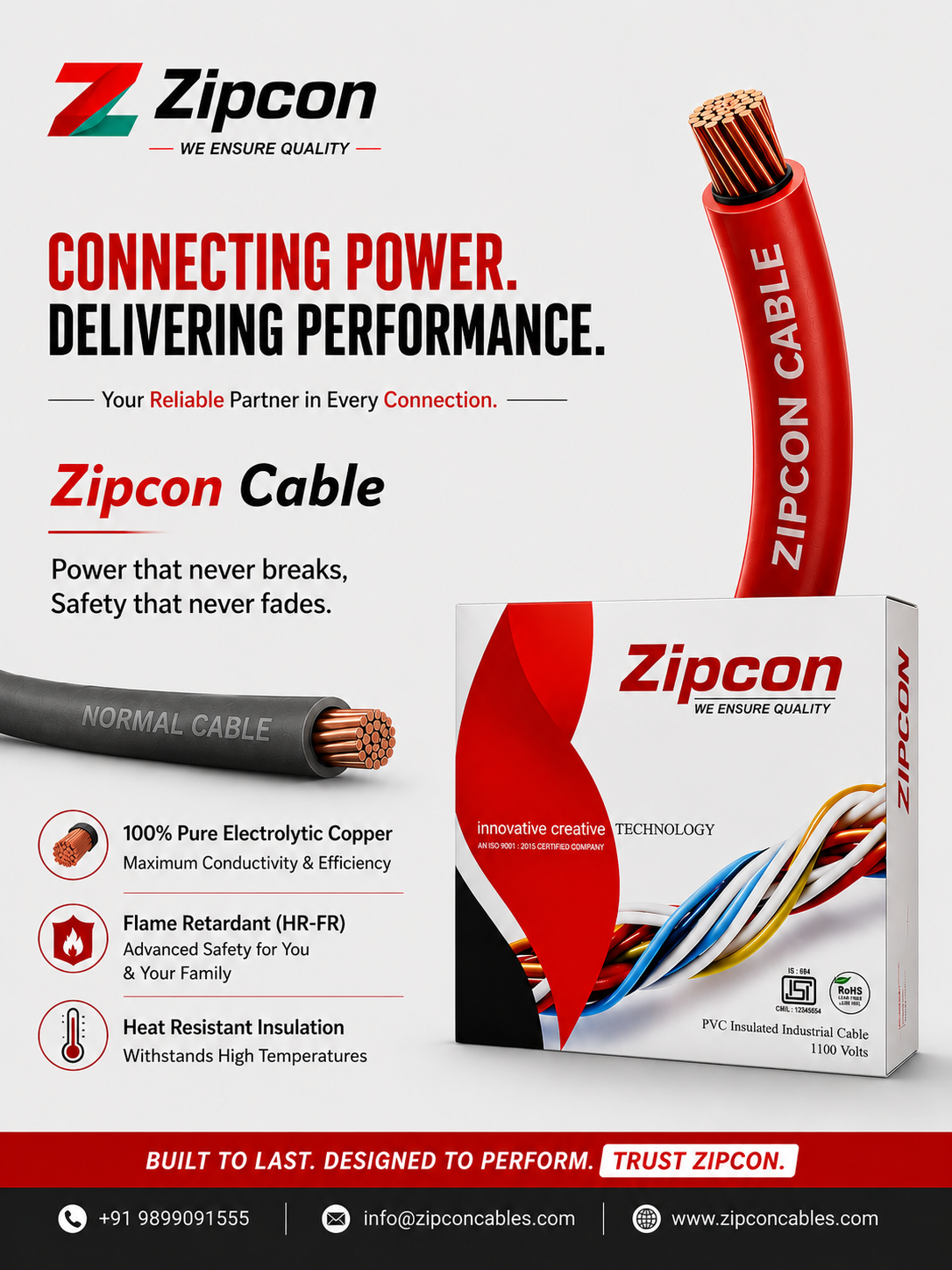
Electrical wiring needs to handle more than current. Cables may need to bend around corners, pass through conduits, connect equipment and withstand repeated handling during installation. Top flexible cable in Indore is therefore a practical choice for electrical applications where flexibility, reliable insulation and dependable conductor performance are important.
The right cable can make installation easier while supporting safe and consistent electrical performance. However, flexibility should not be the only selection factor. Conductor material, cross-sectional area, insulation, voltage rating, current capacity and installation conditions should all match the application. Zipcon Cables offers cable solutions designed for residential, commercial and electrical wiring requirements.
For inquiries or assistance, visit: 👉https://zipconcables.com/contact-us/
What Is a Flexible Cable?
A flexible cable is designed with a construction that allows it to bend more easily than many rigid cable types. Flexible cables commonly use stranded conductors, where multiple smaller wires form a conductor instead of one solid piece.
This construction allows the cable to accommodate bends and movement without making installation unnecessarily difficult. The exact degree of flexibility depends on conductor construction, insulation, sheath material, conductor size and the cable’s intended application.
Why Choose Flexible Cable for Electrical Wiring?
Flexible cables are useful when wiring routes are not completely straight or when equipment connections require easier cable handling.
Easier Installation
Flexible construction allows electricians to route cables around suitable bends and through appropriate pathways. This can make installation more practical in compact electrical spaces.
Better Cable Handling
Stranded conductors generally provide greater flexibility than equivalent solid conductors. This can be useful during termination, routing and equipment connections.
Suitable for Dynamic Applications
Some flexible cable designs are intended for applications where the cable experiences movement. However, not every flexible cable is suitable for continuous flexing, so the manufacturer’s application rating should always be checked.
Cleaner Wiring
A suitably selected flexible cable can help create an organised installation, particularly around electrical equipment, control panels and connection points.
Reliable Electrical Performance
Flexibility does not replace electrical requirements. A quality flexible cable should also provide appropriate conductor capacity, insulation and voltage performance for the intended circuit.
Key Features of a Quality Flexible Cable
When comparing flexible electrical cable in Indore, consider the complete cable construction rather than relying only on the word “flexible.”
Stranded Conductor Construction
Stranded conductors contain multiple smaller wires grouped together. This construction generally improves flexibility and makes the cable easier to handle during installation.
The number and size of strands can vary between cable designs. The appropriate construction depends on the cable’s intended use and technical specifications.
Quality Insulation
The insulation surrounds the conductor and provides electrical separation and protection. It should be suitable for the cable’s rated voltage and expected operating temperature.
For indoor and residential installations, insulation quality is particularly important because cables may be installed inside conduits, walls or electrical enclosures for long periods.
Durable Outer Sheath
Where the cable includes an outer sheath, it provides an additional layer of protection around the internal conductors. Sheath requirements depend on the installation environment and expected mechanical exposure.
Appropriate Current Capacity
The cable must be capable of carrying the expected load under the actual installation conditions. Current-carrying capacity depends on factors such as conductor size, material, installation method and ambient temperature.
Consistent Manufacturing
Uniform conductor dimensions, insulation and overall construction contribute to predictable cable performance. Consistency is especially important when cables are used across multiple circuits in a project.
Flexible Cable vs Rigid Wire
Flexible cables and rigid wires serve different purposes. The better option depends on the electrical installation rather than simply choosing the more flexible product.
| Feature | Flexible Cable | Rigid/Solid Wire |
|---|---|---|
| Conductor | Usually stranded | Often solid or less-flexible construction |
| Flexibility | Higher | Lower |
| Handling | Easier around bends | Better suited to fixed routing |
| Equipment connections | Often convenient | Depends on application |
| Movement | Some types support movement | Generally intended for fixed installations |
| Selection | Based on application and cable rating | Based on application and cable rating |
For a permanent fixed circuit, a rigid conductor may be appropriate. For connections requiring easier bending or handling, a suitable flexible cable can offer practical advantages.
Applications of Flexible Cable in Indore
Home Electrical Wiring
Flexible cable can be useful for suitable appliance connections, internal wiring and other residential applications where the cable specifications match the circuit requirements.
Electrical Panels
Control panels often contain compact wiring routes with multiple bends and connections. Suitable flexible cables can make panel wiring easier to organise.
Appliances and Equipment
Equipment connections may require cables that can be routed around terminals and enclosures. The selected cable must comply with the equipment’s electrical requirements.
Commercial Installations
Offices, shops and other commercial spaces may use flexible cables for specific wiring and equipment connections where flexibility provides an installation advantage.
Control and Automation Systems
Some control applications require multiple conductors and organised routing. Cable selection should follow the equipment and system specifications.
Example: Flexible Cable for Home Wiring
Consider a home renovation in Indore where an electrician needs to route wiring through compact electrical spaces and around several suitable bends. A correctly specified flexible cable can simplify handling and termination.
However, the electrician should first determine the circuit load and cable requirements. Selecting a flexible cable simply because it bends easily can lead to an unsuitable installation if its conductor size, voltage rating or current capacity does not match the circuit.
How to Select the Right Flexible Cable
Step 1: Identify the Application
Determine whether the cable will be used for fixed wiring, appliance connections, control equipment or an application involving movement.
Step 2: Calculate the Load
Identify the expected electrical current and connected load. This provides the basis for selecting an appropriate conductor size.
Step 3: Check Cable Length
Longer cable runs can increase voltage drop. Cable selection should consider the complete circuit length rather than only the visible cable section.
Step 4: Check Installation Conditions
Consider whether the cable will be inside a conduit, exposed to heat, installed in an enclosure or subject to mechanical movement.
Step 5: Verify Cable Ratings
Check voltage rating, temperature rating, conductor material, current capacity and other applicable technical specifications before installation.
Why Choose Zipcon Cables?
Zipcon Cables provides electrical cable solutions for different residential, commercial and industrial requirements. For customers searching for a flexible cable in Indore, the product should be selected according to the specific application rather than based solely on brand, price or flexibility.
Zipcon cables can be considered where their technical specifications match the project’s electrical requirements. Homeowners, electricians, contractors and businesses can evaluate the appropriate Zipcon product based on conductor construction, insulation, size and intended use.
Expert Tips for Buying Flexible Cable in Indore
- Choose the cable based on load: Do not select cable size by appearance or flexibility alone.
- Check the conductor: Confirm whether copper or aluminium is appropriate for the application.
- Consider voltage drop: Longer cable runs may require careful sizing.
- Check insulation: Select insulation suitable for the expected temperature and voltage.
- Match the cable to movement: A flexible cable is not automatically designed for continuous flexing.
- Use suitable terminals: Cable terminals and connectors should be compatible with the conductor.
- Avoid excessive bending: Follow the manufacturer’s recommended minimum bending radius.
- Purchase genuine products: Buy from a reliable manufacturer or authorised source.
Common Mistakes to Avoid
Choosing Only by Flexibility
A cable can be highly flexible but still be unsuitable for a particular electrical load. Electrical capacity and application rating should always come first.
Using an Undersized Cable
An undersized conductor can experience excessive heating when subjected to unsuitable loads. Cable size should be calculated according to the circuit requirements.
Ignoring Installation Conditions
Heat, enclosure conditions, cable grouping and routing can affect cable performance. These factors should be considered during cable selection.
Excessive Bending
Even flexible cables have bending limitations. Sharp bends can place unnecessary mechanical stress on the conductor and insulation.
Poor Termination
Loose terminals can increase contact resistance and create heating at connection points. Proper stripping and termination are essential.
Mixing Incompatible Components
Cable, terminals, connectors, protective devices and equipment should be compatible. Incorrect combinations can reduce the reliability of an otherwise good installation.
Maintenance Tips for Flexible Electrical Cables
Regularly inspect accessible cables for cuts, cracks, exposed conductors, excessive heating or other visible damage. Pay particular attention to areas where cables pass through openings or connect to equipment.
Avoid pulling equipment by its electrical cable and prevent cables from being crushed under heavy objects. Damaged wiring should be inspected and replaced appropriately by a qualified professional.
Conclusion
Choosing the top flexible cable in Indore requires more than looking for a cable that bends easily. Conductor construction, cable size, insulation, voltage rating, current capacity, installation conditions and intended application all affect electrical performance and safety.
For homeowners, electricians, contractors and businesses, Zipcon Cables offers cable solutions that can be evaluated according to specific wiring requirements. Select the appropriate Zipcon flexible cable based on its technical specifications, use proper installation practices and ensure the complete electrical system is correctly protected.
Top 5 FAQs
1. What is a flexible cable used for?
Flexible cables are used in electrical applications where easier bending, handling or equipment connection is required. Their suitability depends on the cable’s specific construction and application rating.
2. Is flexible cable suitable for home wiring?
Suitable flexible cables can be used for specific residential applications, provided their electrical ratings and construction match the requirements of the circuit and installation.
3. What makes a flexible cable different from ordinary wire?
Flexible cables commonly use stranded conductors made from multiple smaller wires. This construction generally allows greater bending flexibility than solid conductors.
4. How do I choose the right flexible cable size?
Cable size should be selected according to electrical load, conductor material, cable length, voltage drop, installation conditions and applicable requirements. A qualified electrician should verify the final selection.
5. Why choose Zipcon flexible cables in Indore?
Zipcon Cables provides cable solutions for various electrical applications. Customers should select the appropriate Zipcon flexible cable according to its technical specifications and the requirements of their particular installation.