

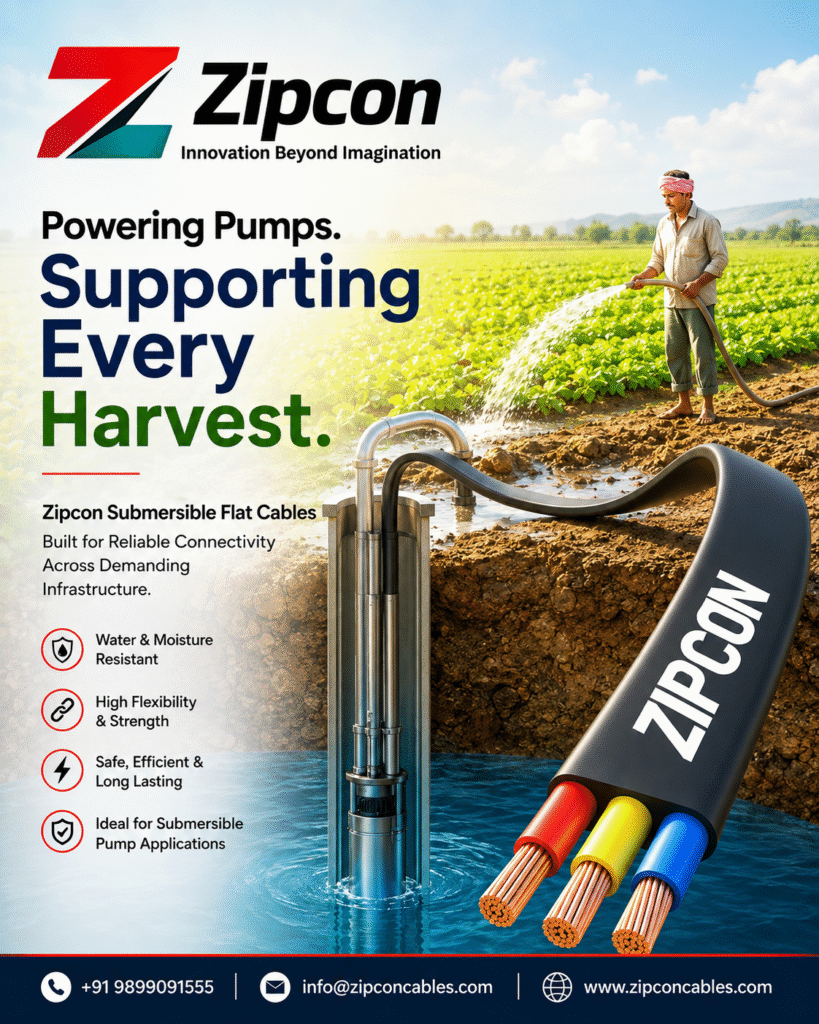
Choosing the right submersible cable in Bhopal is critical for reliable water-pump operation. A submersible pump cable works in a demanding environment where electrical wiring can be exposed to moisture, water pressure, temperature changes, and continuous operating conditions.
A poor-quality or incorrectly selected cable can lead to insulation damage, electrical leakage, voltage drop, and unexpected pump downtime. The cable must therefore be selected according to the pump’s electrical requirements and the conditions in which it will operate.
For borewell pumps, agricultural water systems, residential water supply, and other pumping applications, Zipcon Cables offers dependable cable solutions designed for demanding electrical environments. The right cable can help support stable power transmission and long-term pump performance.
For inquiries or assistance:– https://zipconcables.com/contact-us/
What Is a Submersible Cable?
A submersible cable is an electrical cable specifically intended for connections involving submersible pumps and equipment operating in or around water. Its construction is designed to provide electrical insulation and mechanical protection under demanding conditions.
Unlike ordinary indoor electrical wires, submersible cables need to be suitable for environments involving moisture and water exposure. Their insulation and overall construction are important factors in maintaining electrical safety.
The exact cable type should be selected according to the pump’s voltage, current, number of phases, conductor size, installation depth, cable length, and manufacturer requirements.
Why Submersible Cable Quality Matters
A submersible pump can operate continuously for extended periods. The cable supplying power to the motor must therefore maintain a dependable electrical connection throughout operation.
When a cable is installed in a borewell or other wet environment, insulation quality becomes especially important. Proper insulation helps separate the electrical conductor from water and surrounding materials.
The cable also needs adequate mechanical strength to withstand installation and operating conditions. Choosing a suitable cable is therefore part of protecting both the electrical system and pump performance.
Key Benefits of a Quality Submersible Cable
- Reliable electrical power transmission
- Suitable insulation for wet environments
- Better protection against moisture exposure
- Improved mechanical durability
- Reduced risk of insulation deterioration
- Suitable options for borewell and water-pump applications
- Long-term reliability when correctly selected and installed
Important Features to Look for in a Submersible Cable
1. Reliable Insulation
Insulation is one of the most important parts of a submersible pump cable. It provides electrical separation around the conductor and helps protect the cable from the surrounding environment.
For underwater or wet installations, the insulation system should be appropriate for the intended application, temperature, voltage, and installation conditions.
2. Suitable Conductor Size
The conductor must be capable of carrying the pump’s operating current. The required cross-sectional area depends on factors such as motor power, supply voltage, cable length, installation conditions, and allowable voltage drop.
Using an undersized cable can contribute to voltage drop and excessive heating. Cable sizing should therefore be based on the pump manufacturer’s specifications and electrical calculations.
3. Water-Resistant Construction
Submersible pump cables operate in environments where exposure to water is expected. Their construction must be suitable for the intended wet installation.
A water-resistant cable helps maintain insulation performance when correctly installed and used within its specified operating conditions.
4. Mechanical Strength
Installation can place physical stress on the cable, particularly in deep borewell applications. A suitable cable should have adequate mechanical characteristics for the installation method.
Careful handling during lowering, routing, and connection can also reduce the possibility of physical cable damage.
5. Flexible Construction
Submersible pump installations can involve tight spaces and cable movement during installation. Suitable flexibility can make routing and installation more manageable.
The required flexibility depends on the specific cable construction and application. Excessive bending or improper handling should always be avoided.
Submersible Cable vs Regular Electrical Cable
A regular electrical cable may be suitable for many indoor or dry-location applications, but that does not automatically make it suitable for submersible pump installations.
| Feature | Submersible Cable | Regular Electrical Cable |
|---|---|---|
| Main application | Submersible pumps and wet environments | General electrical applications |
| Water exposure | Designed for specified wet applications | Application-dependent |
| Insulation requirements | Suitable for demanding pump environments | Depends on cable type |
| Mechanical demands | Designed according to intended application | Varies |
| Typical installation | Borewells, pumps, water systems | Homes, buildings, equipment |
| Selection | Pump load + environment + installation | Load + installation + application |
The key consideration is application suitability. A cable should be selected according to its intended use and technical specifications rather than appearance alone.
Types of Submersible Pump Cables
3 Core Submersible Cable
A 3 core submersible cable is commonly used for suitable three-phase pump applications. Each core carries an electrical phase, with the exact configuration determined by the pump and electrical system.
The conductor size should be selected according to motor current, cable length, voltage, and installation requirements.
Flat Submersible Cable
Flat submersible cables are designed in a flat configuration that can be convenient for specific pump installations. Their shape can help with certain borewell installation arrangements.
The appropriate flat cable should still be selected based on electrical ratings and the pump manufacturer’s requirements.
Round Submersible Cable
Round cable constructions are used in suitable applications where a round cable profile is preferred. Their suitability depends on the pump system, installation method, and cable specifications.
Applications of Submersible Cables in Bhopal
Borewell Water Pumps
Borewell pumps require electrical connections that can operate reliably in a wet underground environment. A suitable submersible cable provides the electrical link between the power supply and submerged motor.
Agricultural Irrigation
Farmers use submersible pumps for irrigation and water management. Cable selection becomes important because the equipment may operate for long periods and be exposed to demanding environmental conditions.
Residential Water Supply
Homes using borewell or underground water pumps require dependable electrical connections. A correctly selected submersible pump cable can support consistent pump operation.
Commercial Water Systems
Commercial buildings, institutions, and other facilities may use submersible pumps for water supply or water management. The cable should be selected based on the pump’s load and operating environment.
How to Choose the Right Submersible Cable in Bhopal
Check Pump Power and Current
Start with the pump’s rated power and operating current. These values help determine the appropriate conductor size.
Never select cable size simply because it is commonly used for a particular pump. The actual motor and installation specifications should be considered.
Consider Cable Length
The distance between the electrical supply and pump affects voltage drop. Longer cable runs may require a larger conductor cross-section to maintain acceptable electrical performance.
Identify the Pump Type
Determine whether the pump is single-phase or three-phase and select the appropriate core configuration.
For example, a three-phase pump may require a suitable three-core cable, while other systems can require different arrangements.
Consider Installation Depth
Deep borewell installations can place additional mechanical demands on the cable. Cable selection should account for the depth and installation method.
Check Voltage Rating
The cable must be compatible with the electrical system’s voltage and the pump manufacturer’s requirements.
Choose a Reliable Manufacturer
Cable quality is important when the cable will operate in a demanding environment. Zipcon Cables can be considered for suitable submersible cable applications where dependable construction and long-term performance are priorities.
Examples: Selecting a Submersible Cable
Example 1: Residential Borewell Pump
A home uses a submersible pump to draw groundwater from a borewell. The installer needs to consider the motor’s power, rated current, cable length, borewell depth, and supply type before selecting the cable.
A suitable cable should provide the required current-carrying capacity and insulation for the installation environment.
Example 2: Agricultural Pump
An agricultural pump may operate for several hours during irrigation. A cable that is correctly sized for the motor and cable distance can help reduce excessive voltage drop and support dependable operation.
The installation should also protect the cable from avoidable mechanical damage.
Example 3: Deep Borewell Installation
For a deeper pump installation, cable length increases and mechanical considerations become more significant. Cable sizing should account for voltage drop, while the cable construction should be suitable for the installation depth and conditions.
Why Choose Zipcon Cables for Submersible Applications?
Zipcon Cables provides cable solutions for demanding electrical applications, including suitable submersible pump requirements.
For customers searching for a submersible cable in Bhopal, Zipcon can be considered when durability, dependable insulation, and consistent electrical performance are important. The final cable selection should always match the pump’s technical specifications.
Whether the application involves a residential borewell, agricultural pump, or commercial water system, choosing the correct cable specification is more important than selecting based on price alone.
Expert Tips for Long-Lasting Pump Cable Performance
- Match cable size with pump current. Do not use an undersized conductor for a high-load motor.
- Account for cable length. Longer runs require voltage-drop considerations.
- Check the pump manufacturer’s requirements. Use them as the starting point for cable selection.
- Use suitable cable joints and terminations. Poor connections can compromise the entire electrical system.
- Handle the cable carefully during installation. Avoid cuts, crushing, excessive pulling, and sharp bends.
- Keep cable routing organized. Proper routing reduces unnecessary mechanical stress.
- Inspect connections periodically. Loose or damaged connections can affect pump performance and safety.
- Use qualified electrical professionals. Submersible pump installations involve electrical and wet-environment risks and should be completed according to applicable requirements.
Common Mistakes to Avoid
Using an Ordinary Electrical Cable
A general-purpose electrical cable may not be designed for continuous exposure to wet or submerged conditions. Always verify that the cable is intended for the specific pump application.
Selecting Cable Size Without Calculating Load
Pump power alone is not enough to determine cable size. Current, voltage, cable length, installation conditions, and allowable voltage drop also matter.
Ignoring Voltage Drop
A long cable run can increase voltage drop. Ignoring it can affect motor operation and electrical efficiency.
Poor Cable Jointing
Improper joints can allow moisture ingress or create electrical resistance. Suitable connection methods and accessories should be used.
Damaging the Cable During Installation
Pulling, twisting, crushing, or sharply bending the cable can damage its insulation or conductor. Proper installation practices are essential.
Choosing Only on Price
A submersible cable is part of the pump’s electrical infrastructure. Selecting solely on initial cost can overlook durability, application suitability, and long-term reliability.
Why Reliable Submersible Wiring Matters
The pump motor depends on a stable electrical supply. If the cable is incorrectly sized, damaged, or unsuitable for the environment, the pump may not receive power efficiently.
A properly selected submersible cable helps create a dependable connection between the electrical supply and pump motor. This becomes especially important for agricultural and residential systems where pump downtime can disrupt essential water supply.
For this reason, cable selection should be treated as an important part of the complete pump installation rather than as a minor accessory purchase.
Conclusion
Selecting the right submersible cable in Bhopal is essential for dependable borewell and water-pump performance. Conductor size, pump current, cable length, voltage, number of cores, insulation, installation depth, and environmental conditions should all be evaluated before purchase.
For reliable pump wiring, Zipcon Cables is an option worth considering for suitable residential, agricultural, and commercial applications. Choose the cable according to the pump manufacturer’s specifications and ensure professional installation.
Choose the right submersible cable with Zipcon Cables for safer electrical connections and long-lasting pump performance.
Top 5 FAQs
1. What is a submersible cable?
A submersible cable is designed for electrical connections involving submersible pumps and other applications where the cable may be exposed to water or wet conditions. Its construction provides insulation and protection appropriate to its specified application.
2. Which cable is suitable for a submersible pump?
The suitable cable depends on the pump’s power, current, voltage, phase configuration, cable length, installation depth, and environmental conditions. A qualified installer should select the cable according to the pump manufacturer’s specifications.
3. What size cable is required for a submersible pump?
There is no single cable size suitable for every pump. The required size depends on motor current, voltage, cable length, allowable voltage drop, installation conditions, and cable construction.
4. Can a regular electrical wire be used for a submersible pump?
A regular electrical wire should not be used unless its specifications explicitly make it suitable for the intended wet or submerged application. Submersible pump cables are selected specifically for these demanding conditions.
5. Why choose Zipcon Cables for submersible pumps?
Zipcon Cables offers electrical cable solutions for demanding applications. For submersible pumps, customers can consider the appropriate Zipcon cable based on conductor size, core configuration, insulation, electrical rating, installation conditions, and pump requirements.