

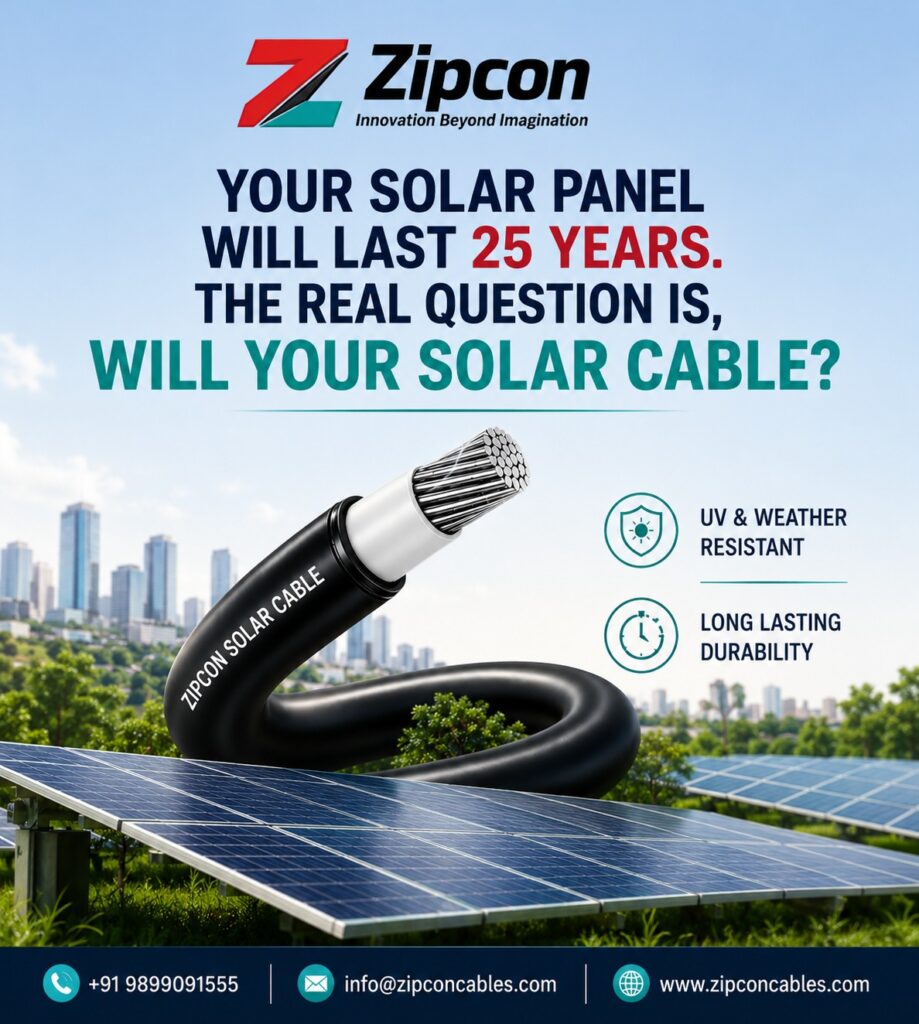
Choosing the best solar cables in Jabalpur is essential for building a reliable and efficient solar power system. Solar cables connect critical components such as solar panels, junction boxes, charge controllers, inverters, and batteries. Their quality directly affects electrical safety, system performance, and long-term durability.
Unlike ordinary electrical wires, solar cables are designed for demanding outdoor conditions. They may be exposed to sunlight, heat, moisture, temperature changes, and mechanical stress for years.
For residential rooftops, commercial installations, agricultural solar systems, and industrial projects, Zipcon Cables offers solar cable solutions designed with reliable insulation and application-focused construction.
For inquiries or assistance:– https://zipconcables.com/contact-us/
What Are Solar Cables?
Solar cables are specially designed electrical cables used to transmit DC power generated by photovoltaic (PV) solar panels. They connect solar modules with other parts of a solar power system, allowing electricity to travel safely between the panels, inverter, battery system, and associated equipment.
Solar installations typically operate outdoors, where cables can face continuous exposure to sunlight, heat, moisture, dust, and changing weather conditions. Therefore, solar cables need insulation and construction suitable for these operating environments.
The correct cable should also be selected according to current capacity, voltage, cable length, installation conditions, and the requirements of the solar system.
Why Quality Solar Cables Matter in Jabalpur
A solar power system is expected to operate for many years. While solar panels and inverters receive most of the attention during system planning, the cables connecting these components are equally important.
Poor-quality or incorrectly sized cables can increase electrical resistance and energy losses. Damaged insulation can also expose the conductor to environmental conditions and create avoidable electrical safety concerns.
1. Designed for Outdoor Conditions
Solar cables are commonly routed outdoors or in partially exposed areas. Their insulation should therefore be capable of handling the environmental conditions expected at the installation site.
A suitable solar cable helps maintain reliable electrical connections even when the system is exposed to sunlight, heat, moisture, and temperature fluctuations.
2. Supports Efficient Power Transmission
Cable resistance can contribute to power losses. Selecting an appropriate conductor size helps control voltage drop and electrical losses within the intended operating conditions.
This becomes particularly important in larger solar systems or installations where cable runs are relatively long.
3. Better Insulation Protection
Solar cables require insulation suitable for photovoltaic applications. Good insulation protects the conductor from external conditions and helps maintain electrical separation between the conductor and surrounding environment.
The insulation should also be handled correctly during installation to prevent cuts, compression, or other physical damage.
4. Suitable for Residential and Industrial Systems
Solar cables are used in systems of different capacities, from residential rooftop installations to commercial and industrial solar projects.
The cable specification should always match the system voltage, current, installation method, environmental conditions, and applicable technical requirements.
Key Features to Look for in the Best Solar Cables in Jabalpur
Selecting a solar cable should involve more than comparing prices. The construction and specifications of the cable determine whether it is suitable for the intended application.
High-Quality Conductors
The conductor is responsible for carrying electrical current from one solar component to another. Copper conductors are widely used in electrical applications because of their good conductivity and flexibility.
A suitable conductor size also helps manage current carrying capacity, voltage drop, and electrical losses.
Durable Insulation
Solar cable insulation must withstand the conditions expected in photovoltaic installations. Exposure to sunlight, heat, moisture, and outdoor environments makes insulation quality particularly important.
A durable insulation system can help protect the conductor throughout the expected service life when the cable is correctly installed.
UV and Weather Resistance
Solar cables installed outdoors may experience prolonged exposure to sunlight and changing weather conditions. UV and weather-resistant construction helps the cable withstand these conditions better than unsuitable conventional wiring.
This is especially important for rooftop and ground-mounted solar installations where sections of the cable remain exposed.
Suitable Voltage and Current Rating
Every solar cable has specific electrical ratings. The selected cable should be capable of handling the system’s expected voltage and current under the actual installation conditions.
Using an unsuitable cable can result in excessive heating, voltage drop, or reduced system reliability.
Flexibility and Easy Installation
Solar cables often need to be routed around solar panels, mounting structures, junction boxes, and other equipment. Suitable flexibility makes installation easier and helps installers create clean and secure cable routes.
However, excessive bending or improper routing should still be avoided.
Solar Cable vs Ordinary Electrical Cable
Solar cables and conventional electrical cables are not automatically interchangeable. Solar installations have specific environmental and electrical requirements that need to be considered during cable selection.
| Feature | Solar Cables | Ordinary Electrical Cables |
|---|---|---|
| Primary application | Photovoltaic systems | General electrical applications |
| Outdoor suitability | Designed for suitable PV applications | Depends on cable construction |
| UV exposure | Suitable products provide UV resistance | Varies by product |
| Environmental exposure | Designed according to specified conditions | Depends on insulation |
| Selection factors | PV voltage, current, temperature, installation | Load, voltage, installation and application |
The correct choice should always be based on the cable’s technical specifications and the requirements of the solar installation.
Types of Solar Cable Applications
Solar cables can be used at different points within a photovoltaic system, depending on the system architecture.
Solar Panel Interconnection
Cables connect individual solar modules and transfer generated DC electricity through the PV array. Reliable connections are important because poor connections can increase resistance and create heating.
Solar Panel to Inverter
DC cables may connect the solar array to the inverter. The cable must be appropriately rated for the system’s voltage, current, environmental conditions, and installation route.
Solar Battery Systems
In systems incorporating batteries, cables are used to connect the battery system with other components. Battery-side cables may have different current requirements, so they should be selected separately according to system specifications.
Commercial and Industrial Solar Installations
Large solar installations can involve longer cable runs and higher electrical loads. Correct cable sizing, routing, protection, and installation become increasingly important as system capacity increases.
How to Choose the Right Solar Cable Size
Cable size should be selected according to the expected current, voltage, cable length, installation conditions, allowable voltage drop, and applicable electrical requirements.
For a residential rooftop system, the cable requirement may differ from a large industrial solar plant. Longer cable runs can increase voltage drop, while higher current levels may require a larger conductor.
Instead of selecting a cable based only on what is commonly used, the solar system designer or qualified installer should calculate the requirements for the specific installation.
Residential Solar Cable Applications
Residential solar systems generally have smaller capacities than industrial installations, but cable quality remains important.
Solar cables may be used for:
- Rooftop solar panels
- Home solar power systems
- Solar inverters
- Battery-backed solar systems
- Solar water pumping systems
- Residential PV arrays
- Solar panel interconnections
For homeowners, selecting an appropriate cable can help support reliable energy transmission between the solar modules and system equipment.
Industrial Solar Cable Applications
Industrial solar projects have more demanding electrical and installation requirements. Cable routes may be longer, electrical currents may be higher, and cables may be exposed to different environmental and mechanical conditions.
Industrial applications can include:
- Factory rooftop solar systems
- Commercial solar plants
- Ground-mounted solar projects
- Large photovoltaic installations
- Solar power generation systems
- Commercial and industrial battery systems
For these applications, cable sizing, routing, protection, termination, and installation planning should be handled by qualified professionals.
Why Choose Zipcon Cables for Solar Applications?
For customers searching for the best solar cables in Jabalpur, Zipcon Cables is a practical brand to consider when evaluating reliable solar wiring solutions.
Zipcon Cables provides cable solutions for different electrical applications, including solar-related requirements. When selecting a Zipcon solar cable, customers should evaluate the conductor, insulation, electrical ratings, environmental suitability, and size according to the specific solar project.
The objective should not be to choose a cable based only on brand or price. The best cable is one whose technical specifications match the actual requirements of the solar installation.
Examples of Choosing Solar Cables
Example 1: Residential Rooftop Solar
Consider a homeowner installing a rooftop PV system. The cables connecting the solar modules to the inverter will be exposed to outdoor conditions and need to be routed safely across the roof.
A suitable solar cable should have appropriate electrical ratings, durable insulation, and outdoor suitability. Correct cable sizing should be determined according to the system current, voltage, cable length, and installation conditions.
Example 2: Solar Water Pump
Solar water pumping systems require reliable transmission of electrical power from the PV array to the pump system.
Because the cable may be exposed to heat, moisture, sunlight, and outdoor conditions, selecting a cable designed for the intended solar application is important.
Example 3: Industrial Solar Installation
An industrial solar project may involve long cable routes, multiple PV strings, and higher electrical loads.
In such systems, cable selection requires careful consideration of conductor size, voltage drop, current carrying capacity, environmental exposure, routing, and protection. Professional system design is essential.
Expert Tips for Buying Solar Cables in Jabalpur
1. Check the Cable’s Electrical Rating
Always verify the cable’s voltage and current specifications before purchase. The rating should be suitable for the solar system in which the cable will be installed.
2. Choose the Correct Conductor Size
Do not assume that a larger or smaller cable is automatically better. Select the conductor size based on current, cable length, voltage drop, installation conditions, and system design.
3. Prioritize Outdoor Durability
For rooftop and ground-mounted installations, check whether the cable is suitable for exposure to sunlight, temperature variations, and moisture.
4. Use Proper Solar Connectors
Cable performance also depends on the quality of terminations and connectors. Poorly fitted connectors can increase resistance and create heating points.
5. Avoid Excessive Cable Length
Unnecessarily long cable routes can increase voltage drop and material requirements. Plan cable routing efficiently while maintaining appropriate separation and protection.
6. Purchase Genuine Products
Buy solar cables from a dependable supplier and verify the product markings, specifications, and authenticity before installation.
7. Get Professional Installation
Solar DC systems require careful handling and correct installation. Cable routing, polarity, connectors, termination, protection, and system commissioning should be handled by qualified personnel.
Common Mistakes to Avoid When Buying Solar Cables
Using Ordinary House Wire for Solar Applications
A conventional house wire may not have the construction required for prolonged outdoor photovoltaic service. Solar applications require cables with appropriate environmental and electrical characteristics.
Choosing Cable Size Only by System Capacity
Knowing the solar system’s total capacity is not enough. Current, cable length, voltage, installation conditions, temperature, and allowable voltage drop also influence cable selection.
Ignoring Cable Routing
Cables left loose, exposed to unnecessary mechanical stress, or routed close to unsuitable surfaces can experience premature damage.
Using Poor-Quality Connectors
Even a good solar cable can develop problems if connectors are incorrectly crimped or poorly fitted. Connections should be made using suitable components and proper tools.
Mixing Incompatible Connectors
Connectors should be compatible and properly matched. Mixing components without confirming compatibility can compromise the reliability of the connection.
Focusing Only on the Lowest Price
Solar cables form part of a long-term energy system. Saving money on unsuitable wiring can lead to higher maintenance costs, replacement requirements, or system losses later.
How to Choose the Best Solar Cable for Your Project
Start by identifying the type and capacity of the solar installation. Determine the system voltage, expected current, cable length, routing method, environmental exposure, and allowable voltage drop.
Next, compare cable specifications, conductor construction, insulation, environmental suitability, and manufacturing quality. For larger residential, commercial, or industrial systems, cable selection should be incorporated into the overall electrical design.
For customers in Jabalpur, choosing a dependable brand such as Zipcon Cables can be part of a quality-focused solar installation strategy.
Conclusion
The best solar cables in Jabalpur should be selected according to the actual requirements of the solar system rather than price alone. A suitable solar cable needs the right conductor size, electrical rating, insulation, outdoor durability, and installation compatibility.
Top 5 FAQs
1. What are solar cables used for?
Solar cables are primarily used to transmit DC electricity between photovoltaic panels and other components such as inverters, junction boxes, charge controllers, and battery systems.
2. Why should solar cables be used instead of ordinary wires?
Solar cables are designed for photovoltaic applications and can provide suitable electrical and environmental characteristics for solar installations. Their suitability for outdoor exposure depends on their specific construction and ratings.
3. How do I choose the right solar cable size?
The appropriate size depends on factors such as system current, voltage, cable length, installation conditions, allowable voltage drop, and applicable electrical requirements. A qualified solar installer or electrical professional should determine the correct specification.
4. Can solar cables be used for residential solar systems?
Yes. Solar cables are commonly used in residential photovoltaic installations, including rooftop solar systems. The cable specification should be selected according to the system design and installation conditions.
5. Why consider Zipcon Cables for solar applications?
Zipcon Cables offers cable solutions for different electrical applications and can be considered when sourcing solar wiring. Before purchasing, verify that the specific Zipcon solar cable has the required conductor, insulation, voltage, current, and environmental specifications for your project.