

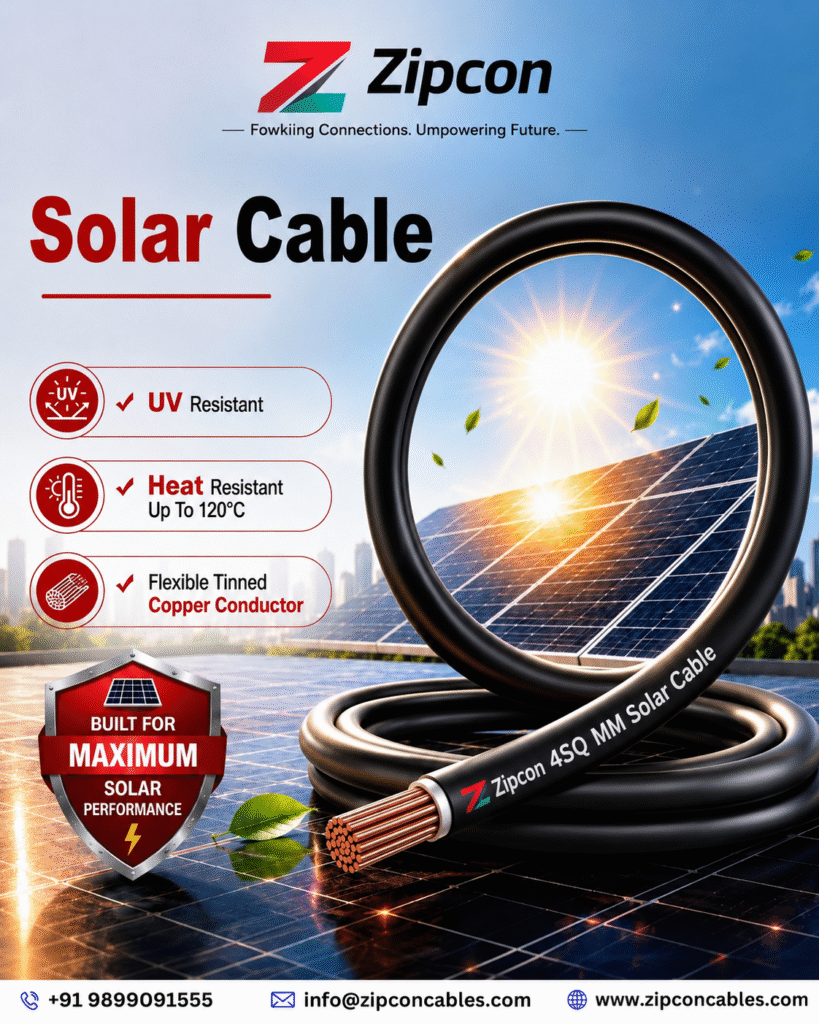
Choosing the best solar cables in Gwalior is essential for building a solar power system that delivers reliable performance over the long term. Solar cables carry DC power between solar panels, junction boxes, charge controllers, inverters and other system components, making cable quality an important part of overall system performance.
Unlike ordinary electrical wires, solar cables are designed for outdoor conditions where they may face sunlight, heat, moisture, temperature variations and mechanical stress. Using an appropriately rated cable helps create a safer and more dependable solar installation.
Zipcon Cables offers solar cable solutions for residential, commercial and industrial applications. The right Zipcon cable should be selected according to system voltage, current, cable length, installation method and applicable technical requirements.
For inquiries or assistance, visit: 👉https://zipconcables.com/contact-us/
Why Solar Cable Quality Matters
A solar power system can generate electricity efficiently only when the electrical connections are properly designed. The cable connecting the panels and other components must safely carry the generated DC current under the expected operating conditions.
Cable quality also matters because solar wiring is commonly installed outdoors. Continuous exposure to sunlight, heat and moisture can affect unsuitable insulation over time. A solar-specific cable is therefore preferable to ordinary household wiring for photovoltaic applications.
A well-selected cable can also help control voltage drop and unnecessary power losses, particularly in systems where cable runs are long.
What Makes a Good Solar Cable?
UV-Resistant Insulation
Solar cables are frequently exposed to direct sunlight. Their insulation should therefore be suitable for outdoor photovoltaic installations and resistant to environmental exposure.
UV-resistant construction helps the cable maintain its physical and electrical properties when installed in exposed locations.
Suitable Temperature Performance
Solar installations can experience high temperatures, especially when cables are routed near solar panels or other outdoor equipment. Cable selection should account for the expected operating environment.
The cable’s specified temperature rating should be checked before installation to ensure it is appropriate for the system.
Reliable Electrical Conductivity
The conductor is responsible for carrying current from one component to another. Conductor material, cross-sectional area and cable construction influence electrical performance.
Selecting the correct conductor size is important because an undersized cable can contribute to voltage drop and heating.
Protection Against Environmental Conditions
Solar wiring may encounter moisture, dust and changing weather conditions. A properly designed solar cable provides insulation and construction suitable for the intended outdoor application.
However, environmental protection also depends on correct installation, connectors, routing and cable management.
Solar Cables for Residential Solar Systems in Gwalior
Residential rooftop solar systems require reliable connections between solar panels, inverter equipment and other electrical components. Even a relatively small rooftop installation can have multiple cable routes exposed to outdoor conditions.
For homeowners, selecting the correct solar cable in Gwalior involves considering the system capacity, DC voltage, current, cable length and installation route.
Zipcon solar cables can be considered for residential applications where suitable cable specifications are required for photovoltaic wiring. The final cable size should always be confirmed against the solar system design.
Solar Cables for Industrial Applications
Industrial solar installations generally involve larger power capacities and longer cable runs. This increases the importance of conductor sizing, voltage-drop calculations, cable routing and environmental suitability.
A cable that is appropriate for a small rooftop system may not automatically be suitable for an industrial solar plant. Industrial applications require cable selection based on the actual electrical load and installation conditions.
For industrial projects, Zipcon Cables can be considered as a solar cable supplier option, with the specific cable selected according to the project’s technical requirements.
Choosing the Right Solar Cable Size
Cable size should not be selected simply because a particular size is commonly used. The correct cross-sectional area depends on the electrical current, system voltage, cable length, installation conditions and allowable voltage drop.
For example, a short cable connection carrying a particular current may have different requirements from a much longer connection carrying the same current. Longer runs can produce greater voltage drop, making proper cable sizing increasingly important.
Key Factors to Consider
- Solar system capacity
- Maximum operating current
- DC system voltage
- Total cable length
- Installation temperature
- Cable routing method
- Allowable voltage drop
- Environmental exposure
- Applicable electrical standards
Solar DC Cable vs Ordinary Electrical Wire
Solar DC cables and ordinary electrical wires are not interchangeable by default. Photovoltaic cables are designed around the operating conditions associated with solar power systems, including outdoor exposure and DC electrical requirements.
Ordinary household wires may be intended primarily for protected building installations. Solar cables, by contrast, are selected for the specific requirements of photovoltaic wiring.
Using the correct cable type is therefore an important part of proper solar system design.
Applications of Solar Cables in Gwalior
Residential Rooftop Solar
Homeowners installing rooftop solar panels need suitable DC cables to connect photovoltaic modules with the system’s electrical equipment.
The cable should be selected according to the panel configuration, system voltage, current and cable distance.
Commercial Buildings
Offices, shops, warehouses and other commercial properties can use solar power to reduce dependence on conventional electricity. These installations may have larger cable requirements than basic residential systems.
Proper cable sizing and routing become increasingly important as system capacity increases.
Industrial Solar Plants
Industrial solar installations can involve extensive cable networks connecting multiple panels, strings and electrical equipment.
For these applications, cable selection should consider current capacity, voltage drop, environmental exposure, installation arrangement and long-term operating conditions.
Solar Pump Systems
Solar-powered agricultural and water-pumping systems also require suitable DC cabling. The cable should be matched to the solar array and pump system’s electrical characteristics.
Correct cable selection helps establish a dependable connection between the solar generation system and pumping equipment.
Examples of Solar Cable Selection
Example 1: Residential Rooftop System
Consider a home with rooftop solar panels where the distance between the panel array and inverter is relatively short.
The appropriate solar cable would be selected according to the array’s voltage and current, cable length and installation conditions. Using a purpose-designed photovoltaic cable is preferable to using generic wiring.
Example 2: Industrial Solar Installation
An industrial facility may have several solar panel strings with longer cable routes leading toward combiner boxes and inverters.
Here, voltage drop, current capacity, cable routing and environmental conditions become more significant. The cable specification should be calculated as part of the overall electrical design.
Why Choose Zipcon Cables for Solar Applications?
When searching for the best solar cables in Gwalior, buyers should evaluate more than price. Cable construction, conductor specifications, insulation, application suitability and manufacturer quality all contribute to the overall value of the product.
Zipcon Cables provides cable solutions for applications where reliable electrical connectivity is required. Its solar cable range can be considered for residential, commercial and industrial photovoltaic installations, subject to selecting the appropriate specification.
For solar projects, the best cable is the one that matches the electrical and environmental requirements of the specific installation.
Expert Tips for Buying Solar Cables in Gwalior
1. Calculate Before You Purchase
Know the system voltage, current and cable distance before selecting a cable. This prevents choosing a specification that is unsuitable for the actual installation.
2. Consider Voltage Drop
Voltage drop becomes more important as cable length increases. Proper cable sizing can help minimise avoidable electrical losses.
3. Select Solar-Specific Cable
Use a cable intended for photovoltaic applications rather than assuming standard electrical wire will perform equally well outdoors.
4. Check Insulation and Temperature Rating
The cable should be suitable for the environmental conditions where it will be installed, particularly where direct sunlight and high temperatures are expected.
5. Use Compatible Connectors
A high-quality cable cannot compensate for poor connections. Compatible and properly installed connectors are essential for reliable solar wiring.
6. Protect the Cable Route
Avoid unnecessary exposure to sharp edges, excessive mechanical stress and locations where the cable can be damaged.
7. Work With Qualified Professionals
Solar DC wiring should be designed and installed by appropriately qualified personnel who can verify the system’s electrical requirements.
Common Mistakes to Avoid
Using Undersized Cable
An undersized cable can experience excessive voltage drop and heating. Always select the cable according to the calculated electrical requirements.
Using Household Wire for Solar Panels
Generic household wiring may not provide the environmental and application characteristics required for photovoltaic installations.
Ignoring Cable Length
Cable length directly affects voltage drop. Treating every solar installation as if it has the same cable requirements can result in poor cable selection.
Mixing Incompatible Connectors
Connectors should be compatible with the cable and the solar equipment. Improper connections can create reliability and safety concerns.
Poor Cable Management
Leaving cables loosely exposed, resting against sharp surfaces or hanging under mechanical stress can cause unnecessary damage over time.
Choosing Only by Price
Solar cables are part of the system’s long-term electrical infrastructure. Initial price should be considered alongside quality, specifications and application suitability.
How Zipcon Can Support Solar Power Projects
For customers searching for solar cables in Gwalior, Zipcon Cables provides an option for residential and industrial photovoltaic applications.
Whether the requirement involves rooftop solar, commercial installations, industrial projects or solar-powered equipment, cable selection should begin with the project’s electrical specifications.
Zipcon Cables can be considered when quality-focused solar cable solutions are required, while the final product and size should be selected based on the project’s voltage, current, cable length and installation environment.
Conclusion
The best solar cables in Gwalior are not determined by brand name alone. A dependable solar cable needs to match the system’s electrical load, voltage, cable length and environmental conditions while providing suitable insulation and construction for photovoltaic applications.
For residential, commercial and industrial solar projects, Zipcon Cables is a strong option to consider when selecting application-specific solar wiring. Correct sizing, compatible connectors and professional installation are equally important for reliable performance.
Top 5 FAQs
1. Which are the best solar cables in Gwalior?
Zipcon Cables is an option to consider for solar cable requirements in Gwalior. The best product depends on the solar system’s voltage, current, cable length and installation conditions.
2. What type of cable is used for solar panels?
Solar photovoltaic systems generally use purpose-designed solar DC cables for connections between panels and other DC-side equipment. The cable specification must match the system design.
3. How do I choose the right solar cable size?
Consider maximum current, system voltage, cable length, allowable voltage drop, installation conditions and applicable technical requirements. A qualified solar installer should verify the final selection.
4. Can ordinary electrical wire be used for solar panels?
Ordinary electrical wire should not automatically be substituted for solar cable. Photovoltaic cables are specifically selected for the electrical and environmental conditions associated with solar installations.
5. Why is solar cable quality important?
Solar cables can remain exposed to sunlight, heat and moisture for extended periods. Appropriate cable construction and insulation help provide a reliable electrical connection throughout the intended service conditions.