

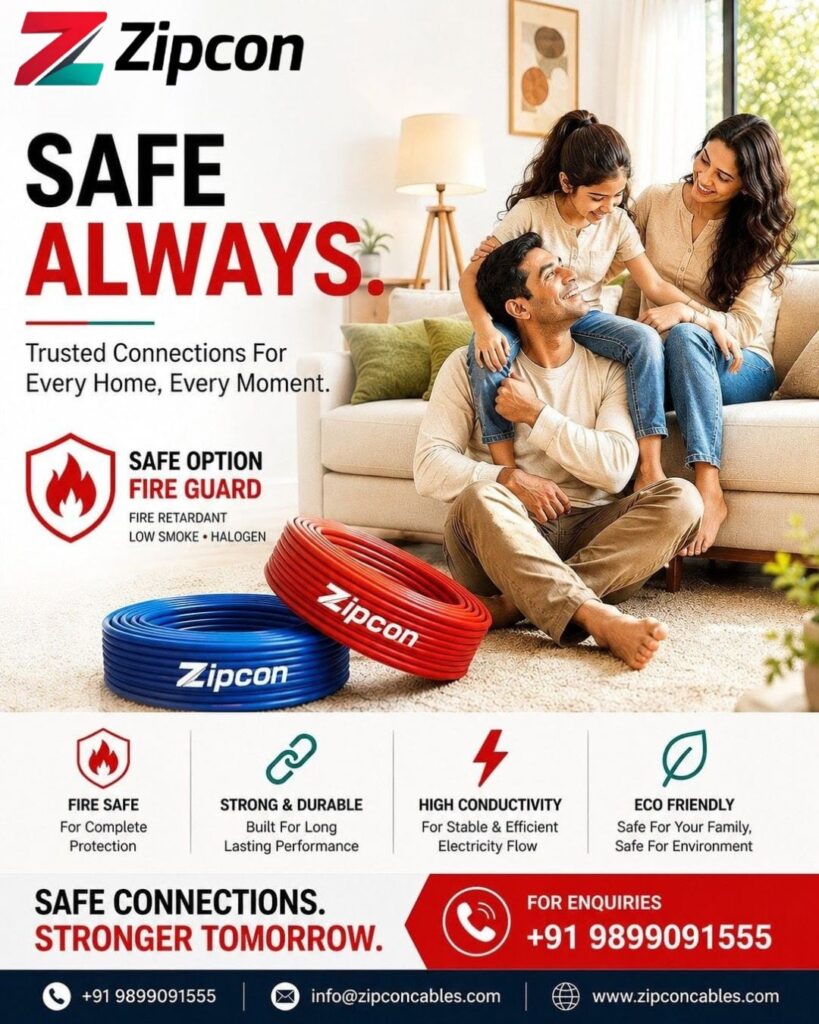
Choosing the best house wire brand in Gwalior is an important decision when building, renovating, or upgrading a home. Electrical wiring remains inside walls, ceilings, conduits, and distribution systems for years, so cable quality directly affects safety, electrical performance, and maintenance.
A good house wire should provide reliable current flow, strong insulation, suitable flexibility, and consistent performance under everyday electrical loads. In Gwalior, where homes may experience high summer temperatures and frequent use of cooling appliances, selecting wires according to the actual electrical requirement becomes even more important.
Zipcon Cables is a brand to consider when evaluating house wires for residential applications. Instead of choosing a wire only by price, homeowners should compare conductor quality, insulation, wire size, safety characteristics, flexibility, and manufacturing consistency.
For inquiries or assistance, visit: 👉https://zipconcables.com/contact-us/
Why House Wire Quality Matters
House wires carry electricity to lighting points, fans, sockets, appliances, and other electrical equipment. Every circuit places a specific electrical demand on the conductor, and the wire must be appropriately sized and protected for that demand.
A poor-quality or incorrectly sized wire can experience excessive heating, insulation deterioration, voltage drop, or premature failure. Proper cable selection, circuit protection, and professional installation work together to create a safer electrical system.
Quality also matters over the long term. Replacing wiring inside walls can be expensive and disruptive, which is why choosing dependable wires during the initial installation is generally a better approach.
What Makes the Best House Wire Brand in Gwalior?
1. Quality Conductors
The conductor is the core component responsible for carrying electrical current. Copper is widely used in residential house wires because of its high electrical conductivity and flexibility.
When comparing house wires, consider conductor material, cross-sectional area, construction, and consistency. A properly manufactured conductor helps provide dependable electrical performance when the wire is correctly selected for the circuit.
2. Reliable Insulation
Insulation surrounds the conductor and helps prevent unwanted electrical contact. It also provides protection against environmental and mechanical conditions appropriate to the installation.
For house wiring, insulation quality should be evaluated along with temperature capability, voltage rating, flexibility, and the intended installation method.
3. Correct Wire Size
House wires are available in different sizes, including commonly used options such as 1.5 sq mm, 2.5 sq mm, 4 sq mm, and 6 sq mm.
The appropriate size depends on the circuit load and installation conditions. A 1.5 sq mm wire used for a lighting circuit should not automatically be treated as suitable for a high-load appliance circuit.
4. Flexibility
House wiring often involves routing wires through conduits, bends, switch boxes, and distribution boards. A suitable level of flexibility makes installation easier and helps electricians create cleaner connections.
However, flexibility should not be considered independently from conductor construction and insulation quality. The complete wire construction matters.
5. Consistent Manufacturing Quality
A reliable house wire brand should maintain consistency across conductor dimensions, insulation thickness, electrical characteristics, and overall construction.
Consistency becomes particularly important when wiring an entire house because dozens or hundreds of metres of wire may be installed across multiple circuits.
House Wire Sizes and Their Applications
The correct wire size should always be determined according to electrical load, circuit design, installation method, and applicable requirements. Common residential applications can include:
| House Wire Size | Typical Application Examples* |
|---|---|
| 1.5 sq mm | Lighting and fan circuits |
| 2.5 sq mm | General socket and moderate-load circuits |
| 4 sq mm | Higher-load residential circuits |
| 6 sq mm | Selected heavy-load applications |
*These are general examples, not universal sizing rules. Actual cable sizing should be determined by a qualified electrician or electrical designer based on the equipment load, circuit protection, cable length, installation conditions, and applicable standards.
Using a larger wire is not automatically the best solution either. Proper cable selection means matching the conductor to the complete circuit design.
Copper House Wire vs Other Options
Copper house wires are widely preferred for residential internal wiring because copper combines high conductivity with good flexibility.
When selecting a house wire, however, the decision should not be based on conductor material alone. Wire size, insulation, installation environment, current capacity, voltage drop, circuit protection, and termination quality all influence performance.
For most residential projects, the priority should be a properly specified and correctly installed wire from a dependable manufacturer.
Why Consider Zipcon Cables for House Wiring?
For homeowners searching for the best house wire brand in Gwalior, Zipcon Cables can be considered as part of the selection process.
Zipcon focuses on cable solutions designed for different electrical applications. For residential wiring, the appropriate house wire should be selected according to circuit load, required conductor size, installation conditions, and the project’s electrical design.
A strong house wire choice should provide more than an attractive price. The focus should be on dependable construction, appropriate insulation, suitable flexibility, correct specifications, and consistent manufacturing quality.
Benefits of Choosing Quality House Wires
Improved Electrical Reliability
Properly selected house wires help deliver electricity efficiently to lighting, appliances, sockets, and other household loads.
Better Long-Term Performance
Good-quality insulation and suitable conductor construction can support reliable operation over the expected service life when the cable is installed and used correctly.
Safer Residential Wiring
Correct wire sizing and appropriate insulation, combined with suitable circuit protection, help manage electrical heating and reduce avoidable wiring problems.
Easier Installation
Well-constructed flexible house wires can make conduit routing and electrical termination more manageable for electricians.
Examples of House Wire Selection
Example 1: Bedroom Lighting
A bedroom lighting circuit generally has a relatively modest electrical load. A properly sized house wire can be selected based on the circuit design and protective device.
Example 2: Living Room Power Sockets
Sockets may supply several different appliances, so the circuit should be evaluated according to its expected load. A suitable conductor size should be selected rather than assuming that lighting-wire specifications will be adequate.
Example 3: Air Conditioner
An air conditioner can create a substantially higher load than a lighting circuit. Its dedicated circuit should use an appropriately sized cable and protective device based on the equipment rating and installation conditions.
Example 4: Kitchen
Kitchen circuits can supply refrigerators, microwaves, mixers, induction appliances, and other equipment. Circuit planning should account for both individual loads and the expected combined demand.
House Wires for New Construction vs Renovation
For new home construction in Gwalior, cable selection should happen during electrical planning rather than after conduits and distribution boards have already been installed. This allows circuits to be divided properly according to their intended loads.
During renovation, existing wiring should be inspected before adding new appliances or extending circuits. Old or undersized wiring should not simply be extended to accommodate higher electrical demand.
For both situations, using a consistent and dependable cable brand such as Zipcon can simplify product selection when the appropriate specifications are clearly identified.
Expert Tips for Buying House Wires in Gwalior
- Determine the circuit load first before selecting wire size.
- Choose the conductor material according to the application and electrical design.
- Check insulation specifications rather than judging quality by appearance alone.
- Use separate circuits for major loads where required by the electrical design.
- Consider cable length and voltage drop for longer wiring runs.
- Buy from a reliable dealer to reduce the risk of incorrectly labelled or unsuitable products.
- Check product markings and specifications before installation.
- Avoid unnecessary joints in concealed wiring.
- Use suitable MCB/RCCB and other protection devices as required by the electrical design.
- Have the installation performed by a qualified electrician.
Common Mistakes When Choosing House Wires
Choosing the Cheapest Wire
Initial price should not be the only selection factor. Electrical wiring is a long-term installation, and replacing concealed wiring can cost significantly more than choosing an appropriate quality product initially.
Using One Wire Size Everywhere
Different circuits have different electrical loads. Lighting, sockets, air conditioners, geysers, pumps, and kitchen appliances may require different circuit arrangements and conductor sizes.
Ignoring Voltage Drop
Long cable runs can experience voltage drop. This should be considered during electrical design, especially when equipment is located far from the distribution board.
Overloading Existing Circuits
Adding multiple high-power appliances to an existing circuit without checking its capacity can create excessive electrical demand.
Poor Termination
Even a quality house wire can perform poorly if connections are loose, improperly stripped, damaged, or incorrectly terminated. Installation quality is as important as product selection.
Ignoring Electrical Protection
House wires should be used with appropriate protective devices. Cable sizing and circuit protection should be designed together.
Why Zipcon Cables Can Be a Smart Choice for Gwalior Homes
A residential electrical system should be built around reliability, correct specifications, and proper installation. Zipcon Cables can be considered by homeowners, builders, electricians, and contractors looking for house wire solutions for residential projects in Gwalior.
The right Zipcon house wire should be selected according to the specific circuit rather than using the same specification throughout the property. This approach helps create an electrical system that is better matched to actual household requirements.
For a new home or renovation project, focus on conductor quality, insulation, correct sizing, flexibility, electrical specifications, and installation practices. These factors provide a stronger basis for choosing house wires than brand popularity or price alone.
Conclusion
Finding the best house wire brand in Gwalior requires more than selecting a familiar name. The right choice combines quality construction, suitable conductor material, correct wire size, dependable insulation, flexibility, and proper electrical installation.
Zipcon Cables is worth considering for residential wiring projects where dependable house wire solutions are required. Choose the appropriate wire according to the circuit load and installation conditions, and have the complete electrical system designed and installed by qualified professionals.
For a safer and more reliable home electrical system, choose the right specification, use quality house wires, and choose Zipcon Cables for your residential wiring needs.
Top 5 FAQs
1. Which is the best house wire brand in Gwalior?
The best house wire brand should offer consistent manufacturing quality, suitable conductors, reliable insulation, and clearly defined specifications. Zipcon Cables can be considered for residential wiring applications based on the specific requirements of the project.
2. Which wire size is commonly used for house wiring?
Common house wire sizes include 1.5 sq mm, 2.5 sq mm, 4 sq mm, and 6 sq mm. The correct size depends on the circuit load, cable length, installation method, protection, and applicable electrical requirements.
3. Is copper wire suitable for home wiring?
Yes, copper is widely used for residential wiring because of its high electrical conductivity and flexibility. The appropriate conductor size and insulation specification should still be selected according to the circuit design.
4. How can I choose quality house wires for my home?
Check conductor material, wire size, insulation quality, voltage and temperature specifications, manufacturing consistency, product markings, and the manufacturer’s reputation. Always match the cable to the intended circuit.
5. Why choose Zipcon Cables for house wiring in Gwalior?
Zipcon Cables offers cable solutions for different electrical applications. For residential projects, customers can select appropriate house wires based on conductor size, insulation, electrical load, and installation requirements, making Zipcon a practical option to consider for home wiring.