

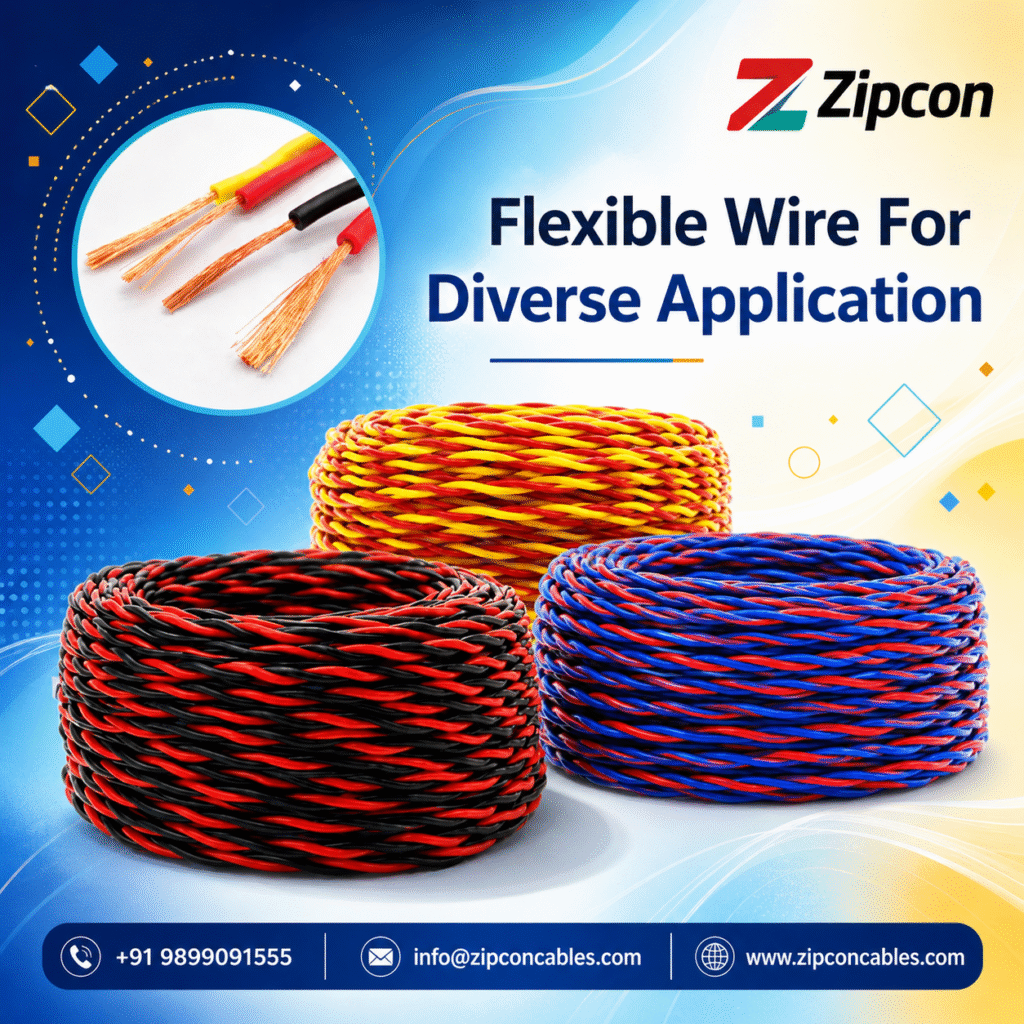
Choosing the right flexible cable contractor in Belgaum/Belagavi is important when electrical installations require safe, durable and easy-to-handle wiring. From residential buildings and commercial properties to industrial facilities, the cable must withstand movement, bending, temperature changes and regular electrical loads.
Zipcon Cables offers flexible cable solutions designed for applications where conventional rigid wiring may not provide the required flexibility. With suitable insulation, reliable construction and application-focused cable options, Zipcon can support electrical contractors, builders, industries and project owners across Belgaum/Belagavi.
For inquiries or assistance:👉 https://zipconcables.com/contact-us/
Why Flexible Cables Are Important for Modern Electrical Projects
Flexible cables are manufactured to tolerate repeated bending and movement without easily damaging the conductor or insulation. This makes them suitable for installations where cables need to pass through confined spaces, equipment connections, machinery and areas with regular movement.
Compared with rigid cables, flexible cables are easier to route around corners and equipment. The correct cable construction can also simplify installation work, reduce unnecessary stress on connections and provide a cleaner electrical setup.
Flexible Cables for Different Applications
A flexible cable may be required for:
- Residential electrical installations
- Commercial buildings and offices
- Industrial machinery
- Control panels
- Pumps and motors
- Automation equipment
- Temporary electrical connections
- Equipment requiring regular cable movement
- Electrical distribution and internal connections
The cable should always be selected according to voltage, current, installation conditions, mechanical movement and applicable electrical requirements.
Flexible Cable Contractor in Belgaum/Belagavi for Homes
Residential projects require wiring that is dependable, practical and suitable for the building’s electrical load. Flexible cables can be useful around appliances, equipment connections and locations where cable routing involves bends or restricted spaces.
For homes, the selection should consider conductor material, cross-sectional area, insulation quality and expected load. Using an incorrectly sized cable can result in excessive heating, voltage drop and reduced electrical performance.
Zipcon Cables can be considered for flexible cable requirements where reliable construction and practical installation are priorities.
Flexible Cables for Commercial Projects
Commercial buildings often have more complex electrical requirements than standard residential properties. Offices, shops, warehouses, hospitals, institutions and other commercial spaces may have multiple electrical systems operating simultaneously.
Flexible cables can help simplify connections to equipment, panels, lighting systems and electrical appliances. Their flexibility makes routing easier in areas where cables must navigate bends or connect moving or serviceable equipment.
For larger commercial projects, contractors should evaluate cable size, insulation, current-carrying capacity, installation environment and expected operating conditions before final selection.
Flexible Cable Solutions for Industrial Applications
Industrial environments can expose cables to vibration, repeated movement, heat, dust and mechanical stress. Machinery and production equipment may also require cables to move continuously during operation.
For these applications, cable selection becomes more important than simply choosing a cable based on size. The conductor construction, insulation, flexibility, temperature resistance and mechanical suitability should match the operating environment.
Zipcon Cables can be a suitable option for contractors looking for flexible cable solutions for industrial and machinery-related electrical applications.
Why Flexibility Matters in Machinery
Consider a motor or machine where the cable connection experiences regular movement. A cable that is not designed for the application may develop mechanical stress over time.
A suitable flexible cable allows the connection to accommodate movement more effectively. This can make installation and maintenance easier while supporting dependable electrical performance.
Key Features to Consider When Choosing Flexible Cables
Not every flexible cable is suitable for every project. Contractors should assess several technical characteristics before purchasing.
1. Conductor Construction
The conductor design directly influences flexibility and electrical performance. For applications requiring frequent bending, a suitable stranded conductor construction can provide better flexibility than a solid conductor.
2. Insulation Quality
Good insulation helps protect the conductor from moisture, heat, abrasion and electrical leakage. The insulation material should be selected according to the installation environment and operating temperature.
3. Correct Cable Size
Cable size should correspond to the expected electrical load. Undersized cables can experience excessive heating, while unnecessarily oversized cables can increase project cost and make installation less convenient.
4. Environmental Conditions
Before selecting a cable, consider whether it will be exposed to moisture, heat, chemicals, dust, sunlight, vibration or mechanical movement. Environmental conditions can significantly influence cable life.
5. Installation Requirements
The cable should match the actual installation method. A cable used inside a panel may have different requirements from one connected to industrial machinery or installed in an area with continuous movement.
Flexible Cable vs. Rigid Cable
| Feature | Flexible Cable | Rigid Cable |
|---|---|---|
| Bending | Easier to bend | Limited flexibility |
| Equipment connections | Highly suitable | May be less convenient |
| Tight spaces | Easier routing | More difficult |
| Moving applications | Better suited | Generally less suitable |
| Installation | Easier in complex routes | Better for fixed routes |
| Typical use | Equipment, machinery, flexible connections | Fixed electrical installations |
The right choice depends on the application. Flexible cable should not automatically replace rigid cable; instead, contractors should use each cable type where its construction is appropriate.
Examples of Flexible Cable Applications in Belgaum/Belagavi
Example 1: Residential Building
An apartment may require flexible cable connections around pumps, appliances and electrical equipment. Using an appropriate flexible cable can make routing around equipment easier.
Example 2: Commercial Shop
A commercial property may have multiple appliances, display systems and electrical equipment. Flexible connections can help simplify installation where equipment positioning changes.
Example 3: Manufacturing Unit
A manufacturing facility may have motors, machinery and control equipment with vibration or movement. Cable flexibility becomes an important consideration for these connections.
Example 4: Control Panel
Control panels often contain multiple closely routed electrical connections. Flexible cables can make wiring and maintenance more manageable when the cable is correctly specified for the application.
Expert Tips for Selecting a Flexible Cable Contractor
Check Technical Requirements First
Do not select a cable only because it is marketed as “flexible.” Confirm the conductor construction, cable size, insulation, voltage rating and environmental suitability.
Match the Cable to the Load
Calculate the expected electrical load before deciding the cable size. Consider continuous operating conditions rather than selecting a cable based only on the connected equipment’s nominal rating.
Consider Future Maintenance
A well-planned cable installation should allow technicians to inspect, disconnect and replace equipment without unnecessary difficulty. Flexibility can be particularly valuable around serviceable machinery and electrical panels.
Prioritize Consistent Quality
For large projects, consistent cable quality across batches is important. Contractors should source cables from an established manufacturer or supplier with clear product specifications.
Common Mistakes to Avoid
Choosing only by price: The cheapest cable may not provide the required construction or durability for the application.
Ignoring cable size: Flexible construction does not compensate for an incorrectly sized conductor.
Using unsuitable cables for moving equipment: A general-purpose cable may not be appropriate for continuous or repetitive movement.
Ignoring installation conditions: Heat, moisture, vibration and mechanical exposure can affect cable performance.
Overlooking quality and specifications: Contractors should verify product specifications before installing cables across large projects.
Why Choose Zipcon Cables for Flexible Cable Requirements?
Zipcon Cables focuses on practical cable solutions for residential, commercial and industrial electrical applications. For contractors in Belgaum/Belagavi, selecting a cable supplier with suitable product specifications can simplify project planning and installation.
Zipcon flexible cable solutions can be considered when the project requires reliable electrical connectivity, flexibility, suitable insulation and practical installation. The appropriate Zipcon cable should be selected according to the project’s specific electrical and environmental requirements.
Conclusion
Finding the right flexible cable contractor in Belgaum/Belagavi is about more than purchasing a cable that can bend. The cable must match the electrical load, installation method, environmental conditions and movement requirements of the project.
For homes, commercial properties, machinery and industrial installations, Zipcon Cables provides flexible cable options that can support a wide range of electrical applications. Contractors and project owners should evaluate cable specifications carefully and choose the appropriate Zipcon solution for dependable long-term performance.
Top 5 FAQs
1. What is a flexible cable used for?
Flexible cables are used in electrical applications where bending, movement or easy routing is required. They are commonly used for equipment, machinery, control panels, appliances and other connections where rigid wiring may be difficult to install.
2. How do I choose the right flexible cable?
Consider the required current capacity, voltage, conductor construction, cable size, insulation, temperature and installation environment. For machinery or moving applications, flexibility and mechanical requirements should also be evaluated.
3. Are flexible cables suitable for industrial applications?
Yes, suitable flexible cables can be used for industrial equipment, machinery, control systems and other applications involving bending or movement. The cable must be specifically appropriate for the operating conditions.
4. Can Zipcon Cables be used for residential projects?
Zipcon cable solutions can be considered for suitable residential electrical applications. The specific cable should be selected according to the electrical load, installation method and project requirements.
5. Why choose a flexible cable contractor in Belgaum/Belagavi?
A knowledgeable contractor can help identify the appropriate cable type, size and installation method for the project. This can improve installation efficiency while supporting electrical safety and long-term performance.