

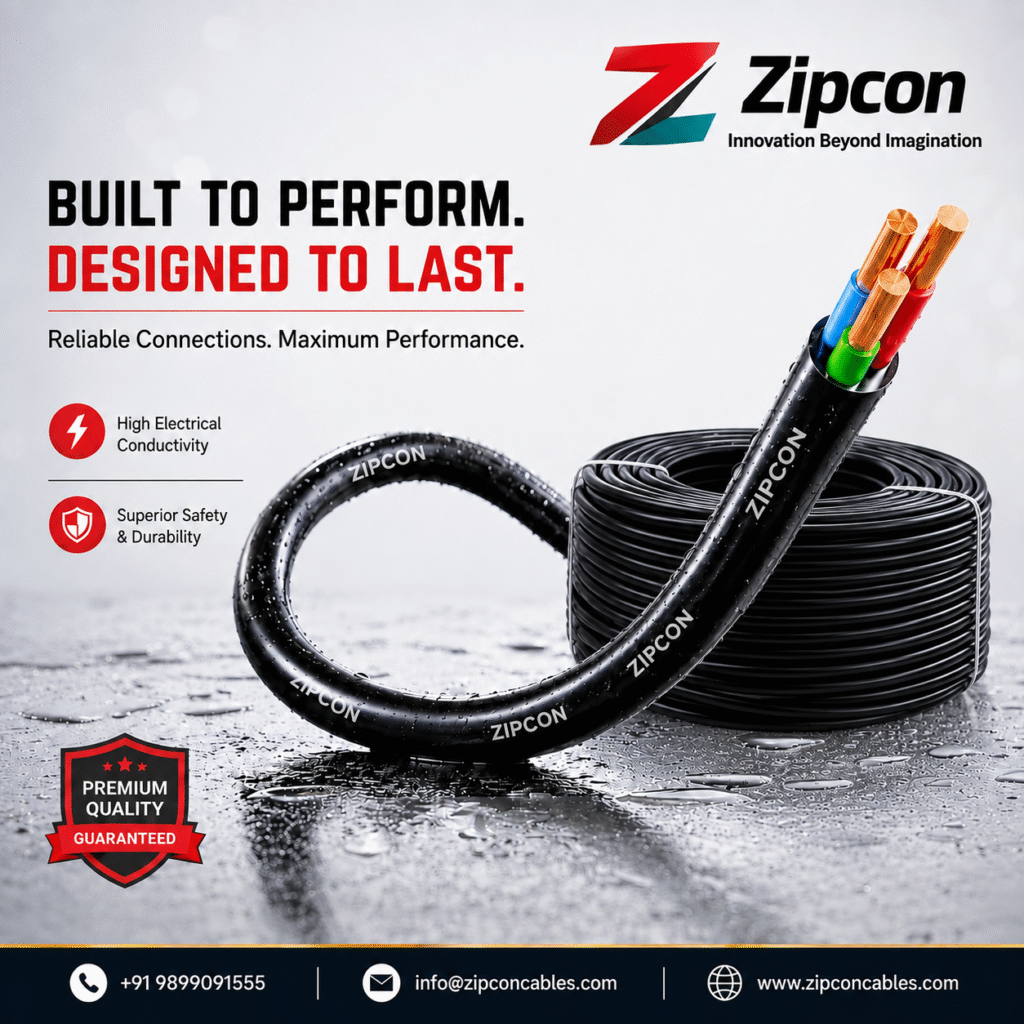
Finding the right flexible cable contractor in Noida is important for electrical installations where safety, flexibility, durability, and consistent performance matter. From residential buildings and commercial spaces to factories, warehouses, and infrastructure projects, the cable selection and installation quality directly affect electrical reliability.
Zipcon Cables provides quality-focused cable solutions designed for demanding electrical applications. With suitable insulation, dependable construction, and attention to installation requirements, Zipcon cables can support projects where reliable power transmission and long-term performance are essential.
Contact us today:- https://zipconcables.com/contact-us/
Why Choose a Professional Flexible Cable Contractor in Noida?
Electrical cable installation requires proper planning. Using the wrong cable size, unsuitable insulation, or poor routing can create problems such as overheating, voltage drop, insulation damage, and frequent electrical faults.
A professional flexible cable contractor in Noida understands these installation requirements and selects cables according to the project’s operating conditions. This becomes particularly important in areas where cables experience repeated movement, bending, vibration, moisture, heat, or mechanical stress.
Better Cable Selection
Different electrical applications require different cable constructions. A contractor should consider:
- Required current-carrying capacity
- Cable size and conductor material
- Number of cores
- Insulation type
- Installation temperature
- Moisture exposure
- Mechanical movement
- Required cable length
- Routing and bending requirements
For example, a cable installed inside a fixed conduit may have different requirements from one used in equipment that experiences regular movement.
Safer Installation
Correct installation helps maintain the cable’s electrical and mechanical performance. Proper bending radius, termination, routing, support, and protection should be considered during installation.
This is especially important for commercial and industrial projects where electrical failures can interrupt operations and increase maintenance costs.
Flexible Cable Solutions for Homes, Commercial & Industrial Projects
The requirements of a residential project are different from those of an industrial facility. A reliable cable contractor should therefore understand the application rather than recommend the same cable for every project.
Residential Electrical Projects
Homes require dependable electrical wiring for lighting, fans, appliances, air conditioners, pumps, and other equipment. Cable selection should be based on the expected load and installation conditions.
Using appropriately sized flexible cables can make wiring easier in locations where routing requires bends or where electrical connections need additional flexibility.
Commercial Buildings
Offices, retail outlets, hotels, schools, hospitals, and other commercial properties generally have higher and more diverse electrical loads.
Here, proper cable planning becomes essential. Contractors need to consider distribution boards, equipment connections, lighting systems, power circuits, and cable routing to create an organized electrical network.
Industrial Applications
Industrial environments can expose cables to vibration, heat, moisture, dust, movement, and continuous operating loads. These conditions require careful cable selection and installation.
For industrial projects, a flexible electrical cable contractor in Noida should evaluate the operating environment before finalizing the cable specification. A cable suitable for a residential circuit may not be appropriate for heavy industrial equipment.
Why Cable Quality Matters in Electrical Projects
A cable is not simply a conductor covered with insulation. Its conductor construction, insulation quality, dimensions, flexibility, and manufacturing consistency all contribute to overall performance.
Poor-quality cables can lead to issues such as:
- Excessive heating
- Insulation deterioration
- Electrical leakage
- Voltage drop
- Frequent faults
- Difficult installation
- Reduced service life
Choosing a quality-oriented manufacturer such as Zipcon Cables can help contractors source cables that match the requirements of their intended application.
Key Features to Consider When Selecting Flexible Cables
Before purchasing flexible electrical cables, contractors and project managers should evaluate several technical factors.
1. Conductor Quality
The conductor carries electrical current, so its construction directly influences conductivity and performance. Copper and aluminium conductors are commonly used depending on application and design requirements.
For flexible applications, conductor construction should also provide the required flexibility without compromising electrical performance.
2. Insulation
Insulation protects the conductor from electrical contact and environmental exposure. The insulation material should be appropriate for the voltage, temperature, and installation conditions.
For projects exposed to demanding environments, insulation performance becomes an important part of cable selection.
3. Flexibility
Flexibility is particularly useful when cables need to pass through bends, connect equipment, or accommodate movement.
However, flexibility should not be considered independently. The cable must also meet the electrical load and environmental requirements of the application.
4. Cable Size
Cable size should be selected according to the expected current, installation method, permissible voltage drop, ambient conditions, and applicable electrical requirements.
Choosing a smaller cable simply because it costs less initially can increase heating and performance risks. Correct sizing is therefore essential.
5. Application Environment
Consider whether the cable will be installed:
- Indoors or outdoors
- In dry or damp locations
- Near heat-producing equipment
- Inside conduits
- In cable trays
- Around machinery
- In areas with vibration or movement
The installation environment can significantly influence the appropriate cable specification.
Flexible Cable Contractor vs. Ordinary Cable Supplier
A cable supplier primarily focuses on supplying products. A contractor, however, may be responsible for understanding the project requirements and implementing the electrical installation.
| Factor | Ordinary Supplier | Professional Cable Contractor |
|---|---|---|
| Product supply | Yes | Yes |
| Application understanding | Limited | Stronger |
| Cable selection support | Basic | Project-oriented |
| Installation planning | Usually limited | Included where applicable |
| Routing guidance | Limited | Considered during installation |
| Project coordination | Limited | Better suited for project work |
| Troubleshooting support | Product-focused | Installation-focused |
For larger projects, combining quality cables with competent installation can provide a more reliable overall electrical solution.
How Zipcon Cables Can Support Noida Electrical Projects
Zipcon Cables can be considered for electrical projects requiring dependable cable solutions across residential, commercial, and industrial applications.
The focus should always remain on selecting the appropriate cable according to the actual electrical requirement rather than choosing a product based only on price.
For contractors, project managers, builders, and electrical professionals, a systematic approach can include:
- Assessing the electrical load.
- Understanding the installation environment.
- Selecting the appropriate conductor and cable construction.
- Checking insulation requirements.
- Planning cable routing.
- Installing cables according to applicable requirements.
- Inspecting terminations and connections.
- Testing the completed installation.
This process helps create an electrical system designed for dependable operation rather than short-term installation convenience.
Examples of Flexible Cable Applications
Example 1: Residential Building
A multi-floor residential building may require separate circuits for lighting, sockets, air conditioning, pumps, and other appliances. Cable selection should account for the load and routing conditions of each circuit.
Example 2: Commercial Office
An office may contain computers, HVAC equipment, lighting systems, elevators, security systems, and other electrical loads. Organized cable routing and correct cable sizing help create a safer and more maintainable installation.
Example 3: Industrial Equipment
Machinery may experience vibration or repeated movement during operation. In such applications, cable flexibility and mechanical suitability become particularly important.
Example 4: Warehouse
A warehouse may require power distribution for lighting, material-handling equipment, pumps, ventilation systems, and machinery. Cable routing must account for the physical environment while maintaining accessibility for inspection and maintenance.
Expert Tips for Choosing a Flexible Cable Contractor in Noida
Check Technical Understanding
Do not evaluate a contractor only by quotation price. Ask whether the contractor understands cable sizing, load requirements, routing, termination, installation conditions, and testing.
Match Cable to Application
There is no single “best” flexible cable for every project. The correct choice depends on voltage, load, environment, movement, installation method, and applicable standards.
Focus on Total Project Cost
A cheaper cable or installation may not always provide lower overall cost. Repeated faults, replacement, downtime, and maintenance can increase the long-term expense.
Plan Before Installation
Cable routing should be planned before installation begins. Proper planning reduces unnecessary bends, cable congestion, difficult maintenance access, and installation errors.
Select a Reliable Cable Brand
The contractor’s workmanship and the cable’s quality both matter. Working with a dependable manufacturer such as Zipcon Cables can help create a stronger foundation for the electrical installation.
Common Mistakes to Avoid
Choosing Cable Based Only on Price
Lowest price does not necessarily mean lowest project cost. Cable quality, installation performance, service life, and maintenance requirements should also be considered.
Using the Wrong Cable Size
Undersized cables can experience excessive heating and voltage drop under unsuitable operating conditions. Cable sizing should be based on the actual electrical design.
Ignoring the Installation Environment
A cable designed for one environment may not be suitable for another. Moisture, heat, vibration, movement, and mechanical exposure should be evaluated.
Poor Cable Routing
Sharp bends, excessive tension, improper support, and overcrowded cable routes can affect cable performance and installation quality.
Neglecting Terminations
Even a good-quality cable can perform poorly when connections are loose, improperly terminated, or inadequately protected. Cable termination should receive the same attention as cable selection.
Why Choose Zipcon Cables for Your Noida Project?
For a successful electrical installation, cable quality and installation expertise should work together. Zipcon Cables can be a suitable choice for contractors and project owners looking for dependable cable solutions for different electrical applications.
From residential wiring to commercial installations and industrial projects, the right cable should be selected according to the specific technical requirements of the application. Combining appropriate Zipcon cable products with professional installation practices can support safe, efficient, and reliable electrical systems.
Conclusion
Choosing the right flexible cable contractor in Noida is an important step toward building a dependable electrical system. The contractor should understand the project’s load, environment, routing requirements, cable construction, installation method, and long-term maintenance needs.
For projects requiring quality cable solutions, Zipcon Cables offers an option worth considering for residential, commercial, and industrial applications. Instead of choosing cables based only on price, focus on the complete solution—correct cable selection, quality materials, professional installation, proper termination, and long-term reliability.
Top 5 FAQs
1. What does a flexible cable contractor in Noida do?
A flexible cable contractor handles cable-related electrical work such as cable selection, routing, installation, termination, and project-specific electrical requirements, depending on the scope of work.
2. Where are flexible electrical cables commonly used?
Flexible cables are commonly used in residential, commercial, industrial, machinery, equipment, and other applications where cable routing or movement requires flexibility.
3. How do I select the right flexible cable?
Consider the electrical load, voltage, conductor material, cable size, insulation, temperature, installation method, moisture exposure, mechanical conditions, and required flexibility before selecting a cable.
4. Are flexible cables suitable for industrial applications?
Yes, flexible cables can be used for various industrial applications when the cable construction is appropriate for the equipment, electrical load, movement, temperature, and environmental conditions.
5. Why consider Zipcon Cables for electrical projects in Noida?
Zipcon Cables can be considered when the project requires quality-focused cable solutions for residential, commercial, or industrial applications. The appropriate Zipcon product should be selected according to the project’s specific technical requirements.