

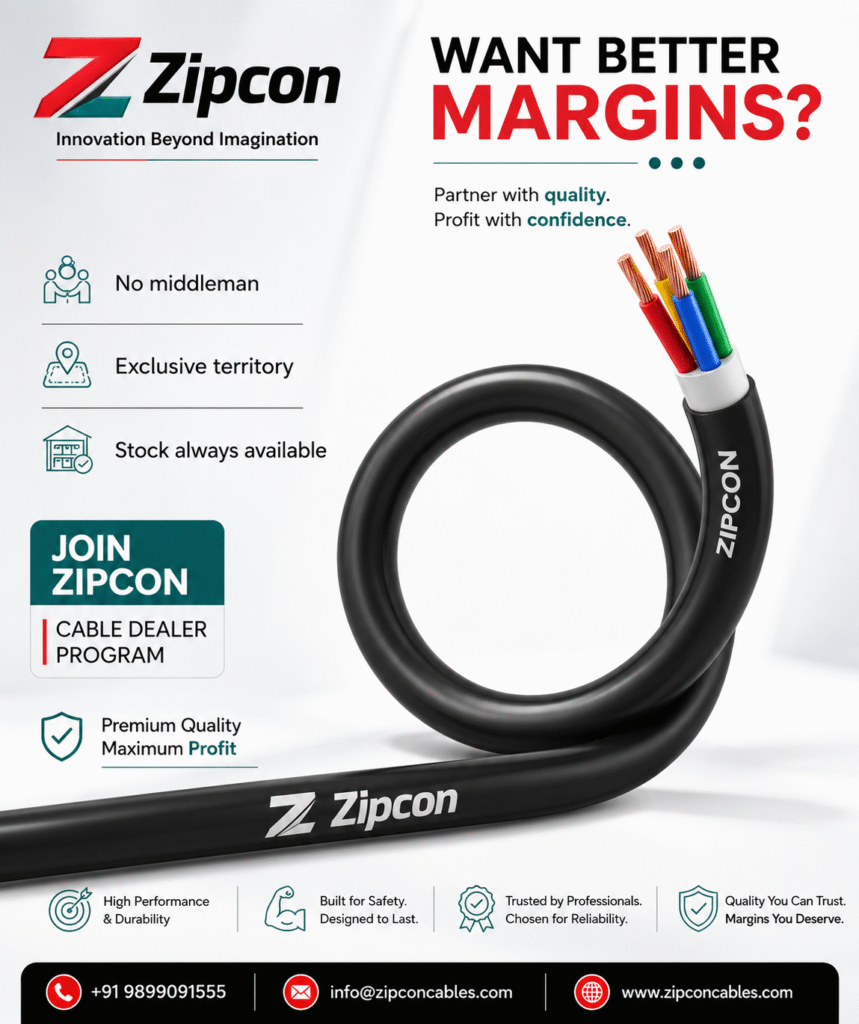
Choosing the right flexible cable contractor in Delhi is essential for electrical projects where dependable power transmission, proper installation, flexibility, and long-term performance matter. Residential buildings, offices, retail spaces, factories, warehouses, and infrastructure projects all have different electrical requirements.
A professional contractor should understand more than cable installation. Cable size, conductor construction, insulation, operating temperature, routing, bending requirements, electrical load, and installation conditions all influence the right cable selection.
Zipcon Cables offers cable solutions suitable for different electrical applications, helping contractors and project owners focus on quality and application-specific performance. The right combination of quality cables and proper installation can reduce avoidable electrical problems and maintenance requirements.
Contact us today:- https://zipconcables.com/contact-us/
Why Choose a Professional Flexible Cable Contractor in Delhi?
Delhi has a wide range of residential, commercial, industrial, and infrastructure projects. Each project can have different electrical loads and installation conditions, making proper cable planning important.
A qualified flexible cable contractor in Delhi can assess the application before recommending and installing cables. This helps ensure that the cable is suitable for the expected load, environment, routing method, and equipment connection.
Proper Cable Selection
Cable selection should be based on technical requirements rather than price alone. Important factors include:
- Current-carrying capacity
- Voltage requirements
- Conductor material
- Cable cross-sectional area
- Number of cores
- Insulation material
- Installation environment
- Temperature conditions
- Flexibility requirements
- Cable routing method
For example, a cable used for a fixed residential circuit may have different requirements from a cable connected to equipment that experiences regular movement or vibration.
Reliable Installation
Even a quality cable can perform poorly when it is installed incorrectly. Excessive bending, mechanical stress, poor support, improper termination, or unsuitable routing can affect cable performance.
Professional installation focuses on protecting the cable throughout its service life, not simply completing the initial wiring work.
Flexible Cable Solutions for Residential Projects
Modern homes use electrical systems for lighting, appliances, air conditioners, water pumps, kitchen equipment, entertainment systems, and other loads. Proper cable selection becomes increasingly important as electrical demand increases.
Home Wiring Applications
Flexible electrical cables can be useful in applications where routing involves bends or where equipment connections require easier handling. Cable selection should still be based on the circuit’s electrical load and installation conditions.
For residential projects, contractors should avoid using one cable size throughout the property without assessing individual circuits. High-load equipment may require different cable specifications from lighting or general-purpose circuits.
Example: New Residential Building
Consider a multi-floor home with lighting circuits, sockets, air conditioning, water pumps, and kitchen appliances. Each circuit should be evaluated according to its expected load and cable routing.
A professional contractor can organize the wiring layout and select suitable cable specifications while keeping installation accessible for future maintenance.
Flexible Cable Contractor for Commercial Projects
Commercial properties often have more complex electrical requirements than homes. Offices, hotels, schools, retail stores, hospitals, restaurants, and showrooms may operate lighting, HVAC systems, computers, elevators, pumps, and other equipment simultaneously.
A flexible cable contractor in Delhi working on commercial projects should consider the complete electrical layout rather than treating every circuit independently.
Commercial Cable Planning
Important considerations can include:
- Distribution board connections
- Power and lighting circuits
- Equipment connections
- Cable tray routing
- Conduit installation
- Cable identification
- Termination and testing
- Maintenance accessibility
Well-planned cable routing can make future inspection and maintenance easier while reducing unnecessary cable congestion.
Flexible Cable Solutions for Industrial Applications
Industrial electrical installations can be more demanding because cables may be exposed to machinery vibration, heat, dust, moisture, mechanical movement, and continuous operating loads.
A cable suitable for a residential application should not automatically be considered suitable for industrial machinery. Industrial cable selection requires an understanding of the equipment and operating environment.
Industrial Applications
Flexible cables can be used in appropriate industrial applications involving:
- Machinery connections
- Control equipment
- Motors
- Industrial panels
- Production systems
- Material-handling equipment
- Pumps
- Automated equipment
The specific cable construction should always be selected according to the equipment’s electrical and environmental requirements.
What Makes a Good Flexible Electrical Cable?
Flexibility is only one part of cable performance. A suitable cable must also provide the required electrical and mechanical characteristics for its intended application.
Conductor Construction
The conductor carries electrical current and therefore plays a central role in cable performance. Copper and aluminium are commonly used conductor materials, depending on the product and application.
For flexible applications, conductor construction also affects how easily the cable can be routed and handled.
Insulation Quality
Cable insulation provides electrical separation and protects the conductor from environmental exposure. The insulation should be appropriate for the cable’s operating voltage and temperature requirements.
In demanding environments, insulation performance becomes particularly important because heat, moisture, and mechanical conditions can affect service life.
Correct Cable Size
Cable size should be selected based on current demand, voltage drop, installation method, ambient temperature, and other relevant electrical design factors.
Using an undersized cable can result in excessive heating or unacceptable voltage drop. Correct sizing is therefore one of the most important parts of electrical cable planning.
Flexibility and Bending
A flexible cable should be capable of being routed through the required bends without excessive mechanical stress. The manufacturer’s specified bending requirements should be followed during installation.
Flexibility becomes especially useful around equipment, panels, machinery, and locations where cable routing cannot remain completely straight.
Zipcon Cables for Electrical Projects in Delhi
Zipcon Cables can be considered for residential, commercial, and industrial electrical projects where dependable cable solutions are required.
The correct product should always be selected according to the specific application. Cable type, conductor, size, insulation, voltage rating, environmental conditions, and installation method should be evaluated before finalizing the specification.
For contractors and project managers, working with a quality-focused cable manufacturer can simplify product selection and help maintain consistency across larger electrical installations.
Flexible Cable Contractor vs. Cable Supplier
A cable supplier primarily provides the required products, while a contractor may be involved in planning and executing the electrical installation.
| Factor | Cable Supplier | Professional Contractor |
|---|---|---|
| Cable supply | Yes | Yes |
| Product information | Yes | Yes |
| Installation planning | Limited | Project-focused |
| Cable routing | Usually not included | Considered during installation |
| Termination | Usually not included | May be included |
| Site coordination | Limited | More extensive |
| Installation troubleshooting | Product-focused | Installation-focused |
For projects where installation quality is as important as product selection, working with experienced electrical professionals can provide a more complete solution.
Examples of Flexible Cable Applications
Example 1: Residential Apartment
An apartment may require separate circuits for lighting, kitchen appliances, air conditioning, water heating, and general sockets. Proper cable sizing and routing can help maintain reliable electrical operation.
Example 2: Office Building
An office may have computer systems, networking equipment, lighting, HVAC, elevators, and other electrical loads. Organized cable routing is essential for maintenance and future expansion.
Example 3: Manufacturing Facility
A manufacturing facility may operate motors, machinery, control panels, pumps, and automated systems. Cable selection should account for electrical load as well as vibration, movement, heat, and other site conditions.
Example 4: Retail Store
A retail outlet may require cables for lighting, air conditioning, signage, security systems, refrigeration, and power outlets. A properly designed electrical layout can help avoid circuit overload and simplify maintenance.
Expert Tips for Choosing a Flexible Cable Contractor in Delhi
1. Evaluate Technical Knowledge
Look for a contractor who understands cable sizing, electrical loads, routing, termination, and installation conditions. A low quotation should not be the only selection criterion.
2. Match the Cable to the Application
Avoid selecting cables solely because they are labeled “flexible.” Flexibility does not determine whether a cable is suitable for a particular voltage, load, temperature, or environment.
3. Check Cable Specifications
Review conductor construction, cable size, insulation, voltage rating, applicable specifications, and intended application before purchasing.
4. Plan Cable Routing Before Installation
A proper route reduces unnecessary bends, mechanical stress, congestion, and maintenance difficulties. Planning is particularly important for commercial and industrial projects.
5. Consider Long-Term Cost
The initial cable price is only one component of the total project cost. Installation quality, maintenance, downtime, replacement requirements, and service life should also be considered.
6. Choose a Reliable Cable Brand
Using quality-focused products from Zipcon Cables alongside proper installation practices can support dependable electrical infrastructure across different project types.
Common Mistakes to Avoid
Choosing Only on Price
The cheapest cable may not provide the characteristics required for the application. Compare specifications, construction, quality, and expected service requirements before making a decision.
Using Undersized Cables
Cable sizing should be based on the actual electrical load and installation conditions. Undersized cables can experience excessive heating and voltage drop.
Ignoring Environmental Conditions
Heat, moisture, vibration, movement, and mechanical exposure can affect cable performance. These factors should be considered before selecting a product.
Excessive Cable Bending
Flexible does not mean unlimited bending. The cable manufacturer’s recommended bending practices should be followed during installation.
Poor Termination
Loose or improperly made connections can cause heating, electrical faults, and unreliable equipment operation. Proper termination is essential to the overall quality of an electrical installation.
Overcrowding Cable Routes
Excessive cables in a confined route can make inspection difficult and may affect heat dissipation. Cable routing should be planned according to the installation requirements.
Why Choose Zipcon Cables for Delhi Projects?
Delhi’s electrical infrastructure includes homes, offices, commercial complexes, manufacturing facilities, warehouses, and infrastructure developments. These projects require cable solutions selected according to their specific electrical and environmental conditions.
Zipcon Cables can support contractors, builders, electrical professionals, and project owners looking for dependable cable products for different applications.
The strongest electrical solution comes from combining the right product with the right installation method. Quality cable, accurate sizing, professional routing, proper termination, and appropriate testing all contribute to reliable electrical performance.
Conclusion
Finding the right flexible cable contractor in Delhi is an important decision for residential, commercial, and industrial electrical projects. A reliable contractor should understand the electrical load, cable specifications, installation environment, routing requirements, and long-term maintenance needs.
For quality-focused cable requirements, Zipcon Cables offers solutions that can be considered across a range of electrical applications. Instead of selecting a cable only by price or flexibility, evaluate the complete requirement and choose a product that matches the project’s technical conditions.
For a dependable electrical installation, focus on four essentials: correct cable selection, quality products, professional installation, and proper maintenance.
Top 5 FAQs
1. What does a flexible cable contractor in Delhi do?
A flexible cable contractor may handle cable selection, electrical installation, cable routing, termination, testing, and other project-specific requirements depending on the scope of work.
2. Where are flexible cables used?
Flexible cables are used in suitable residential, commercial, industrial, machinery, equipment, and electrical connection applications where easier routing or cable movement is required.
3. How do I choose the right flexible cable?
Consider current load, voltage, conductor material, cable size, insulation, temperature, installation method, environmental exposure, and flexibility requirements before selecting a cable.
4. Are flexible cables suitable for industrial projects?
Yes, flexible cables can be suitable for industrial applications when their electrical, mechanical, temperature, and environmental specifications match the equipment and installation conditions.
5. Why choose Zipcon Cables for electrical projects in Delhi?
Zipcon Cables can be considered for quality-focused cable requirements across residential, commercial, and industrial applications. The appropriate cable should be selected based on the project’s specific technical requirements.