
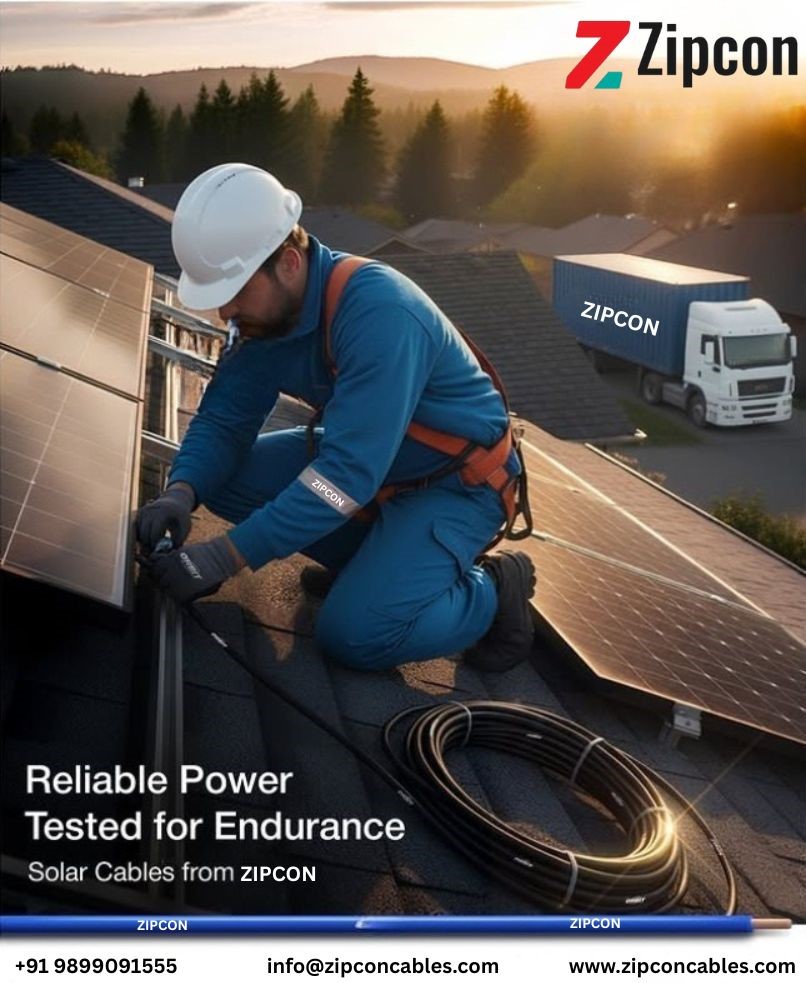
Best Solar Cable in Karnataka is a national leader in renewable energy, home to the massive Pavagada Solar Park and a rapidly growing rooftop solar sector. However, the state’s unique climatic profile—ranging from the high-heat, drought-prone zones of Tumakuru to the humid, monsoon-heavy regions of the Western Ghats—poses significant challenges for electrical infrastructure.
For engineers, EPC contractors, and homeowners, selecting the right solar cable is not just about cost; it is about ensuring decades of reliable power generation. At Zipcon Cables, we believe that understanding the technical nuances between copper and aluminum conductors is the first step toward a high-performing solar installation.
1. Conductivity: Why Material Choice Dictates Efficiency
Conductivity is the measure of a material’s ability to allow the flow of electric current.3 In solar applications, where every watt counts, the choice between copper and aluminum is critical.
- Copper: With a conductivity rating of nearly 97% IACS (International Annealed Copper Standard), copper is the gold standard. It has lower electrical resistance, which means minimal energy is lost as heat during transmission.
- Aluminum: Aluminum offers roughly 61% of the conductivity of copper. To carry the same current as a copper cable, an aluminum conductor must have a cross-sectional area approximately 1.6 times larger.
- The Verdict: For high-efficiency systems where space is limited and maximum power harvest is required, copper cables from Zipcon ensure that the energy generated by your panels actually reaches your inverter.
2. Durability in Karnataka’s Climate
Solar cables are “front-line” components, exposed to 25+ years of intense UV radiation and temperature fluctuations.
In regions like North Karnataka (Kalaburagi, Vijayapura), temperatures can soar, while Coastal Karnataka (Mangaluru) faces high humidity and salt mist.
- Corrosion Resistance: Aluminum is prone to oxidation, forming a resistive oxide layer that can lead to hot spots at connections. Copper, especially when tinned (as offered by Zipcon), provides superior resistance to corrosion and moisture.
- Thermal Stability: Copper has a melting point of approximately 1,085°C, significantly higher than aluminum’s 660°C. This makes copper cables much more resilient during extreme heat or accidental overloads.
3. Weight vs. Performance: The Installation Trade-off
Weight is a major factor in logistics and structural loading.
- Aluminum: It is nearly three times lighter than copper for the same volume. This makes it a popular choice for large-scale utility projects where thousands of meters of cable are suspended on overhead structures.
- Copper: While heavier, copper’s higher density allows for compact cable runs. For residential rooftops where weight is less of a concern than space and reliability, copper is the more practical choice.
4. Cost: Initial Investment vs. Long-term Value
Price is often the deciding factor, but it requires a “Life Cycle Cost” (LCC) perspective.
- Initial Cost: Aluminum cables can be 30% to 50% cheaper upfront.
- Long-term Value: Copper cables typically last 25+ years, whereas aluminum cables may require more frequent maintenance or replacement (often within 10–15 years) due to connection failures or oxidation.
Pro Tip: If your project budget is tight and the system is massive (multi-megawatt), aluminum is viable. For rooftop systems where the “cost of failure” is high, copper offers a better ROI.
5. Safety: Overheating and Fire Prevention
Safety is paramount in solar installations, which operate at high DC voltages.
- Thermal Expansion: Aluminum expands and contracts significantly more than copper when heated. This can lead to “creep,” where connections loosen over time, causing arcing—a leading cause of solar fires.
- Fire Retardancy: Zipcon Cables utilizes XLPE (Cross-linked Polyethylene) insulation, which is halogen-free and flame-retardant, meeting international safety standards (like IEC 60332-1) to ensure that even in the event of a fault, fire propagation is halted.
6. Installation Needs: Flexibility and Handling
Installation ease directly impacts labor costs.
- Flexibility: Copper is naturally more ductile. Zipcon’s stranded copper cables offer a smaller bending radius, making them easier to route through tight conduits and around corners on complex rooftops.
- Complexity: Aluminum requires specialized bi-metal lugs and anti-oxidant pastes to prevent galvanic corrosion at connection points. Copper uses standard connectors, reducing the risk of installer error.
7. Typical Use Cases: Which Should You Choose?
| Application Type | Recommended Material | Why? |
| Residential Rooftop (1kW – 10kW) | Copper | Limited space; requires maximum efficiency and low maintenance. |
| Commercial/Industrial (100kW+) | Copper | Reliability and safety are critical for high-value assets. |
| Large Utility Solar Parks (MW) | Aluminum | Significant cost and weight savings for long-distance runs. |
| Coastal/Humid Areas24 | Tinned Copper25 | Prevents salt-mist corrosion and maintains conductivity.26 |
Real-World Scenarios
- Scenario A: A textile mill in Surat (hot/humid) is installing a 500kW rooftop plant. Recommendation: Zipcon Tinned Copper Cables. The humidity and high current load demand a material that won’t oxidize or overheat.
- Scenario B: A 50MW ground-mounted park in Pavagada (dry/vast). Recommendation: Aluminum cables for the long-distance transmission lines to save on structural and material costs, using copper only for the critical string-to-box connections.
Conclusion: Why Zipcon Cables?
Choosing the right solar cable is the difference between a system that pays for itself and one that becomes a liability. Zipcon Cables provides high-quality, UV-stabilized, and flame-retardant cables designed specifically for India’s harsh environments. Our products offer:
- 99.99% Pure Electrolytic Grade Copper for minimum power loss.
- Advanced XLPE Insulation for 25-year durability.
- Compliance with Global Standards (TUV, IEC) to ensure safety.
For your next solar project in Karnataka, don’t compromise on the lifeline of your system. Choose Zipcon Cables for reliability that lasts.