
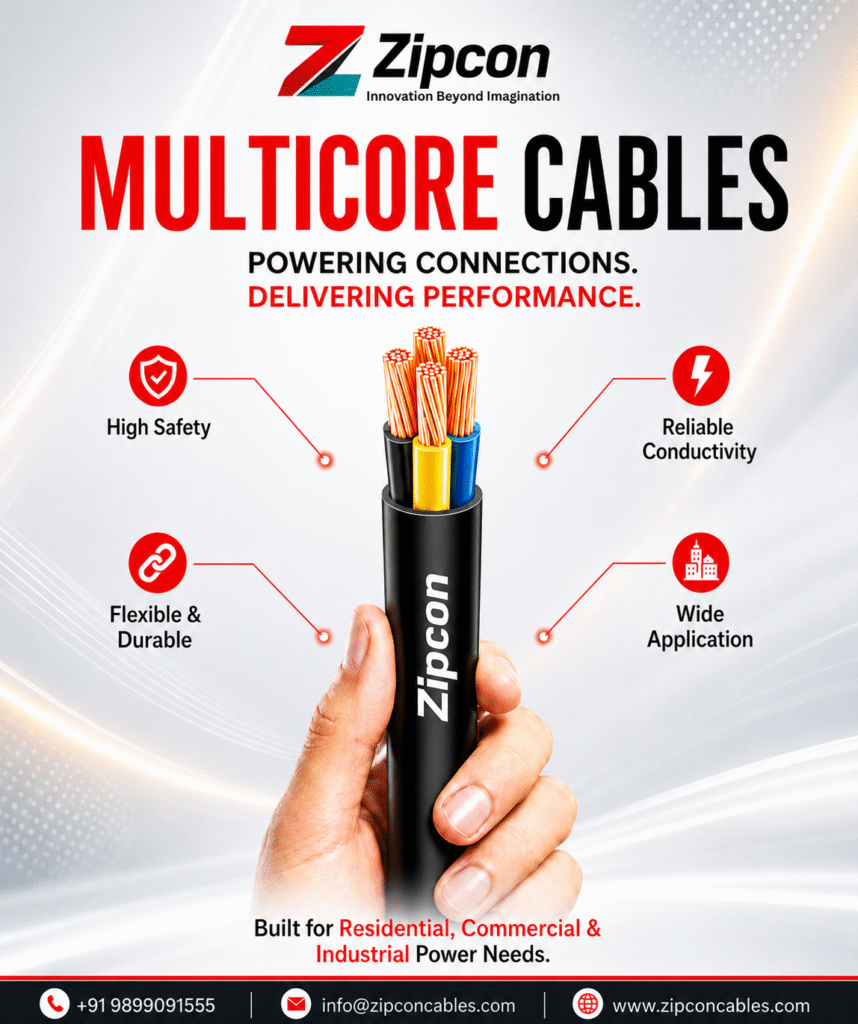
Choosing the top electrical cables in Gwalior is essential for safe wiring, stable power transmission, and long-term electrical performance. Whether you are wiring a new home, renovating a commercial building, or installing cables for industrial equipment, the cable quality directly affects safety and reliability.
Gwalior’s hot summers, dust, varying electrical loads, and demanding residential and commercial applications make proper cable selection important. A cable should match the required load, installation environment, voltage, conductor material, insulation quality, and expected service life.
For homeowners, electricians, builders, contractors, and businesses, Zipcon Cables offers a practical range of electrical cables designed for dependable electrical connections. Selecting the right Zipcon cable according to the application can help reduce overheating, insulation damage, voltage-related problems, and premature replacement.
For inquiries or assistance, visit: 👉https://zipconcables.com/contact-us/
Why Choosing the Right Electrical Cable Matters in Gwalior
An electrical cable is more than a conductor covered with insulation. Its construction determines how effectively it carries current and how safely it performs under continuous electrical load.
Using an undersized or poor-quality cable can increase resistance and heat generation. Over time, excessive heating can damage insulation, reduce cable life, and increase electrical safety risks. The correct cable size and insulation specification are therefore important for both residential and commercial wiring.
For example, a cable suitable for lighting circuits may not be appropriate for an air conditioner, water pump, heavy machinery, or commercial distribution system. Each application requires a cable selected according to its electrical and installation requirements.
Types of Electrical Cables Used in Residential and Commercial Applications
1. House Wires
House wires are commonly used for residential lighting, sockets, fans, appliances, and internal electrical circuits. Flexible copper conductors with quality PVC insulation are preferred for many indoor wiring applications because they are easier to route and terminate.
For homes in Gwalior, choose house wires based on circuit load, conductor size, insulation properties, and installation conditions rather than price alone.
2. Flexible Cables
Flexible cables are useful where the cable needs to bend or move during installation or operation. They can be suitable for appliances, equipment, control connections, and other applications requiring flexibility.
A properly constructed flexible cable should maintain mechanical strength while providing reliable electrical conductivity and insulation protection.
3. Multicore Cables
Multicore cables contain multiple insulated conductors within a common outer covering. They can simplify installations where several electrical connections need to run together.
These cables are useful in various residential, commercial, control, and equipment-related applications. Selecting the correct number of cores and conductor size is important for the intended circuit.
4. Round Cables
Round electrical cables are commonly selected for installations where mechanical handling, routing, and protection are important. Their construction can make cable management easier in suitable applications.
Before selecting a round cable, check its conductor material, cross-sectional area, insulation type, voltage rating, and intended installation environment.
5. Submersible Cables
Submersible cables are designed for applications involving water exposure, particularly pump and borewell installations. They require insulation and construction suitable for wet environments.
For agricultural properties, residential borewells, and commercial water systems around Gwalior, selecting a suitable submersible cable is critical because ordinary indoor wiring is not designed for continuous underwater service.
Copper vs Aluminium Electrical Cables
The conductor material is one of the most important considerations when selecting an electrical cable.
Copper cables offer high electrical conductivity and are widely used for residential wiring and applications where compact cable dimensions and flexibility are valuable. They are particularly common in internal house wiring and many equipment connections.
Aluminium cables can be useful for larger power distribution applications where conductor weight and cost need to be considered. However, the cable must be correctly sized and installed using appropriate termination practices.
The best choice depends on the load, cable length, installation method, budget, and electrical design—not simply on the conductor material.
How to Choose the Top Electrical Cables in Gwalior
Consider the Electrical Load
First determine the expected current demand of the circuit. High-load equipment such as air conditioners, pumps, heaters, motors, and industrial machines may require larger conductors than lighting or low-load circuits.
Using the correct cable size helps manage current safely and reduces unnecessary voltage drop and heating.
Check Cable Size
Cable size is generally specified according to conductor cross-sectional area, such as 1.5 sq mm, 2.5 sq mm, 4 sq mm, 6 sq mm, and larger sizes.
The required size depends on the application, current, installation conditions, cable length, and permissible voltage drop. An electrician or electrical engineer should determine the appropriate size for critical installations.
Evaluate Insulation Quality
Insulation protects the conductor from direct contact, moisture, heat, and mechanical conditions. Quality insulation is therefore essential for safe cable operation.
For residential and commercial applications, look for cables with insulation appropriate to the installation environment and required temperature and voltage conditions.
Check Flexibility and Construction
Cable construction should match the installation. Flexible cables are easier to route through bends, while specific flat or round constructions may be more suitable for particular installations.
The cable should also have consistent insulation, proper conductor construction, and a strong outer covering where required.
Buy From a Reliable Cable Brand
A reliable manufacturer provides greater confidence in consistent manufacturing quality and product specifications. Always purchase cables through dependable dealers and verify product markings, specifications, and packaging.
For customers searching for electrical cable suppliers in Gwalior, Zipcon Cables can be considered for applications where dependable cable construction and application-specific options are required.
Residential Electrical Cable Selection: Practical Examples
For a typical home, different circuits can require different cable sizes and constructions.
Example 1: Lighting circuit
Lighting circuits generally have lower electrical loads than power circuits. A suitable house wire should be selected according to the actual circuit design and applicable electrical requirements.
Example 2: Air conditioner circuit
An air conditioner can place a substantially higher continuous load on its circuit. The cable should therefore be selected according to the equipment rating, circuit protection, cable length, and installation conditions.
Example 3: Water pump
A pump requires a cable suitable for its electrical load and installation environment. If the pump is installed in a borewell, a suitable submersible cable should be used rather than ordinary house wiring.
Commercial Electrical Cable Applications
Commercial buildings typically have more complex electrical requirements than individual homes. Offices, retail stores, schools, hospitals, warehouses, hotels, and other buildings may contain lighting systems, HVAC equipment, pumps, elevators, computers, machinery, and multiple distribution circuits.
This makes cable selection particularly important. Commercial installations should consider load diversity, cable routing, voltage drop, ambient temperature, grouping, protection systems, and future load requirements.
For large installations, cable selection should be carried out as part of a proper electrical design rather than simply choosing the largest or cheapest available cable.
Why Consider Zipcon Cables?
When searching for top electrical cables in Gwalior, Zipcon Cables can be considered for residential and commercial electrical applications where dependable construction and suitable cable specifications are important.
Zipcon’s cable range includes options such as house wires, flexible cables, multicore cables, round cables, and application-specific cables. The appropriate product should be selected according to conductor size, electrical load, installation environment, and intended use.
The key advantage of choosing a cable brand should be consistency: consistent conductor construction, insulation quality, dimensional control, and clearly defined product specifications. These factors matter more than choosing a cable based solely on its initial purchase price.
Expert Tips for Buying Electrical Cables in Gwalior
- Calculate the load first: Do not select a cable size only by looking at the appliance name.
- Consider cable length: Longer cable runs can make voltage drop an important consideration.
- Match insulation to the environment: Wet, hot, outdoor, underground, and indoor installations have different requirements.
- Avoid unnecessary joints: Continuous cable runs can reduce potential connection-related problems.
- Use suitable circuit protection: Cable selection and protective devices should work together.
- Buy from an authorized or reliable dealer: This reduces the risk of receiving incorrectly labelled or poor-quality products.
- Check specifications: Verify conductor material, cross-sectional area, voltage rating, insulation type, and applicable standards.
- Get professional installation: Correct cable selection cannot compensate for poor termination or installation practices.
Common Mistakes to Avoid When Buying Electrical Cables
Choosing Cable Based Only on Price
The cheapest cable is not necessarily the most economical choice. Poor-quality materials can result in shorter service life, heating, electrical faults, or replacement costs.
Using the Same Cable for Every Circuit
Different circuits have different loads and environmental requirements. A cable appropriate for lighting may not be suitable for a high-load appliance or motor.
Ignoring Installation Conditions
Cable capacity can be affected by ambient temperature, grouping, conduit conditions, installation method, and surrounding environment. These factors should be considered during electrical design.
Using Ordinary Cable for Wet Applications
Water-exposed applications require cables specifically designed for those conditions. Using unsuitable wiring around pumps or continuously wet locations can compromise insulation performance.
Ignoring Voltage Drop
For longer cable runs, voltage drop can affect equipment performance. Cable size should therefore be considered together with circuit length and load.
Why Zipcon Can Be a Practical Choice for Gwalior
Gwalior’s residential and commercial construction market includes everything from individual homes and apartments to shops, offices, warehouses, and industrial facilities. These applications require different types and sizes of electrical cables.
Zipcon Cables provides options that can be matched to different electrical requirements. Whether the requirement is residential house wiring, flexible connections, multicore applications, or pump-related cabling, selecting the correct Zipcon product for the specific application is the important step.
Instead of selecting a cable only because it is marketed as premium, compare its specifications with your actual electrical requirements. A correctly sized, properly installed cable from a dependable manufacturer provides a stronger foundation for safe and reliable electrical wiring.
Conclusion
Finding the top electrical cables in Gwalior starts with understanding the application—not simply choosing a popular product. Conductor material, cable size, insulation, load capacity, installation environment, cable length, and construction quality all influence electrical performance.
For residential and commercial projects, Zipcon Cables is a brand worth considering when evaluating electrical cable options. Choose the appropriate Zipcon cable based on the actual load and installation conditions, and ensure that installation and protection are handled by qualified electrical professionals.
For safer wiring, dependable performance, and application-specific cable selection, choose the right cable—not just the cheapest cable. Choose Zipcon Cables.
Top 5 FAQs
1. Which are the top electrical cables in Gwalior?
The best electrical cable depends on the application, load, conductor material, cable size, insulation, and installation environment. Zipcon Cables offers different cable options that can be evaluated according to residential and commercial requirements.
2. Which cable is suitable for house wiring in Gwalior?
Suitable house wiring cables should have the correct conductor size, insulation, voltage rating, and flexibility for the intended circuit. The required size should be determined from the circuit load and installation conditions.
3. Are copper or aluminium cables better?
Neither is universally better. Copper is commonly preferred for many internal wiring applications because of its high conductivity and flexibility, while aluminium can be useful for suitable larger power-distribution applications. The choice should be based on the electrical design.
4. How do I select the correct electrical cable size?
Consider the expected current, equipment load, cable length, installation method, ambient conditions, voltage drop, and applicable electrical requirements. For important installations, cable sizing should be performed by a qualified electrical professional.
5. Why choose Zipcon Cables for electrical wiring?
Zipcon Cables offers multiple cable types for different electrical applications. Customers can select the appropriate product based on conductor size, construction, insulation, electrical load, and installation requirements, making it a practical option for residential and commercial wiring.