
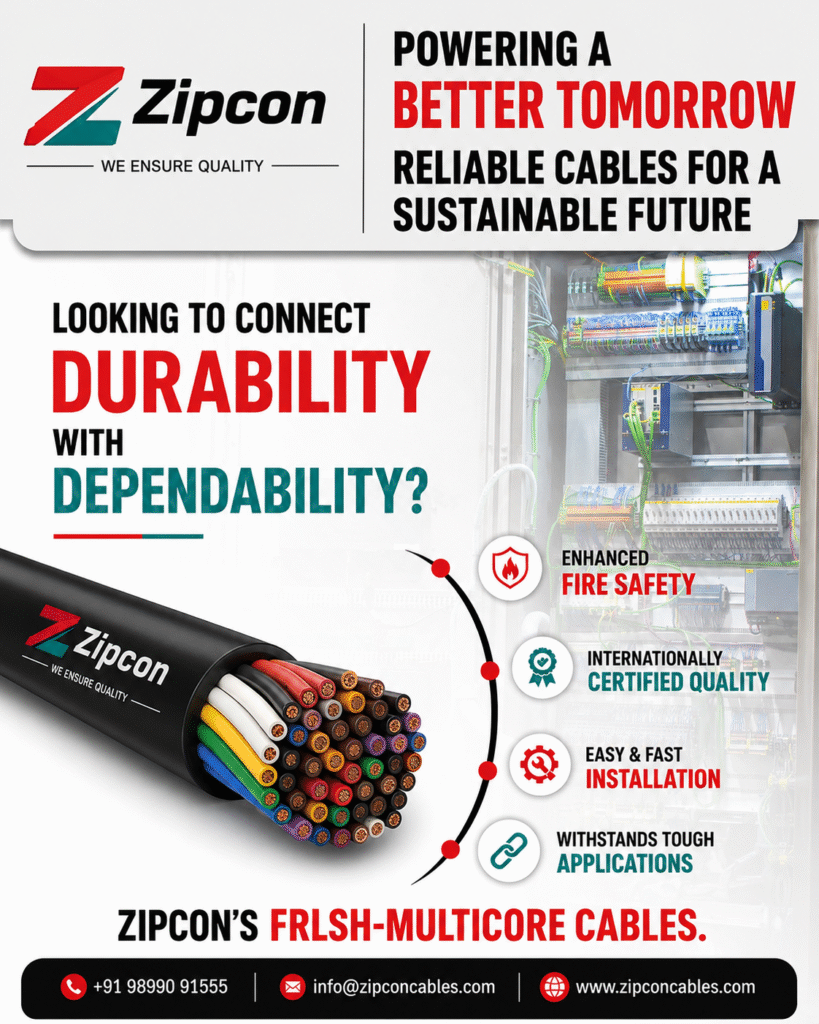
Choosing the best multicore cable in Kerala is important for industrial plants, commercial buildings, machinery, control systems, and other electrical installations where reliable power transmission is essential. A suitable multicore cable can simplify wiring, improve installation efficiency, and provide dependable performance under demanding operating conditions.
Kerala’s humid climate, high rainfall, industrial environments, and varied commercial applications make cable quality particularly important. Multicore cables with appropriate insulation, conductor quality, flexibility, and mechanical protection can help create safer and more durable electrical systems.
For businesses looking for dependable electrical cables, Zipcon Cables offers multicore cable solutions designed for applications that require consistent electrical performance, durability, and reliable insulation.
Contact us today:- https://zipconcables.com/contact-us/
What Is a Multicore Cable?
A multicore cable contains two or more individually insulated conductors enclosed within a common outer sheath. Instead of installing multiple separate single-core cables, several conductors can be routed together through one cable.
For example, a 3-core cable can carry three electrical conductors, while 4-core, 5-core, and higher-core configurations can be used for more complex power, control, and electrical distribution requirements.
The exact cable construction depends on the application. Conductor material, cross-sectional area, insulation type, voltage rating, sheath material, flexibility, and environmental resistance should all be considered before selecting a cable.
Why Multicore Cables Are Important for Industrial & Commercial Applications
Industrial and commercial electrical systems often contain multiple circuits operating within the same installation. Using appropriately designed multicore cables can make these systems easier to organize and install.
1. Simplified Cable Installation
Multiple conductors are combined into a single cable, reducing the number of individual cables that need to be routed. This can make cable management cleaner and simplify installation in electrical panels, machinery, buildings, and distribution systems.
2. Better Cable Management
Multicore construction keeps related conductors together. This helps reduce wiring clutter and can make identification, routing, and maintenance more convenient.
3. Reliable Electrical Performance
A quality multicore cable uses properly manufactured conductors and suitable insulation to provide stable current transmission. Correct conductor sizing is essential to control voltage drop and prevent excessive heating.
4. Space Efficiency
When several circuits or conductors need to be routed through a restricted area, multicore cables can provide a more compact wiring solution than multiple individual cables.
5. Protection Against Environmental Conditions
Industrial and commercial installations may expose cables to moisture, heat, dust, chemicals, vibration, or mechanical stress. The correct insulation and sheath construction can provide protection appropriate to the installation environment.
Types of Multicore Cables for Different Applications
The best multicore cable depends on the electrical load and installation conditions. Common configurations include:
3 Core Multicore Cable
A 3-core cable is commonly used in electrical systems where three conductors are required. Depending on its design and rating, it can be used for power connections, motors, machinery, and other electrical applications.
4 Core Multicore Cable
4-core cables are widely used in three-phase systems where an additional conductor is required for the particular electrical configuration. They can be suitable for industrial distribution and equipment connections.
5 Core Multicore Cable
5-core cables can be useful for installations requiring three-phase conductors along with neutral and earth/PE arrangements, depending on the system design and applicable standards.
Control Multicore Cables
Control multicore cables are designed for systems where several low-power control signals need to be routed together. They can be used in automation panels, control equipment, industrial machinery, and instrumentation-related applications.
Key Factors When Choosing the Best Multicore Cable in Kerala
Selecting a cable based only on price can lead to higher maintenance costs and performance problems. Consider the following factors before purchasing.
Conductor Material
Copper and aluminium are common conductor materials. Copper generally offers high conductivity and excellent flexibility, while aluminium can provide a cost-effective solution for suitable power applications.
The conductor material should be selected according to the required current capacity, installation method, voltage drop, cable size, and project specifications.
Cable Size
Cable size is one of the most important selection factors. A cable that is too small for the connected load can experience excessive heating and voltage drop.
The required size should be calculated based on load current, installation conditions, ambient temperature, permissible voltage drop, grouping, and applicable electrical requirements.
Insulation Quality
The insulation protects conductors from electrical contact and environmental exposure. Depending on the application, cables may use PVC or other suitable insulation systems.
For Kerala’s humid conditions, choosing a cable with insulation and sheathing appropriate for moisture and the intended installation environment is especially important.
Voltage Rating
Always select a cable with a voltage rating suitable for the electrical system. Industrial equipment and commercial installations can have different voltage requirements, so the cable should match the project’s electrical specifications.
Flexibility
If a cable must be routed around machinery, panels, bends, or confined spaces, flexibility becomes important. The construction of the conductor and insulation affects how easily a multicore cable can be installed.
Temperature Resistance
Industrial equipment can generate substantial heat. Cable selection should consider the expected operating temperature and the manufacturer’s specified temperature limits.
Mechanical Protection
Cables installed in exposed industrial areas may experience vibration, abrasion, impact, or pulling forces. Where necessary, choose cable construction that provides the appropriate mechanical protection for the installation.
Multicore Cable Applications in Kerala
Multicore cables can be used across a wide range of industrial and commercial environments.
Industrial Applications
Common applications include:
- Manufacturing plants
- Motor connections
- Industrial machinery
- Control panels
- Automation systems
- Electrical distribution
- Factory equipment
- Pumping systems
- Processing units
- Industrial control circuits
Commercial Applications
Commercial installations may include:
- Office buildings
- Shopping complexes
- Hotels
- Hospitals
- Educational institutions
- Warehouses
- Commercial kitchens
- Retail facilities
- Building services
- HVAC and electrical systems
The appropriate cable construction will depend on the equipment, electrical load, installation method, and local project requirements.
Why Cable Quality Matters in Kerala
Kerala’s environmental conditions can influence electrical installations. High humidity, monsoon rainfall, moisture exposure, and coastal conditions in some areas can increase the importance of proper insulation, sheathing, installation, and cable protection.
A quality cable is not simply about the conductor. The complete construction—including insulation, sheath, conductor stranding, manufacturing consistency, and applicable testing—affects long-term performance.
For this reason, buyers should evaluate technical specifications and manufacturer reliability instead of selecting a multicore cable solely on its initial price.
Multicore Cable vs Single-Core Cable
| Feature | Multicore Cable | Single-Core Cable |
|---|---|---|
| Conductors | Multiple conductors in one cable | One conductor |
| Installation | Convenient for grouped circuits | Requires separate cable routing |
| Cable Management | More organized | Can require more space |
| Applications | Power, control, machinery, commercial wiring | Distribution and specialized wiring |
| Space Requirement | Often more compact for multiple conductors | Multiple cables may require additional routing |
| Selection | Depends on number of required cores | Depends mainly on individual circuit requirements |
Neither option is universally better. The correct choice depends on the electrical design, load, installation method, and project requirements.
Examples of Multicore Cable Selection
Example 1: Industrial Motor Connection
An industrial motor installation may require multiple conductors in a controlled routing environment. A correctly sized multicore cable can simplify the connection while keeping the conductors organized.
The cable size should be selected according to the motor’s rated current, starting conditions, installation method, voltage drop, and applicable electrical requirements.
Example 2: Commercial Building
A commercial building may have several electrical systems operating in different areas. Multicore cables can help organize connections between electrical panels, equipment, and control systems where the cable configuration is suitable.
Example 3: Industrial Control Panel
A control panel may require numerous signal or control connections. A purpose-designed control multicore cable can group these conductors together, making routing and cable identification easier.
Expert Tips for Buying Multicore Cable in Kerala
1. Calculate the electrical load first.
Do not select cable size based solely on the equipment’s physical connection size. Current capacity and voltage-drop requirements should be considered.
2. Check the cable construction.
Review conductor material, conductor class, insulation, sheath, voltage rating, and temperature characteristics.
3. Consider the installation environment.
Indoor, outdoor, underground, wet, hot, industrial, and mechanically exposed installations can require different cable constructions.
4. Buy from a reliable manufacturer.
Consistent manufacturing quality is important for electrical safety and long-term performance.
5. Avoid choosing solely by price.
A lower initial price does not necessarily mean lower total cost. Cable quality can influence installation reliability, maintenance, and service life.
6. Verify technical specifications.
Before purchasing, compare the manufacturer’s technical data with the requirements of the electrical project.
Common Mistakes When Choosing Multicore Cables
Choosing an Undersized Cable
Using an undersized cable for a high electrical load can increase heating and voltage drop. Cable sizing should always be based on the actual installation requirements.
Ignoring Environmental Conditions
A cable suitable for a dry indoor installation may not be appropriate for a wet or exposed environment. Moisture, temperature, chemicals, and mechanical stress should be evaluated.
Selecting Only by Price
Price comparison is useful, but it should not replace technical evaluation. Conductor quality, insulation, manufacturing standards, and application suitability are equally important.
Using the Wrong Number of Cores
Choosing a cable with fewer or unsuitable cores can result in complicated modifications during installation. Determine the required conductor configuration before ordering.
Poor Installation Practices
Even a high-quality cable can perform poorly if it is incorrectly installed. Excessive bending, improper termination, insufficient support, or damage to the outer sheath can affect cable performance.
Why Choose Zipcon Cables for Multicore Cable Requirements?
Zipcon Cables focuses on electrical cable solutions designed for dependable performance across different applications. For industrial and commercial projects, cable selection should combine appropriate conductor construction, insulation quality, correct sizing, and application-specific performance.
When sourcing multicore cables in Kerala, Zipcon can be considered for projects where reliable electrical connectivity, durable construction, and consistent cable performance are priorities.
Before purchasing, buyers should match the required cable specifications with the project’s load, voltage, installation environment, and applicable standards.
Conclusion
The best multicore cable in Kerala is not simply the cable with the lowest price or the largest conductor. It is the cable that correctly matches the electrical load, number of cores, conductor material, insulation, voltage rating, installation environment, flexibility, and required protection.
For industrial plants, commercial buildings, machinery, control systems, and electrical distribution applications, selecting the right multicore cable can improve installation efficiency and support dependable long-term operation.
If you are sourcing multicore cables for an industrial or commercial project in Kerala, consider Zipcon Cables for reliable cable solutions and select the exact cable specification according to your application’s electrical requirements.
Top 5 FAQs
1. What is the best multicore cable for industrial applications?
The best multicore cable depends on the load, voltage, number of cores, installation method, temperature, mechanical conditions, and required insulation. There is no single cable specification suitable for every industrial application.
2. Which multicore cable is suitable for commercial buildings?
The appropriate cable depends on the building’s electrical system and application. 3-core, 4-core, 5-core, and control multicore cables may be used for different power and control requirements.
3. How do I select the correct multicore cable size?
Cable size should be selected based on load current, conductor material, permissible voltage drop, installation conditions, ambient temperature, cable grouping, and applicable electrical requirements.
4. Are multicore cables suitable for Kerala’s climate?
Yes, multicore cables can be suitable for Kerala when their insulation, sheath, and construction are appropriate for the installation environment. Moisture, humidity, heat, outdoor exposure, and mechanical conditions should be considered.
5. Why choose Zipcon Cables for multicore cable requirements?
Zipcon Cables can be considered for industrial and commercial cable requirements where dependable construction and consistent electrical performance are important. The specific cable should always be selected according to the project’s technical requirements.