
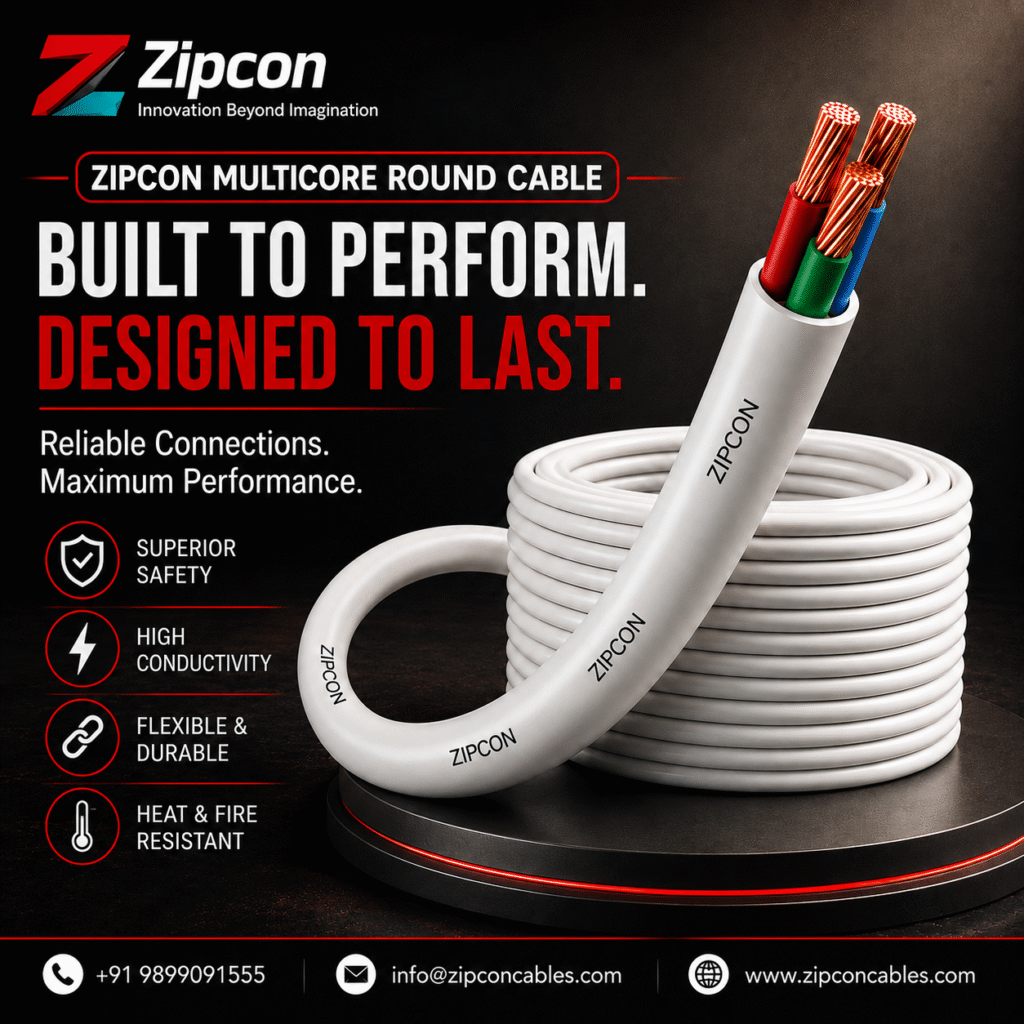
Choosing the best multicore round cable in Jabalpur is important for electrical installations that require multiple conductors within a single, organized cable. Multicore round cables can simplify wiring, improve cable management, and provide a practical solution for residential, commercial, industrial, and equipment-related applications.
A multicore cable combines individually insulated conductors inside a common outer sheath. The round construction provides a compact and manageable profile, while the number and size of cores determine how the cable can be used. Selecting the correct cable requires attention to conductor material, core configuration, cross-sectional area, insulation, voltage rating, current capacity, and installation conditions.
Zipcon Cables offers multicore cable solutions designed for applications where reliable electrical connectivity, organized installation, and durable cable construction are important. For projects in Jabalpur, choosing the right Zipcon multicore round cable according to the electrical requirement can support consistent long-term performance.
For inquiries or assistance:– https://zipconcables.com/contact-us/
What Is a Multicore Round Cable?
A multicore round cable contains two or more insulated electrical conductors enclosed within a common outer sheath. Each core is electrically separated from the others, allowing multiple circuits or electrical connections to be managed through a single cable assembly.
The round outer construction helps the cable maintain a compact form and makes it practical for routing through suitable conduits, cable trays, equipment connections, and other installations. The exact application depends on the cable’s construction and technical specifications.
For example, a multicore cable may be used where several electrical conductors need to travel between two points without installing multiple separate single-core cables.
Why Multicore Round Cables Are Used
Multicore round cables provide several practical advantages when the application requires multiple conductors.
Organized Cable Management
Instead of routing multiple individual cables separately, several conductors can be grouped within one outer sheath. This can create a cleaner and more organized installation.
This is particularly useful in installations where space is limited or where cable routing needs to remain structured.
Easier Installation
Using one multicore cable can simplify cable routing compared with managing several separate cables. This can reduce installation complexity when the cable specification is appropriate for the application.
However, cable weight, bending radius, route length, and installation method should always be considered.
Reduced Cable Clutter
Multiple individual wires can create unnecessary congestion around electrical panels and equipment. A multicore round cable provides a consolidated wiring arrangement.
This can make identification, routing, and maintenance more manageable when the cable cores are properly marked and terminated.
Suitable for Multiple Applications
Depending on the construction, multicore round cables can be used across residential, commercial, industrial, control, power, and equipment-related applications.
The cable should always be selected based on its specified purpose rather than assuming that every multicore cable is suitable for every electrical installation.
Key Features to Consider in a Multicore Round Cable
Finding the best multicore round cable in Jabalpur requires comparing technical characteristics rather than focusing only on price.
Conductor Material
The conductor determines the cable’s ability to carry electrical current. Copper is commonly used where high conductivity and flexibility are required, while aluminium is also used in applications where its specific characteristics and cost advantages are suitable.
The conductor material should match the project’s electrical and installation requirements.
Number of Cores
Multicore cables are available with different core configurations. The required number of cores depends on the equipment, circuit arrangement, control requirements, and electrical design.
Choosing the correct core configuration prevents unnecessary wiring changes during installation.
Cross-Sectional Area
The cross-sectional area, commonly specified in square millimetres, affects the current-carrying capability of the conductor.
A cable that is too small for the expected load may not be suitable for the application. Cable sizing should be calculated according to load, installation conditions, cable length, and applicable electrical requirements.
Insulation Quality
Each conductor needs suitable insulation to maintain electrical separation. The overall cable construction also requires an appropriate outer sheath for its intended installation environment.
Good insulation should be compatible with the expected operating voltage, temperature, moisture exposure, and mechanical conditions.
Outer Sheath
The outer sheath protects the internal cores and provides additional mechanical and environmental protection.
For demanding installations, the sheath material and construction should be evaluated according to factors such as abrasion, moisture, temperature, and installation conditions.
Applications of Multicore Round Cables
Multicore round cables can be used in a variety of electrical installations when their specifications match the application.
Residential Applications
They may be used for selected equipment connections, control arrangements, power distribution, and other residential electrical applications where multiple conductors need to be routed together.
The exact cable type and size should be selected according to the circuit design.
Commercial Buildings
Offices, retail properties, hotels, institutions, and other commercial buildings often have complex electrical systems involving multiple equipment and distribution points.
A suitable multicore cable can help organize connections and simplify cable routing in appropriate applications.
Industrial Applications
Industrial environments can require cables for equipment, control systems, machinery, power connections, and other electrical functions.
Industrial cable selection requires additional attention to mechanical stress, temperature, chemical exposure, vibration, installation method, and operating conditions.
Electrical Panels and Equipment
Multicore cables can provide a practical way to connect equipment where multiple electrical conductors are required between connection points.
Correct core identification and termination are important to maintain reliable electrical connections.
Multicore Round Cable vs Single-Core Cable
Both multicore and single-core cables have their own applications.
| Feature | Multicore Round Cable | Single-Core Cable |
|---|---|---|
| Conductors | Multiple cores in one cable | One conductor per cable |
| Cable Management | More organized for multi-conductor connections | Requires separate cable routing |
| Installation | Can simplify multi-core routing | Useful where individual conductors are preferred |
| Space Requirement | Consolidated cable arrangement | Multiple cables may require more routing space |
| Application | Multi-conductor systems and equipment | Individual circuits and specific wiring arrangements |
| Maintenance | Requires proper core identification | Individual cable identification is straightforward |
The choice should depend on the electrical design rather than treating one construction as universally better.
How to Choose the Best Multicore Round Cable in Jabalpur
Step 1: Identify the Application
First determine whether the cable will be used for power, control, equipment connection, distribution, or another purpose.
The application determines the required cable construction and technical specifications.
Step 2: Determine the Number of Cores
Calculate how many conductors are required for the installation. Avoid choosing a core configuration simply because it is readily available.
Step 3: Calculate the Electrical Load
Determine the expected current and electrical load before selecting the conductor size. This is especially important for power applications.
Step 4: Consider Cable Length
Long cable runs can introduce voltage-drop considerations. The installation length should therefore be included in the cable selection process.
Step 5: Evaluate the Installation Environment
Indoor, outdoor, underground, conduit, tray, machinery, and moisture-prone environments can have different requirements.
Choose a cable construction that is suitable for the actual environment.
Step 6: Check Manufacturer Specifications
Before purchasing, verify conductor material, core size, number of cores, insulation, voltage rating, temperature rating, sheath construction, and applicable standards.
Why Choose Zipcon Multicore Round Cables?
Zipcon Cables provides cable solutions for electrical applications where dependable construction and consistent performance are important. Its multicore round cable range can be considered for projects requiring multiple conductors within a single cable arrangement.
For customers searching for a multicore round cable in Jabalpur, Zipcon provides an option to evaluate based on the project’s actual electrical requirements. Selecting the correct core configuration and conductor size is essential for achieving the intended performance.
Zipcon cables can be considered by electricians, contractors, builders, industrial users, electrical dealers, and project buyers looking for practical cable solutions.
Examples: Selecting a Multicore Round Cable
Example 1: Equipment Connection
Suppose electrical equipment requires several conductors between a control panel and the equipment. Routing separate cables for each connection may create unnecessary cable clutter.
A suitably specified multicore round cable can consolidate those conductors into a single cable route.
Example 2: Commercial Installation
A commercial facility may have several equipment connections that require organized cable routing. Using appropriate multicore cables can help keep wiring structured.
The cable must still be selected according to load, core requirements, environmental conditions, and applicable standards.
Example 3: Industrial Machinery
Industrial machinery can require multiple conductors for power, control, or auxiliary functions. Cable selection should account for vibration, temperature, mechanical movement, and other operating conditions.
A cable designed for the relevant environment can provide more dependable service than a general-purpose product used outside its intended application.
Expert Tips for Buying Multicore Round Cable in Jabalpur
- Check the number of cores: Make sure the cable has the required conductor configuration.
- Choose the correct conductor size: Base sizing on electrical load and installation conditions.
- Verify insulation specifications: Insulation should be suitable for the expected voltage and operating environment.
- Consider cable length: Longer runs may require additional attention to voltage drop.
- Check the outer sheath: The sheath should provide suitable protection for the installation environment.
- Buy from a reliable manufacturer or authorized dealer: This helps reduce the risk of unsuitable or counterfeit products.
- Use qualified installation: Correct termination, routing, bending, and support are essential for reliable performance.
- Inspect the cable before installation: Do not use cable with damaged insulation or visible physical defects.
Common Mistakes to Avoid
Selecting Only by Price
The cheapest cable may not provide the required construction or performance. Total value should be evaluated through specifications, quality, service life, and application suitability.
Ignoring the Number of Cores
Using a cable with fewer cores than required can create installation limitations. Determine the complete wiring requirement before purchasing.
Choosing an Undersized Conductor
Conductor size should correspond to the expected electrical load. Undersizing can lead to excessive heating and voltage-drop concerns.
Ignoring the Installation Environment
A cable suitable for a protected indoor installation may not be suitable for outdoor, wet, high-temperature, or mechanically demanding conditions.
Incorrect Termination
Loose terminals, poor stripping, incorrect connectors, and improper termination can affect electrical reliability and create unnecessary connection problems.
Excessive Bending
Cables have recommended bending limitations. Excessive bending can damage the construction or affect long-term performance.
Why Quality Matters for Electrical Projects in Jabalpur
Electrical installations are expected to operate reliably for years, making cable quality an important part of project planning. Replacing an incorrectly selected cable after installation can require additional labour, downtime, and material costs.
Jabalpur’s residential, commercial, and industrial projects can involve different electrical environments. Therefore, the right cable should be selected according to the actual application rather than using the same product specification for every project.
With Zipcon Cables, buyers can evaluate multicore round cable solutions based on conductor configuration, size, insulation, construction, and application requirements.
Conclusion
The best multicore round cable in Jabalpur is not simply the cable with the lowest price or the highest number of cores. It is the cable whose specifications match the electrical load, installation environment, core requirements, and expected operating conditions.
Zipcon Cables can be considered for residential, commercial, industrial, and equipment-related electrical applications where organized multi-conductor wiring and dependable cable construction are required.
Before purchasing, confirm the number of cores, conductor material, cross-sectional area, insulation, voltage rating, cable length, installation environment, and applicable specifications. Choose the right Zipcon multicore round cable for the application and ensure professional installation for reliable electrical performance.
Top 5 FAQs
1. Which is the best multicore round cable in Jabalpur?
The best multicore round cable depends on the application, number of cores, electrical load, conductor size, insulation, installation environment, and required specifications. Zipcon Cables offers multicore cable solutions that can be selected according to project requirements.
2. What is a multicore round cable used for?
A multicore round cable is used where multiple insulated conductors need to be routed together inside a common outer sheath. Applications can include equipment connections, control systems, commercial installations, industrial systems, and selected power applications.
3. How do I select the correct multicore cable size?
Select the cable based on the expected current, number of cores, conductor material, cable length, installation method, ambient conditions, voltage drop, and applicable requirements. A qualified electrical professional should determine the final cable size for a specific installation.
4. Is a multicore cable better than a single-core cable?
Neither construction is universally better. Multicore cables are useful when several conductors need to be routed together, while single-core cables can be more appropriate for individual circuits or installations designed around separate conductors.
5. Why choose Zipcon multicore round cables?
Zipcon Cables provides multicore cable solutions that can be evaluated for different electrical applications. Buyers can select the appropriate Zipcon cable according to core configuration, conductor size, insulation, installation conditions, and project requirements.