
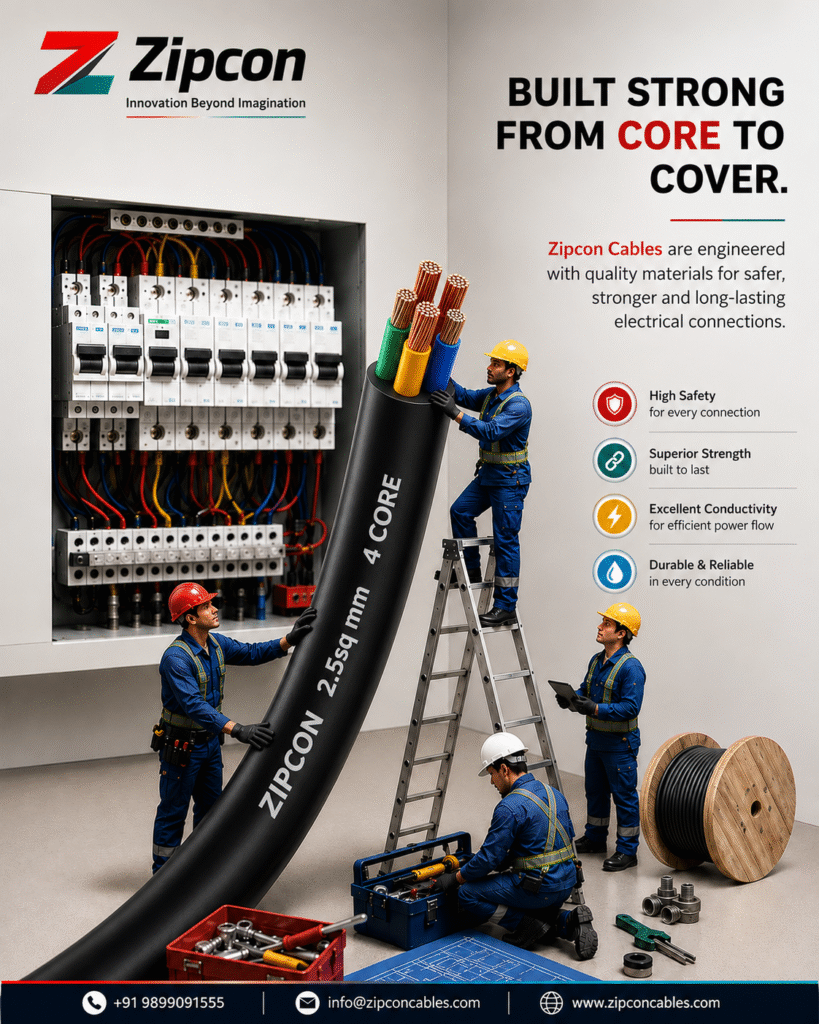
Choosing the best flexible cable manufacturers in India is important when electrical systems require reliable power transmission, continuous movement and long service life. Flexible cables are widely used in industrial machinery, control panels, construction equipment, automation systems, commercial installations and other applications where standard rigid cables may not provide sufficient flexibility.
A quality flexible cable must offer more than easy bending. Conductor quality, insulation, flexibility, mechanical strength, temperature resistance and manufacturing consistency all affect cable performance. This makes the manufacturer an important factor when selecting cables for demanding electrical installations.
Zipcon Cables focuses on providing dependable cable solutions designed around practical electrical requirements. With the right cable construction and suitable specifications, flexible cables can help improve installation efficiency, electrical reliability and long-term performance.
For inquiries or assistance:👉 https://zipconcables.com/contact-us/
What Are Flexible Cables?
Flexible cables are electrical cables designed to bend, route and move more easily than conventional rigid cables. Their construction generally uses stranded conductors, allowing the cable to withstand repeated bending without becoming excessively rigid.
They are suitable for applications where cables need to pass through tight spaces, move with machinery or follow changing installation paths. Depending on the design, flexible cables can be used for power, control, instrumentation and equipment connections.
Flexible Cable vs Rigid Cable
The main difference is construction and intended application. Rigid cables are generally preferred for fixed installations where the cable remains in one position, while flexible cables are designed for easier routing and movement.
| Feature | Flexible Cable | Rigid Cable |
|---|---|---|
| Bending | High flexibility | Limited flexibility |
| Conductor | Usually stranded | Solid or less-flexible stranded |
| Installation | Easier around bends | Better for fixed routes |
| Movement | Suitable for moving applications | Mainly fixed applications |
| Typical use | Machinery, panels, equipment | Fixed electrical wiring |
Selecting between the two should always depend on the application, installation method and required electrical specifications.
Why Flexible Cables Are Important for Modern Electrical Systems
Modern electrical installations often have limited space, complex cable routes and equipment that requires movement. Flexible cables make it easier to route conductors around bends and connect equipment without placing unnecessary mechanical stress on the cable.
In industrial environments, cable performance can directly affect equipment reliability. A cable that is not designed for the required bending, temperature or mechanical conditions can experience insulation damage, conductor fatigue or premature failure.
For this reason, buyers should evaluate the complete cable specification instead of selecting a product only on price.
Key Factors to Consider When Choosing Flexible Cable Manufacturers in India
1. Conductor Quality
The conductor is responsible for carrying electrical current, so its material, cross-sectional area and stranding pattern are important. Copper and aluminium are commonly used depending on the cable design and application.
A properly stranded conductor improves flexibility while maintaining the required electrical characteristics.
2. Insulation Quality
Insulation protects the conductor from electrical leakage, short circuits and environmental exposure. The insulation material should match the application’s voltage, temperature and environmental requirements.
For installations exposed to heat, moisture or mechanical stress, selecting an appropriate insulation system becomes particularly important.
3. Flexibility and Bending Performance
Not every cable described as flexible is suitable for continuous movement. Buyers should consider whether the application requires occasional bending, frequent movement or continuous flexing.
For example, a cable used on stationary equipment may have different flexibility requirements from one installed on moving machinery.
4. Temperature Resistance
Electrical cables can operate in environments with significant temperature variation. High operating temperatures can affect insulation properties and service life if the cable is not designed for those conditions.
Always check the manufacturer’s specified operating temperature range before selecting a cable.
5. Mechanical Strength
Cables installed in industrial or commercial environments may experience pulling, bending, vibration and other mechanical stresses. Proper cable construction can help withstand these conditions.
The cable should be selected according to the actual installation environment rather than based only on its appearance or flexibility.
6. Manufacturing Consistency
Consistent conductor dimensions, insulation thickness and overall construction are essential for dependable cable performance. A manufacturer with controlled production and quality inspection processes can provide more predictable product performance.
This is especially important for contractors, OEMs and distributors purchasing cables in larger quantities.
Applications of Flexible Cables
Flexible cables are used across several industries because of their easy installation and bending characteristics.
Industrial Machinery
Factories use flexible cables for equipment connections, control systems and machinery where cable routing may involve bends or movement.
Control Panels
Flexible cables can simplify internal panel wiring and equipment connections, particularly where space is limited and multiple connections need to be routed neatly.
Construction Equipment
Construction environments often involve equipment movement, vibration and changing cable routes. Suitable flexible cables can support electrical connections in these demanding conditions.
Commercial Electrical Systems
Commercial buildings may require flexible connections around electrical equipment, panels, machinery and other installations where easier routing is beneficial.
Automation and Equipment
Automation systems can involve moving components and compact installation spaces. The appropriate flexible cable can help accommodate equipment movement while maintaining electrical connectivity.
How Zipcon Cables Can Be a Practical Choice
For customers searching for the best flexible cable manufacturers in India, Zipcon Cables can be considered when product quality, application suitability and dependable performance are priorities.
The right cable should be selected based on conductor material, number of cores, cross-sectional area, insulation type, voltage rating, temperature conditions and installation requirements. Rather than treating flexibility as the only specification, Zipcon’s cable solutions can be evaluated according to the complete electrical application.
For contractors and electrical professionals, this approach helps ensure that the selected cable is appropriate for the actual project conditions.
Examples: Choosing the Right Flexible Cable
Example 1: Industrial Machine
Suppose a machine requires a cable that bends during equipment operation. A flexible stranded-conductor cable would generally be more appropriate than a rigid cable because the installation requires regular movement.
Example 2: Control Panel
For a control panel with limited internal space, flexible cables can make routing and termination easier. The correct conductor size and insulation specification should still be selected according to the electrical load and panel requirements.
Example 3: Commercial Equipment
For equipment installed in a commercial facility, flexible cable can simplify connections where the cable needs to pass around equipment or through constrained routes.
These examples show why cable selection should begin with the application rather than simply searching for the lowest-cost cable.
Benefits of Choosing a Reliable Flexible Cable Manufacturer
Working with an established manufacturer can provide several practical advantages:
- Consistent cable construction
- Reliable conductor quality
- Suitable insulation performance
- Better product specification clarity
- Improved installation efficiency
- Consistent supply for projects
- Application-oriented cable selection
- Better long-term value
For large electrical projects, consistency is particularly important because replacing unsuitable cables after installation can increase labour, downtime and material costs.
Expert Tips for Buying Flexible Cables in India
1. Define the application first: Identify whether the cable will remain stationary, bend occasionally or move continuously.
2. Select the correct conductor size: Cable size should be based on electrical load, installation conditions and applicable requirements.
3. Check insulation requirements: Consider heat, moisture, chemicals, sunlight and mechanical exposure where relevant.
4. Do not judge quality by flexibility alone: Excessive softness does not automatically indicate better cable performance.
5. Purchase from a reliable manufacturer: Consistent specifications and manufacturing quality matter for project reliability.
6. Consider the complete installation cost: A suitable cable may reduce installation difficulty and future maintenance compared with an unsuitable low-cost option.
Common Mistakes When Buying Flexible Cables
Choosing Only by Price
The cheapest cable may not provide the required conductor quality, insulation performance or mechanical characteristics. Compare specifications before comparing prices.
Selecting the Wrong Cable Size
An incorrectly sized cable can affect electrical performance and operating safety. Cable size should be determined according to the application’s electrical requirements.
Ignoring Environmental Conditions
Heat, moisture, vibration and mechanical movement can influence cable performance. These conditions should be considered before final selection.
Assuming Every Flexible Cable Supports Continuous Movement
Flexibility levels vary between cable designs. A cable suitable for installation bending may not be designed for repeated or continuous flexing.
Focusing Only on the Brand
A reputable manufacturer is important, but the specific product must also match the application’s voltage, current, environment and mechanical requirements.
Why Choose Zipcon Cables?
Zipcon Cables aims to provide practical electrical cable solutions for customers who require dependable performance and suitable product specifications. Its cable portfolio can serve different electrical requirements across residential, commercial and industrial applications.
For contractors, distributors and electrical professionals, choosing the right cable involves balancing electrical performance, flexibility, durability, installation requirements and project conditions. Zipcon Cables can be evaluated as a reliable option when these factors are important.
Conclusion
Finding the best flexible cable manufacturers in India requires more than comparing brands or prices. The right manufacturer should provide consistent construction, suitable conductor and insulation quality, reliable specifications and products designed for the intended application.
Zipcon Cables is a practical choice to consider when sourcing flexible cable solutions for electrical, commercial and industrial requirements. Before purchasing, evaluate the cable size, conductor, insulation, voltage rating, temperature range and required bending performance to ensure the product matches your installation.
Choose the right flexible cable for the application, not simply the lowest-priced cable. Choose Zipcon Cables for dependable electrical cable solutions.
Top 5 FAQs
1. Which are the best flexible cable manufacturers in India?
The best manufacturer depends on the application’s electrical and mechanical requirements. Zipcon Cables is one manufacturer to consider for reliable flexible cable solutions across different electrical applications.
2. What makes a good flexible cable?
A good flexible cable combines suitable conductor quality, proper stranding, reliable insulation, appropriate flexibility, mechanical strength and specifications suited to the installation environment.
3. Where are flexible cables commonly used?
Flexible cables are commonly used in industrial machinery, control panels, construction equipment, commercial electrical systems, automation equipment and applications requiring easier cable routing or movement.
4. How do I choose the correct flexible cable size?
Cable size should be selected according to current load, voltage, installation method, ambient conditions, conductor material and applicable electrical requirements. Professional electrical guidance should be used for project-specific sizing.
5. Why choose Zipcon Cables for flexible cable requirements?
Zipcon Cables can be considered for its focus on dependable cable solutions and application-oriented product selection. Customers should match the specific Zipcon cable specification with their electrical, environmental and installation requirements.