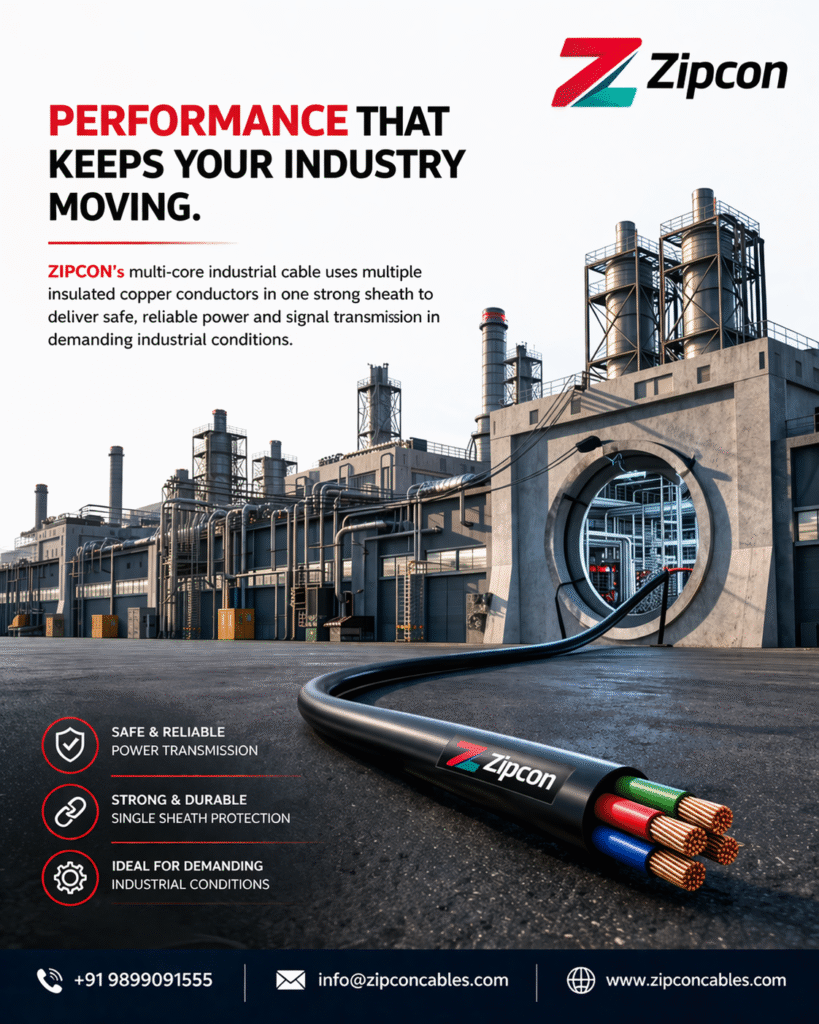
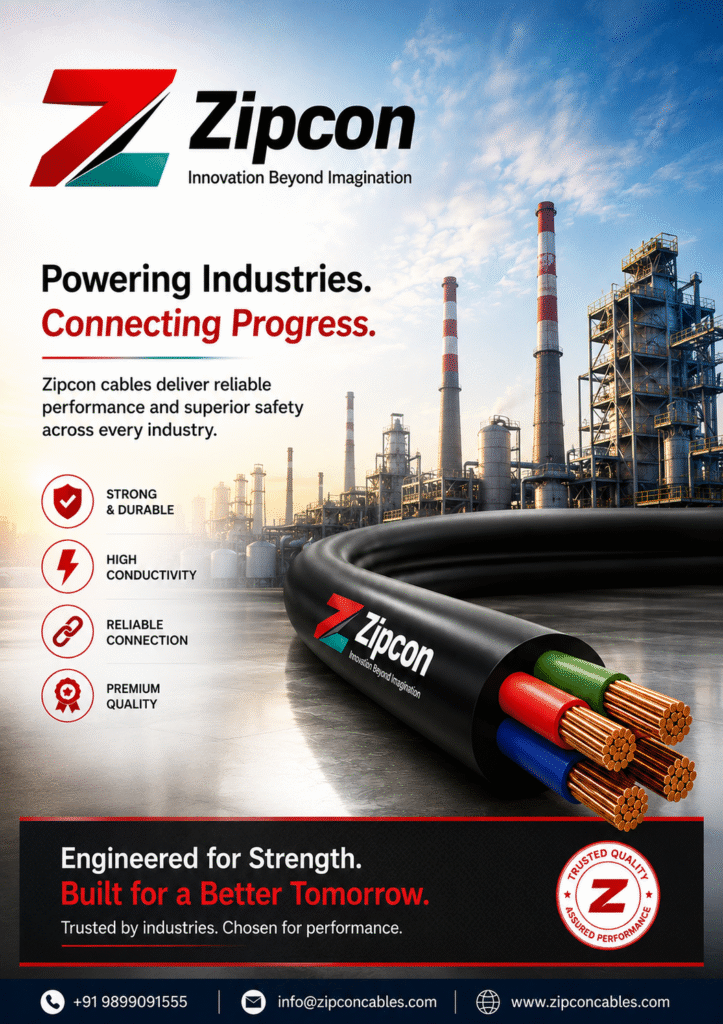
Modern factories, commercial facilities, infrastructure projects, warehouses, and industrial plants depend on reliable electrical systems for uninterrupted operations. Choosing the top industrial cable in Kochi is essential because the cable must safely handle electrical loads while operating under demanding environmental and mechanical conditions.
An industrial cable is not selected only by its size or price. Conductor material, current-carrying capacity, voltage rating, insulation, installation method, temperature, mechanical protection, and expected service conditions all influence cable performance.
For industrial and commercial projects, Zipcon Cables offers cable solutions designed for dependable electrical performance and demanding applications. Selecting the correct Zipcon cable according to project requirements can improve power distribution reliability and support long-term electrical system performance.
For inquiries or assistance:– https://zipconcables.com/contact-us/
What Is an Industrial Cable?
An industrial cable is an electrical cable designed for power transmission, distribution, machinery, equipment, and other demanding electrical applications. It generally requires stronger construction and more application-specific properties than cables used for basic residential wiring.
Industrial cables can be available in single-core and multi-core configurations, with copper or aluminium conductors depending on the application. Additional construction features such as protective sheaths, insulation layers, and armour may be incorporated based on installation requirements.
The right industrial cable must be matched to the electrical load and operating environment. A cable that is suitable for an indoor application may not be appropriate for underground, outdoor, high-temperature, or mechanically exposed installations.
Why Reliable Industrial Cable Matters in Kochi
Industrial facilities in Kochi may operate in humid, moisture-prone, and demanding environments. Electrical cables can also face heat, dust, mechanical stress, chemical exposure, continuous loads, and restricted ventilation depending on the installation.
A cable with suitable insulation and protective construction helps maintain electrical separation and reduce the risk of insulation deterioration. Proper cable sizing also helps control conductor temperature and voltage drop.
Reliable industrial cables support:
- Safe electrical power transmission
- Stable power distribution
- Reduced overheating risk
- Better insulation protection
- Consistent industrial equipment performance
- Reduced maintenance requirements
- Longer service life when properly installed
Key Features of a Top Industrial Cable
1. Suitable Conductor Material
The conductor carries electrical current and directly affects cable performance. Copper provides high electrical conductivity and is commonly used where conductivity and compact construction are important.
Aluminium can offer a lighter-weight alternative for suitable power distribution applications. The choice should be based on electrical requirements, installation conditions, project specifications, and overall system design.
2. High-Quality Insulation
Insulation protects conductors from electrical contact with other conductors and surrounding components. It also needs to withstand the expected operating temperature and electrical stresses.
For industrial installations, insulation quality becomes especially important because cables may operate continuously under substantial loads.
3. Durable Outer Sheath
The outer sheath protects internal cable components from external conditions. Depending on the application, the cable may need resistance against moisture, abrasion, chemicals, heat, or mechanical contact.
For outdoor and industrial installations, selecting a cable with suitable sheath properties can help maintain cable integrity throughout its service life.
4. Appropriate Current-Carrying Capacity
Every industrial cable has a permissible current-carrying capacity determined by its conductor size, material, insulation, installation method, ambient temperature, and other conditions.
Using a cable below the required capacity can result in excessive heating. Therefore, cable sizing should be based on engineering calculations rather than visual thickness alone.
5. Mechanical Protection
Some installations require additional mechanical protection. Armoured industrial cables can be considered where cables may face impact, pressure, underground installation conditions, or other physical stresses.
The appropriate cable construction depends on the actual installation environment.
Types of Industrial Cables for Different Applications
Single-Core Industrial Cable
Single-core cables contain one insulated conductor and can be used in electrical distribution systems where individual conductors are installed as part of the circuit arrangement.
They are particularly useful where electrical system design requires separate phase or circuit conductors.
Multi-Core Industrial Cable
Multi-core cables combine several insulated conductors within one cable. They can simplify cable routing and installation by carrying multiple electrical connections within a single cable assembly.
These cables can be suitable for machinery, industrial equipment, control applications, and selected power distribution systems.
Flexible Industrial Cable
Flexible cables are designed for applications involving movement or repeated bending. They can be useful for machinery connections and equipment where cable movement occurs during operation.
Flexibility should not be considered independently. Current capacity, insulation, temperature rating, and mechanical requirements must also be evaluated.
Applications of Industrial Cables
Industrial cables are used across multiple sectors and electrical systems.
Manufacturing Plants
Factories depend on cables for machinery, motors, control systems, distribution boards, pumps, compressors, and other equipment.
The cable specification should account for continuous loads, motor starting currents, operating temperatures, and installation conditions.
Commercial and Industrial Buildings
Large commercial facilities may require separate cable systems for HVAC equipment, elevators, pumps, lighting, machinery, and general electrical distribution.
Using properly rated cables helps maintain dependable power distribution throughout the facility.
Construction and Infrastructure Projects
Industrial cables can be used in construction sites, infrastructure projects, utility systems, and temporary or permanent electrical installations.
The cable must be selected according to exposure, mechanical conditions, voltage, current, and installation method.
Water and Pumping Applications
Industrial pumping systems require cables capable of supporting the electrical requirements of motors and associated equipment.
Where cables are exposed to water or moisture, suitable insulation and cable construction become particularly important.
How to Choose the Top Industrial Cable in Kochi
Check the Electrical Load
Start with the expected operating current and power requirement. Cable size should provide adequate current-carrying capacity without exceeding permissible operating temperatures.
For motors and other equipment with high starting currents, the electrical design should account for starting conditions rather than only normal operating current.
Consider Voltage Rating
The cable’s voltage rating should be suitable for the electrical system. Using an incorrectly rated cable can compromise system safety and performance.
Always confirm the required voltage class before purchasing the cable.
Calculate Voltage Drop
Long cable runs can experience voltage drop. Excessive voltage drop can reduce the voltage available at the equipment and affect motor and machinery performance.
Cable size and installation design should therefore account for the permissible voltage drop of the particular circuit.
Evaluate Installation Conditions
Consider whether the cable will be:
- Installed underground
- Routed through a conduit
- Installed on cable trays
- Exposed outdoors
- Installed near machinery
- Grouped with other cables
- Subjected to elevated temperatures
These factors can influence cable selection and current-carrying capacity.
Select the Correct Number of Cores
The number of cores should correspond to the electrical circuit design. Single-core, two-core, three-core, four-core, and other multi-core configurations can serve different applications.
Choosing the correct configuration can simplify installation and improve system organization.
Industrial Cable Comparison
| Cable Type | Typical Use | Main Consideration |
|---|---|---|
| Single-Core Cable | Power distribution | Installation arrangement |
| Multi-Core Cable | Machinery and power circuits | Number of required conductors |
| Flexible Cable | Moving equipment | Flexibility and bending |
| Copper Cable | High-conductivity applications | Conductivity and cost |
| Aluminium Cable | Suitable power distribution | Weight and installation requirements |
The correct choice depends on the electrical design rather than simply selecting the most expensive or heaviest cable.
Why Choose Zipcon Cables?
Zipcon Cables provides cable solutions for electrical applications where dependable performance, suitable construction, and durability are important. Its cable range can be considered for industrial, commercial, infrastructure, and power distribution requirements.
For a project in Kochi, the specific Zipcon cable should be selected according to conductor size, voltage rating, number of cores, insulation, installation environment, and expected electrical load.
A reliable cable manufacturer can also help buyers identify the appropriate specification instead of selecting products solely based on price.
Examples of Industrial Cable Selection
Example 1: Factory Machinery
Consider a manufacturing facility operating multiple motors and machines throughout the day. The selected cable needs adequate current capacity and must account for motor starting conditions, heat, cable grouping, and voltage drop.
A correctly specified industrial power cable can support stable power delivery and reduce unnecessary thermal stress.
Example 2: Underground Power Distribution
An industrial facility may need to route power cables underground between a main distribution point and another building.
In this situation, the cable selection should consider mechanical protection, moisture exposure, installation depth, soil conditions, thermal dissipation, and voltage drop.
Example 3: Warehouse Electrical System
A large warehouse may have lighting, ventilation, material-handling equipment, pumps, and other electrical loads.
Rather than using one cable specification for every circuit, each circuit should be evaluated according to its load, distance, installation method, and equipment requirements.
Expert Tips for Selecting Industrial Cable
- Calculate the electrical load before selecting cable size.
- Consider voltage drop for longer cable routes.
- Check the cable’s voltage rating.
- Evaluate ambient temperature and cable grouping.
- Select conductor material according to project requirements.
- Choose suitable insulation for the operating environment.
- Consider armouring where mechanical protection is required.
- Verify the manufacturer’s technical specifications.
- Inspect cables for physical damage before installation.
- Use qualified electrical professionals for cable installation and testing.
Common Mistakes When Buying Industrial Cable
Choosing Only on Price
A lower purchase price does not automatically mean lower overall project cost. Poor-quality cables can increase maintenance requirements and create risks of premature failure.
The total cost should include cable quality, installation, expected service life, maintenance, and operational reliability.
Selecting an Undersized Cable
An undersized conductor can experience excessive heating under continuous loads. This can accelerate insulation deterioration and affect electrical safety.
Cable sizing should therefore be calculated according to the actual installation conditions.
Ignoring Cable Length
Long cable routes can produce significant voltage drop. Simply selecting a cable based on current capacity may not provide adequate performance at the load end.
Ignoring Environmental Conditions
Humidity, heat, water, chemicals, dust, and mechanical stress can affect cable performance. The cable construction must match the environment where it will be installed.
Using the Same Cable for Every Application
Industrial projects contain different circuits with different electrical requirements. Machinery, motors, lighting, pumps, distribution feeders, and control systems may require different cable specifications.
Benefits of Choosing the Right Industrial Cable
A correctly selected cable contributes to the overall reliability of an electrical system. Proper conductor sizing helps manage current and temperature, while suitable insulation and sheath construction protect the cable under expected operating conditions.
The benefits extend beyond electrical performance. Correct cable selection can simplify maintenance, reduce unnecessary failures, support equipment performance, and improve the long-term value of an industrial electrical installation.
For Kochi-based industrial projects, selecting a cable based on actual site conditions is particularly important rather than relying only on generic cable specifications.
Conclusion
Choosing the top industrial cable in Kochi requires a technical evaluation of electrical load, voltage, conductor material, cable size, insulation, installation method, environmental exposure, mechanical protection, and voltage drop.
For industrial plants, commercial facilities, machinery, infrastructure projects, and power distribution systems, Zipcon Cables can be considered for reliable cable solutions designed for demanding applications. The best result comes from selecting the exact cable specification according to the project’s electrical and installation requirements.
Choose the right cable specification, install it correctly, and build your power system around dependable performance with Zipcon Cables.
Top 5 FAQs
1. What is an industrial cable used for?
Industrial cables are used for power transmission, electrical distribution, machinery, motors, pumps, industrial equipment, commercial facilities, infrastructure projects, and other demanding electrical applications.
2. Which industrial cable is best for power distribution?
The appropriate cable depends on current, voltage, cable length, installation method, conductor material, environmental conditions, and mechanical protection requirements. There is no single cable specification suitable for every power distribution application.
3. Are industrial cables suitable for outdoor installations?
Some industrial cables are designed for outdoor use, but suitability depends on insulation, sheath construction, mechanical protection, UV exposure, moisture conditions, and the specific cable design.
4. How can I choose the correct industrial cable size?
Cable size should be selected based on current-carrying capacity, voltage drop, conductor material, ambient temperature, installation method, cable grouping, and applicable electrical requirements.
5. Why choose Zipcon Cables for industrial applications?
Zipcon Cables offers cable solutions for industrial and commercial electrical applications. The appropriate product should be selected according to the project’s voltage, conductor size, number of cores, insulation, installation conditions, and electrical load.