
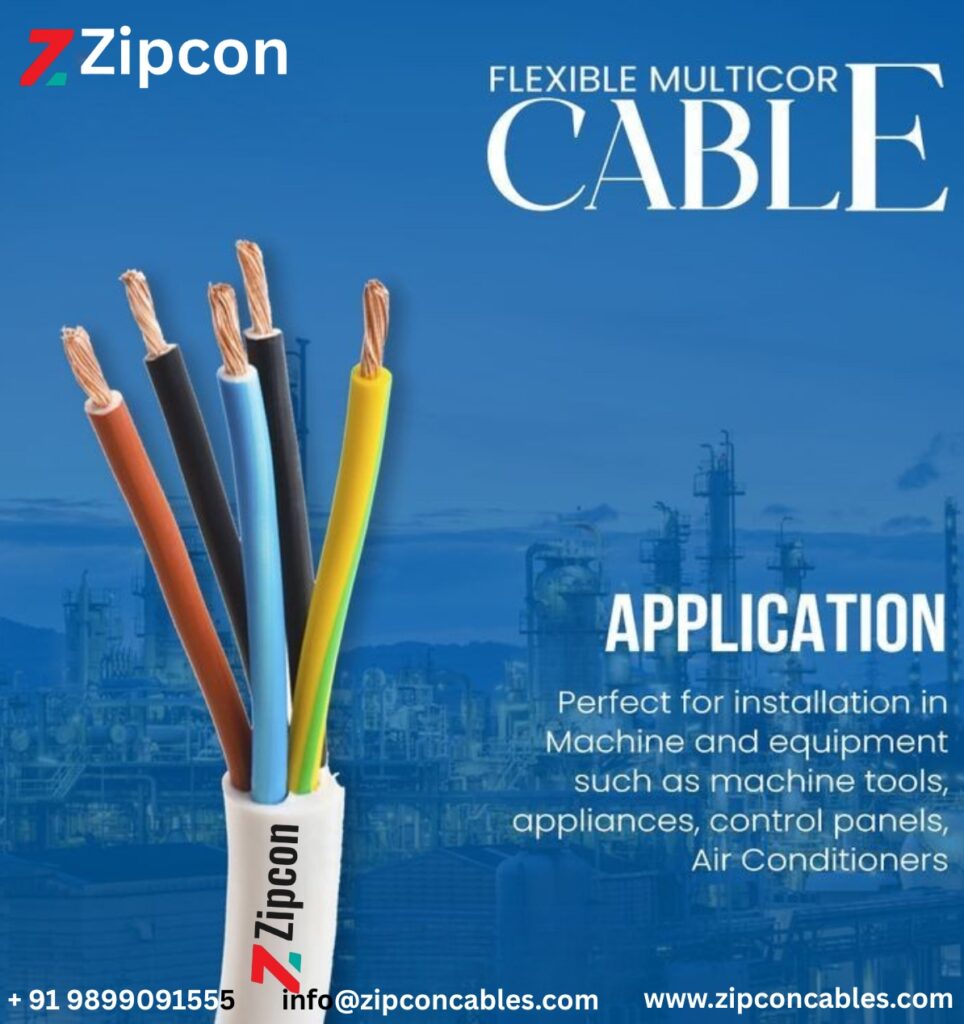
Safe and efficient power distribution depends heavily on the quality of the cables used in an electrical system. High-performance multicore cables provide an organized solution by combining multiple insulated conductors within a common protective sheath. This makes them suitable for applications where several electrical connections need to be routed through the same installation path.
From industrial machinery and control panels to commercial electrical systems, multicore cables help simplify wiring while supporting dependable power transmission. Their construction can provide electrical separation between cores, mechanical protection, and cleaner cable management compared with multiple individually routed wires.
Zipcon Cables focuses on practical cable solutions designed for demanding electrical applications. Selecting the right multicore cable from a quality manufacturer can help improve installation efficiency, electrical reliability, and long-term system performance.
Contact us today:- https://zipconcables.com/contact-us/
What Are High-Performance Multicore Cables?
A multicore cable consists of multiple individually insulated conductors assembled inside a common outer sheath. Each core can carry a separate electrical circuit, control signal, or power connection depending on the cable design and application.
The term high-performance multicore cables refers to cables selected or engineered to provide reliable performance under defined electrical, mechanical, and environmental conditions. Performance depends on factors such as conductor material, cross-sectional area, insulation system, sheath construction, temperature rating, voltage rating, and flexibility.
For example, an industrial machine may require several connections between its control panel and operating components. Instead of routing many separate cables, a suitable multicore cable can consolidate those connections into one organized cable assembly.
Why Multicore Cables Matter in Power Distribution
Power distribution systems require controlled and reliable movement of electrical energy from one point to another. Cable selection affects current carrying capacity, voltage drop, heat generation, insulation performance, and mechanical reliability.
Better Cable Organization
Multicore construction groups multiple conductors into a single cable. This can reduce wiring clutter and make cable routing easier, particularly in control panels, machinery, and structured electrical installations.
Efficient Installation
Routing one multicore cable can be more practical than installing several separate cables along the same path. It can reduce the number of individual cable runs and simplify installation planning.
Protection of Internal Conductors
The outer sheath provides another layer of protection around the insulated cores. Depending on the cable construction, this can help protect the cable from abrasion, handling, and other external stresses.
Easier Identification and Maintenance
When cores are properly identified, technicians can trace individual circuits within the multicore cable more efficiently. This can make inspection, troubleshooting, and maintenance more organized.
Construction of a High-Performance Multicore Cable
The performance of a multicore cable depends on how its individual components work together.
1. Conductors
Conductors carry the electrical current. Copper and aluminium are commonly used conductor materials, with the appropriate choice depending on the cable’s electrical and application requirements.
Conductor size must be selected according to factors such as expected current, voltage drop, installation method, ambient temperature, and applicable specifications.
2. Core Insulation
Each conductor receives an insulation layer that separates it electrically from other cores. Insulation selection is important because it must withstand the expected electrical and thermal conditions.
3. Core Assembly
The insulated cores are arranged into a unified cable structure. Proper construction helps maintain the cable’s physical integrity and supports consistent handling and installation.
4. Outer Sheath
The outer sheath protects the assembled cores against external mechanical and environmental conditions. Its material and construction should match the intended installation environment.
Applications of High-Performance Multicore Cables
Multicore cables can support a wide range of electrical and industrial applications.
Industrial Power Distribution
Factories and industrial facilities often have multiple electrical connections running between equipment, panels, motors, and distribution points. Multicore cables can help organize these connections while reducing cable-routing complexity.
Control Panels
Control panels contain numerous circuits for switches, sensors, relays, actuators, and other equipment. Multicore cables can provide an organized connection between panels and external components.
Industrial Machinery
Machinery frequently requires multiple electrical connections in a limited installation area. A suitable multicore cable can combine these connections while maintaining separation between individual cores.
Automation Systems
Automation equipment depends on reliable connections between controllers, sensors, drives, and machines. Correctly specified multicore cables can support these systems where multiple conductors need to follow a common route.
Commercial Electrical Installations
Commercial buildings may require structured cable routing for electrical equipment, control systems, and other installations. Multicore construction can help improve organization where multiple conductors share a route.
Multicore Cable vs Single-Core Cable
The choice between multicore and single-core cables depends on the system design.
| Feature | Multicore Cable | Single-Core Cable |
|---|---|---|
| Number of conductors | Multiple | One |
| Cable management | More consolidated | Requires multiple cable runs for multiple circuits |
| Installation | Useful for grouped connections | Useful for individual circuits |
| Outer protection | Common sheath around cores | Protection depends on installation |
| Application | Control, machinery, distribution and grouped connections | Individual power or circuit connections |
| Space management | Can reduce routing complexity | Multiple cables may require more routing space |
For installations where multiple conductors travel along the same route, multicore cables can provide a practical and organized solution.
Factors That Determine Multicore Cable Performance
Not every multicore cable is suitable for every power distribution application. The cable must be selected according to the operating conditions.
Current Carrying Capacity
The conductor must be appropriately sized for the expected electrical load. An unsuitable conductor size can contribute to excessive heating and voltage drop.
Voltage Rating
The cable’s voltage rating should be suitable for the electrical system. Using a cable outside its intended rating can compromise electrical safety and performance.
Temperature
Operating temperature affects conductor resistance and insulation performance. Cable selection should account for both ambient conditions and heat generated during operation.
Flexibility
Some installations require cables to bend during installation, while others involve repeated movement. The required flexibility should be considered before selecting a cable.
Environmental Exposure
Moisture, dust, chemicals, sunlight, abrasion, vibration, and mechanical impact can affect cable service life. The outer sheath and overall construction should be appropriate for the environment.
Examples of Multicore Cable Use
Example 1: Factory Control Panel
A manufacturing machine has several control circuits connecting its field components to a control cabinet. A multicore cable can group these connections into one organized cable route, reducing wiring complexity.
Example 2: Industrial Equipment
Equipment installed several metres away from a control system may require multiple conductors. Instead of routing separate wires individually, a suitable multicore cable can provide one consolidated connection.
Example 3: Structured Electrical Installation
Where multiple circuits need to follow the same route, multicore construction can simplify cable management and make the installation easier to inspect.
Benefits of Choosing Zipcon Cables
Zipcon Cables provides cable solutions for customers looking for dependable electrical performance and practical installation options. For multicore cable applications, the focus should be on matching the cable construction with the actual electrical and environmental requirements.
A good cable selection considers conductor size, core configuration, insulation, sheath, flexibility, operating temperature, voltage requirements, and installation conditions. This application-focused approach helps prevent problems caused by selecting a cable based only on price or appearance.
For contractors, industrial buyers, electrical professionals, and project managers, choosing a suitable manufacturer can also make it easier to maintain consistency across larger cable requirements.
Expert Tips for Selecting Multicore Cables
- Calculate the electrical load first: Determine current requirements before selecting conductor size.
- Choose the correct number of cores: Avoid selecting a cable with fewer cores than the actual system requires.
- Check voltage and temperature ratings: These specifications should match the operating conditions.
- Evaluate the installation environment: Consider moisture, heat, abrasion, chemicals, vibration, and outdoor exposure.
- Consider cable flexibility: Moving machinery may require a construction specifically designed for repeated bending.
- Prioritize construction quality: Conductor consistency, insulation quality, sheath performance, and manufacturing control all affect cable reliability.
- Follow applicable electrical standards: Ensure the selected cable meets the relevant requirements for its intended application.
Common Mistakes When Selecting Multicore Cables
Choosing Based Only on Price
The lowest purchase price does not necessarily represent the lowest overall cost. Poor cable performance can lead to premature replacement, maintenance issues, and installation problems.
Using an Undersized Conductor
An undersized conductor may not be appropriate for the required load. Conductor sizing should account for current, installation conditions, temperature, and voltage drop.
Ignoring Environmental Conditions
A cable exposed to moisture, heat, chemicals, or abrasion requires appropriate construction. Ignoring these factors can reduce service life.
Overlooking Flexibility
A cable designed for fixed installation should not automatically be used in an application involving continuous movement. Cable construction must match the mechanical duty.
Not Checking Technical Specifications
Core count, conductor size, insulation, sheath, voltage rating, temperature rating, and installation requirements should be checked before purchasing.
Why Choose Zipcon Cables for Power Distribution?
For safe power distribution, cable selection should be based on technical requirements rather than simply brand name or initial price. Zipcon Cables offers cable solutions aimed at supporting reliable electrical connections across industrial, commercial, and equipment-based applications.
The right multicore cable can help create a more organized electrical installation while providing the required protection and electrical performance. When ordering, providing complete application details allows the appropriate cable specification to be selected.
Conclusion
High-performance multicore cables provide an efficient way to manage multiple electrical connections within a single protected cable assembly. Their ability to combine several insulated conductors makes them useful for industrial machinery, control panels, automation systems, commercial installations, and structured power distribution.
For reliable results, cable selection should consider conductor size, core count, voltage, current, insulation, sheath, temperature, flexibility, and environmental exposure. Zipcon Cables can be considered for applications requiring durable and dependable multicore cable solutions.
A safe electrical installation starts with the right specification. Choose the cable according to the actual application, installation environment, and electrical load to achieve reliable long-term performance.
Top 5 FAQs
1. What are high-performance multicore cables?
High-performance multicore cables contain multiple insulated conductors within a common outer sheath and are selected for reliable electrical, mechanical, and environmental performance in defined applications.
2. Where are multicore cables used?
They are commonly used in industrial machinery, control panels, automation systems, electrical equipment, commercial installations, and applications where multiple conductors need to share a cable route.
3. How do multicore cables improve power distribution?
They consolidate multiple conductors into one cable assembly, which can simplify routing, improve cable organization, reduce wiring complexity, and provide common external protection.
4. How do I select the right multicore cable?
Consider the number of cores, conductor size, current, voltage, temperature, insulation, sheath, flexibility, installation method, and environmental conditions before selecting a cable.
5. Why choose Zipcon Cables for multicore cable requirements?
Zipcon Cables focuses on practical cable solutions for electrical and industrial applications. The appropriate Zipcon multicore cable should be selected according to the project’s electrical, mechanical, and environmental requirements.