
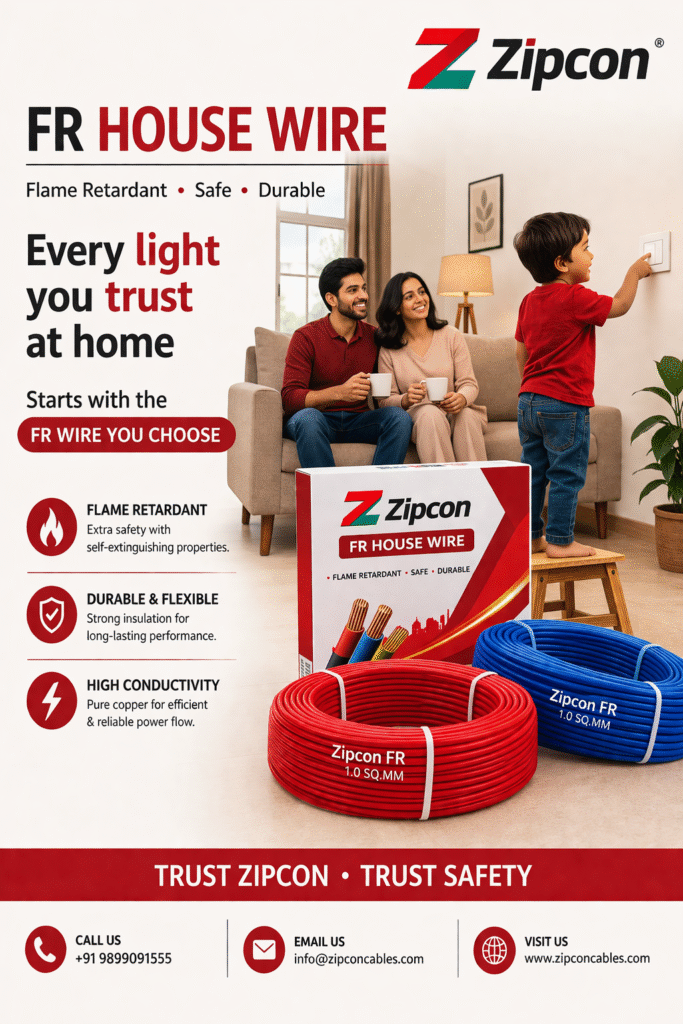
Choosing the best HRFR house wires in Gwalior is important for building a safe, reliable and long-lasting electrical system. House wires remain inside walls, conduits and ceilings for years, so insulation quality, conductor performance and resistance to heat are key factors when selecting wiring.
Zipcon Cables offers HRFR house wires designed for residential and commercial electrical applications where dependable performance and safety matter. HRFR technology helps provide improved resistance to heat and flame compared with conventional wiring, making it a practical choice for modern electrical installations.
For inquiries or assistance:– https://zipconcables.com/contact-us/
What Are HRFR House Wires?
HRFR stands for Heat Resistant Flame Retardant. HRFR house wires are manufactured with insulation designed to withstand elevated temperatures and help resist the spread of flame under specified conditions.
Electrical wires can generate heat when they carry current, particularly when circuits are heavily loaded. Good-quality insulation helps protect the conductor and surrounding installation from excessive thermal stress.
For homeowners and electricians, HRFR wires can therefore be a suitable choice for applications where electrical safety, insulation durability and heat resistance are important.
Why Choose HRFR House Wires in Gwalior?
Gwalior’s residential and commercial properties require electrical wiring that can handle everyday loads reliably. Fans, air conditioners, refrigerators, water pumps, televisions, lighting systems and other appliances can place different demands on household circuits.
1. Better Heat Resistance
Heat resistance is an important feature of modern house wiring. HRFR insulation is designed to maintain its performance under higher operating temperatures within the cable’s specified limits.
This can be particularly useful for circuits supplying appliances that operate for extended periods.
2. Flame-Retardant Insulation
Flame-retardant insulation can help limit the propagation of fire along the cable when exposed to a flame source, subject to the applicable test conditions and standards.
This makes HRFR wiring a valuable consideration for residential buildings, offices and commercial spaces where electrical safety is a priority.
3. Long-Term Wiring Performance
A house wire is expected to remain functional for years after installation. Quality insulation and a properly sized conductor help support consistent electrical performance and reduce premature deterioration.
Zipcon Cables focuses on reliable wiring solutions suitable for modern electrical installations.
4. Suitable for Modern Electrical Loads
Today’s homes use considerably more electrical equipment than traditional households. Air conditioners, geysers, microwaves, washing machines, computers and other appliances require appropriately designed circuits.
Using the correct HRFR wire size for each circuit helps ensure the wiring is matched to its intended electrical load.
Zipcon Cables: A Reliable Choice for House Wiring
Zipcon Cables provides house wiring solutions with a focus on safety, durability and dependable electrical performance. Its HRFR house wires are positioned as a practical option for residential and commercial wiring requirements.
For a new construction project, renovation or electrical upgrade, the right combination of wire size, conductor quality, insulation and installation practices is essential.
Rather than selecting a wire based only on price, compare its specifications, applicable standards, current-carrying capacity and intended application.
Choosing the Right HRFR House Wire Size
Wire size should be selected according to the electrical load, circuit length, installation method and applicable electrical requirements. Common house-wire sizes may include 1.0 sq mm, 1.5 sq mm, 2.5 sq mm, 4 sq mm and 6 sq mm, but the appropriate size depends on the actual circuit.
Typical Applications
| Wire Size | Common Application* |
|---|---|
| 1.0 sq mm | Lighting and low-load circuits |
| 1.5 sq mm | Lighting and general-purpose circuits |
| 2.5 sq mm | Socket and moderate-load circuits |
| 4 sq mm | Higher-load circuits |
| 6 sq mm | Heavy-load applications and selected feeders |
*Actual sizing should be determined by a qualified electrician based on load calculation, installation conditions and applicable electrical standards.
Using an undersized wire for a high-load appliance can increase heating and create unnecessary electrical risk. Oversizing is not automatically harmful, but it may increase installation cost without providing a practical benefit for a particular circuit.
Where Can HRFR House Wires Be Used?
HRFR house wires can be considered for several electrical installations, including:
- Residential houses and apartments
- Villas and independent homes
- Offices and commercial buildings
- Shops and retail spaces
- Schools and institutional buildings
- Renovation and rewiring projects
- Lighting and socket circuits
- Appliance-specific electrical circuits
The exact cable construction and suitability should always be verified against the manufacturer’s specifications and project requirements.
Example: Selecting Wiring for a New Home
Consider a new home with separate circuits for lighting, general sockets, kitchen appliances and air conditioners.
Instead of connecting every appliance to one circuit, the electrician can divide the electrical system into appropriately rated circuits. Each circuit can then be provided with the correct wire size and suitable protective device.
For example, lighting circuits may require smaller conductors than circuits supplying high-power appliances. This approach improves load management and makes electrical maintenance easier.
HRFR House Wires vs Conventional House Wires
The main distinction is the insulation’s performance characteristics.
Conventional wires may be suitable for many standard applications when correctly specified and installed. HRFR wires, however, are designed with enhanced heat-resistance and flame-retardant properties.
For projects where additional thermal and flame-performance characteristics are desired, HRFR house wires can offer an appropriate wiring solution.
The decision should ultimately be based on the required specifications rather than simply choosing a wire because it carries an HRFR label.
Expert Tips for Buying House Wires in Gwalior
Check the Wire Specifications
Before purchasing, check the conductor material, cross-sectional area, insulation type, voltage rating and relevant certification or compliance information.
Match Wire Size to Load
Never select a wire size only because it is commonly used. Calculate the expected load and consider circuit length, installation conditions and voltage-drop requirements.
Use Quality Protection Devices
Good wiring should be combined with correctly rated MCBs, RCCBs/RCBOs and other protective devices. Cable selection and circuit protection should work together.
Avoid Mixing Poor-Quality Materials
Using premium wires with low-quality accessories can compromise the overall electrical installation. Switches, sockets, connectors, distribution boards and protective devices should also be selected carefully.
Buy From a Reliable Source
Purchase Zipcon HRFR house wires through reliable distributors or dealers and verify product markings, packaging and specifications before installation.
Common Mistakes to Avoid
Choosing wire based only on price: The cheapest option may not provide the required insulation or conductor performance.
Using the wrong wire size: A conductor that is not suitable for the circuit load can cause excessive heating.
Ignoring voltage drop: Long cable runs can require additional consideration for conductor size.
Overloading sockets: Multiple high-power appliances should not be connected to a circuit that was not designed for their combined load.
Poor installation practices: Loose connections, damaged insulation, improper bending and unsuitable joints can affect electrical safety even when the cable itself is high quality.
Why Zipcon HRFR House Wires Can Be a Smart Choice
For customers looking for safe and durable house wires in Gwalior, Zipcon HRFR cables provide a solution focused on heat resistance, flame-retardant insulation and dependable everyday wiring performance.
The best electrical installation is not determined by the cable alone. Correct sizing, proper installation, suitable circuit protection and quality accessories are equally important.
For residential and commercial projects, consider Zipcon Cables HRFR house wires when selecting wiring designed for modern electrical requirements.
Conclusion
Choosing the best HRFR house wires in Gwalior means looking beyond the initial purchase price. Heat resistance, flame-retardant properties, conductor quality, correct wire sizing and installation standards all contribute to a safer electrical system.
Zipcon Cables offers HRFR house wiring solutions for customers seeking reliable and durable electrical performance. Select the appropriate wire size for every circuit, use compatible protection devices and have the installation completed by a qualified electrician.
For dependable house wiring, choose the right specifications, choose quality materials, and choose Zipcon Cables.
Top 5 FAQs
1. What are HRFR house wires?
HRFR house wires are electrical wires with insulation designed to provide enhanced Heat Resistance and Flame Retardance compared with standard insulation types. They are commonly considered for residential and commercial electrical installations.
2. Why should I choose HRFR wires for house wiring?
HRFR wires can provide improved thermal and flame-performance characteristics, making them a suitable option where enhanced electrical safety and insulation performance are required.
3. Which HRFR wire size is best for a house?
There is no single wire size that is best for an entire house. Different circuits require different conductor sizes depending on their electrical load, circuit length, installation method and applicable requirements.
4. Are Zipcon HRFR house wires suitable for residential wiring?
Zipcon HRFR house wires are intended for house-wiring applications where the specified cable characteristics match the electrical installation requirements. Always check the product specifications and use the appropriate size.
5. How can I choose the best house wire in Gwalior?
Compare conductor quality, insulation type, wire size, voltage rating, applicable standards, manufacturer specifications and intended application. For installation, consult a qualified electrician to ensure correct sizing and protection.