
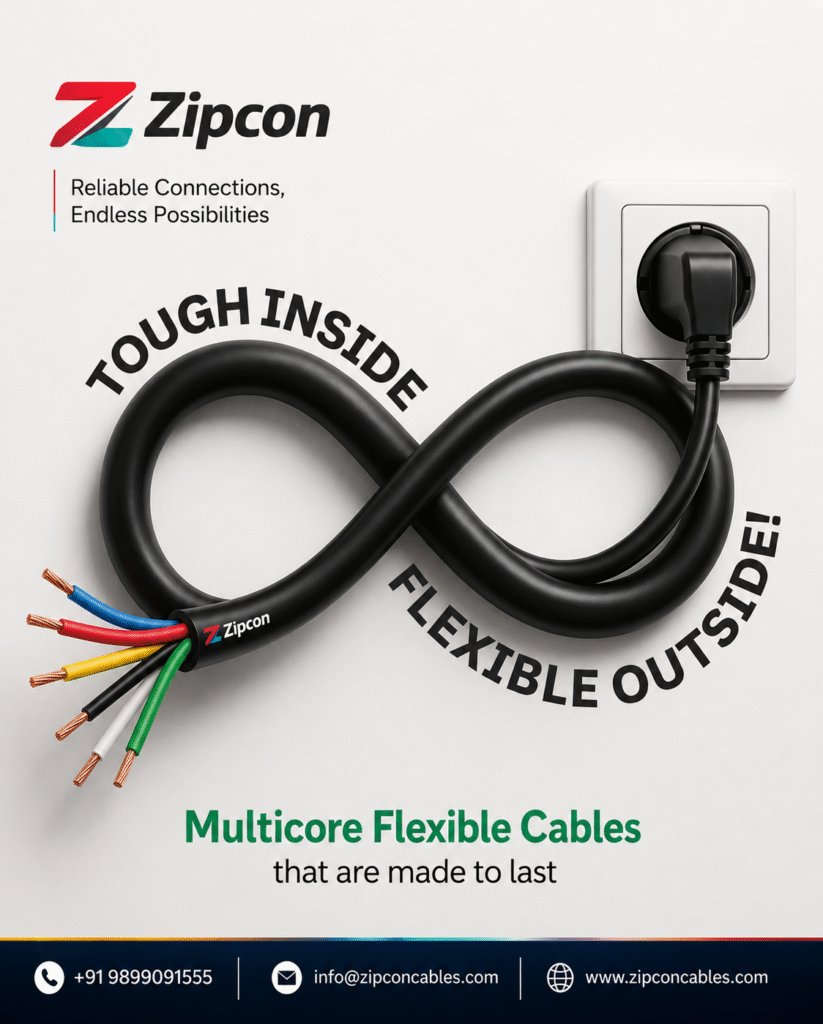
Finding the right multicore cable in Kochi is important for industrial plants, commercial buildings, control panels, machinery, automation systems, and power distribution networks. A suitable multicore cable simplifies wiring, improves connection reliability, and helps electrical systems operate safely under demanding conditions.
Kochi’s industrial and commercial environments often require cables that can handle continuous operation, temperature variations, moisture, mechanical stress, and complex electrical installations. Choosing a cable only by price can result in insulation failures, difficult maintenance, frequent replacements, and unnecessary downtime.
Zipcon Cables offers multicore cable solutions designed for applications where dependable electrical connectivity, insulation performance, flexibility, and long service life matter. Selecting the right conductor material, number of cores, cross-sectional area, insulation, voltage rating, and installation type can significantly improve overall system performance.
For inquiries or assistance: https://zipconcables.com/contact-us/
What Is a Multicore Cable?
A multicore cable contains multiple individually insulated conductors enclosed within a common outer sheath. Instead of installing several separate single-core cables, multiple electrical circuits or signals can be routed through one organized cable assembly.
For example, a four-core cable can be used where four electrical conductors are required within the same installation. Larger multicore configurations are commonly used for control systems, industrial machinery, automation equipment, instrumentation, and commercial electrical networks.
The construction of the cable depends on its intended application. Conductor material, insulation compound, sheath material, conductor size, number of cores, voltage rating, and flexibility all influence its suitability for a particular electrical system.
Why Multicore Cables Are Important in Kochi
Industrial and commercial installations in Kochi can involve challenging operating conditions. Manufacturing facilities, warehouses, commercial complexes, workshops, processing units, and infrastructure projects may require cables to operate continuously while exposed to heat, humidity, dust, vibration, and mechanical movement.
A properly selected industrial multicore cable keeps multiple connections organized and reduces the complexity associated with installing numerous individual cables. This can make installation, identification, inspection, and maintenance more manageable.
Multicore cables can also help create cleaner electrical layouts. When the cable specification matches the application’s current, voltage, environmental, and mechanical requirements, it can contribute to dependable long-term operation.
Key Applications of Multicore Cable in Industrial & Commercial Projects
1. Industrial Machinery
Industrial machines frequently require several electrical connections for motors, controls, sensors, switches, and auxiliary equipment. Multicore cables can consolidate these connections into a structured cable arrangement.
This is particularly useful in manufacturing environments where equipment is installed in compact areas and wiring must remain organized.
2. Control Panels
Control panels often contain multiple circuits connecting switches, relays, indicators, controllers, and other components. Multicore cables can simplify these connections and reduce the number of separate cable runs.
Proper core identification is particularly important in control-panel installations because it makes troubleshooting and maintenance easier.
3. Automation Systems
Modern industrial automation requires reliable connections between machines, controllers, sensors, and other equipment. Depending on the system, multicore cables can be used for power, control, or signal-related applications.
The cable should be selected according to the electrical characteristics of the connected equipment rather than simply choosing the largest available cable.
4. Commercial Buildings
Commercial buildings can use multicore cables in electrical distribution, equipment connections, control systems, HVAC-related installations, and other electrical infrastructure.
In larger projects, organized cable routing becomes increasingly important because maintenance teams need clear and accessible electrical connections.
5. Pumps and Industrial Equipment
Pumping systems and industrial equipment can require multiple conductors for power and control functions. A correctly specified multicore cable can provide a practical wiring solution where several conductors need to be routed together.
The actual cable construction should always be matched to the equipment manufacturer’s electrical requirements and installation environment.
Multicore Cable vs Single-Core Cable
Both multicore and single-core cables have important applications, but their practical advantages differ.
| Feature | Multicore Cable | Single-Core Cable |
|---|---|---|
| Construction | Multiple insulated conductors in one sheath | One insulated conductor |
| Wiring organization | More compact | Requires multiple cable runs |
| Installation | Convenient for multiple connections | Useful for individual circuits |
| Maintenance | Easier core grouping | Individual cables are easy to replace |
| Typical applications | Control, machinery, commercial and industrial wiring | Power distribution and specialized installations |
| Space requirement | Generally more organized | Can require additional routing space |
For installations requiring several conductors in the same route, multicore cable can provide a cleaner and more organized solution.
How to Choose the Best Multicore Cable in Kochi
Choosing the best cable requires more than checking the number of cores. The following specifications should be evaluated before purchasing.
1. Number of Cores
Determine how many conductors the application actually requires. Common configurations include 2-core, 3-core, 4-core, and higher-core arrangements.
Selecting the correct number of cores avoids unnecessary wiring and allows the installation to remain organized.
2. Conductor Material
Copper and aluminium are commonly used conductor materials, depending on the application and required electrical characteristics.
Copper generally provides high conductivity and is widely selected for applications where compact construction and efficient current transmission are important. Aluminium can be considered for applications where weight and cost considerations are significant.
3. Cable Size
Cable size should be selected according to current carrying capacity, voltage drop, installation conditions, conductor material, and applicable electrical requirements.
For example, a motor installation with a higher current demand may require a larger conductor size than a low-current control circuit. Oversizing or undersizing without proper calculation can create unnecessary cost or performance problems.
4. Insulation Quality
The insulation protects conductors from electrical contact, moisture, environmental exposure, and physical damage.
For industrial and commercial applications, insulation must be suitable for the expected temperature, voltage, installation conditions, and mechanical environment.
5. Voltage Rating
The cable’s voltage rating must match or exceed the requirements of the electrical system.
Using a cable without considering its rated voltage can compromise electrical safety and system reliability.
6. Flexibility
If the cable will be installed in equipment that experiences movement or vibration, flexibility becomes an important consideration.
Flexible multicore cables can be more suitable for applications involving repeated movement, bending, or equipment operation.
7. Environmental Conditions
Kochi’s humid coastal environment makes environmental suitability particularly important for many installations. Cables may encounter moisture, heat, dust, chemicals, or mechanical stress depending on the location.
The insulation and outer sheath should therefore be selected according to actual installation conditions.
Benefits of Using Quality Multicore Cables
Organized Electrical Installation
Multiple conductors are contained within one cable assembly, helping reduce cable clutter and making routing more systematic.
Easier Identification and Maintenance
When cores are properly identified, electricians and maintenance teams can trace individual connections more efficiently during inspection or troubleshooting.
Better Space Utilization
A multicore arrangement can reduce the number of separate cable runs required for systems involving multiple connections.
Reliable Electrical Performance
A properly designed cable with suitable conductor size and insulation can provide stable electrical performance under its intended operating conditions.
Reduced Installation Complexity
Using one appropriate multicore cable instead of several individual cables can simplify certain installations and improve overall cable management.
Why Zipcon Cables for Multicore Cable Requirements?
Zipcon Cables focuses on cable solutions for applications where electrical reliability, insulation performance, durability, and practical installation are important.
For industrial and commercial users, the right multicore cable should be selected based on the actual application rather than using a generic specification. Factors such as core configuration, conductor size, insulation, voltage rating, flexibility, and operating environment should be considered before final selection.
Zipcon’s cable solutions can be considered for applications requiring dependable connectivity across industrial equipment, commercial installations, control systems, machinery, and other electrical applications.
Examples of Multicore Cable Selection
Example 1: Industrial Control Panel
Suppose a control panel requires several connections between switches, indicators, relays, and control equipment. Instead of routing numerous independent wires across the installation, an appropriately configured multicore cable can consolidate the required conductors.
This produces a more organized wiring arrangement and can make future troubleshooting easier.
Example 2: Commercial Equipment
A commercial facility may have equipment requiring multiple electrical connections in a limited routing space. A suitable multicore cable can keep these connections grouped together while reducing cable congestion.
The final cable selection should consider the equipment’s current, voltage, installation route, and environmental conditions.
Example 3: Industrial Machinery
A machine may require multiple conductors for power and control functions. The cable must be selected based on the machine manufacturer’s requirements, operating temperature, movement, current demand, and installation method.
In such applications, flexibility and mechanical durability can be as important as electrical capacity.
Expert Tips for Buying Multicore Cable in Kochi
1. Calculate the electrical requirement first.
Do not select a cable simply because it has a larger conductor size. Current capacity and voltage drop should be evaluated according to the installation.
2. Consider the installation environment.
Indoor, outdoor, humid, high-temperature, chemically exposed, and mechanically demanding installations can require different cable constructions.
3. Check the complete specification.
Review conductor material, number of cores, conductor size, insulation, voltage rating, sheath, temperature rating, and applicable standards.
4. Avoid choosing solely by price.
A low initial purchase price can become expensive if poor-quality insulation or unsuitable construction results in premature failure.
5. Buy from a reliable cable manufacturer or supplier.
Consistent manufacturing quality and proper technical specifications are important when cables are being used in critical industrial or commercial systems.
6. Match the cable to the equipment.
Always verify the equipment manufacturer’s cable requirements before finalizing the product.
Common Mistakes When Choosing Multicore Cable
Choosing the Wrong Cable Size
A cable that is too small for the required current can experience excessive heating and voltage drop. Cable sizing should be based on the actual electrical load and installation conditions.
Ignoring Voltage Drop
Long cable runs can experience voltage drop. This is particularly important for installations where equipment is located far from the electrical source.
Selecting Cable Only by Core Count
The number of cores is only one part of cable selection. Conductor size, insulation, voltage rating, temperature, flexibility, and environmental suitability also matter.
Ignoring Humidity and Moisture
In coastal and humid environments, environmental conditions should be considered when selecting insulation and sheath construction.
Using an Industrial Cable for the Wrong Application
Not every multicore cable is suitable for every industrial application. Power, control, instrumentation, and flexible applications may require different cable constructions.
Focusing Only on Initial Cost
Cable replacement, downtime, maintenance, and installation costs can exceed the initial price difference between a low-cost and properly specified cable.
Why Quality Matters More in Industrial Applications
Industrial cable failure can affect much more than an individual electrical connection. It can interrupt production, damage equipment, increase maintenance requirements, and create safety concerns.
For this reason, industrial users should evaluate the complete cable specification instead of choosing based on price alone. A cable selected for the correct current, voltage, environment, and mechanical conditions is more likely to deliver dependable service.
For businesses in Kochi, selecting a reliable multicore cable supplier in Kochi and verifying the cable’s technical specifications before purchase can help prevent avoidable installation and maintenance issues.
Multicore Cable for Kochi’s Commercial & Industrial Growth
Kochi has a wide range of commercial, infrastructure, manufacturing, logistics, marine-related, and industrial activities. These environments require electrical systems that can remain dependable under continuous operating conditions.
From machinery and control panels to commercial equipment and industrial installations, multicore cables provide a practical way to organize multiple electrical connections. However, the best cable is always the one that matches the specific electrical and environmental requirements of the application.
Choosing a trusted manufacturer such as Zipcon Cables can help businesses focus on cable quality, appropriate specifications, and application-based selection rather than making decisions based only on price.
Conclusion
The best multicore cable in Kochi is not simply the cable with the highest number of cores or the lowest price. It should provide the right combination of conductor size, core configuration, insulation, voltage rating, flexibility, mechanical strength, and environmental suitability for the intended application.
For industrial plants, commercial buildings, machinery, control panels, automation systems, and equipment installations, proper cable selection can improve wiring organization and long-term electrical reliability.
If you are sourcing multicore cables for an industrial or commercial project, evaluate your load requirements, installation environment, cable route, required cores, and applicable specifications before purchasing. Zipcon Cables can be considered when dependable cable construction and application-focused solutions are priorities.
Top 5 FAQs
1. What is a multicore cable used for?
A multicore cable is used when multiple insulated conductors need to be routed together. It is commonly used in industrial machinery, control panels, automation systems, commercial equipment, and electrical installations.
2. How do I choose the right multicore cable?
Consider the number of cores, conductor material, conductor size, current requirement, voltage rating, insulation, flexibility, installation method, temperature, and environmental conditions before selecting a cable.
3. Is multicore cable suitable for industrial applications?
Yes. Multicore cables are widely used in industrial applications such as machinery, control panels, automation equipment, pumps, and electrical systems, provided the cable specification matches the application.
4. Why is insulation important in multicore cables?
Insulation separates individual conductors and protects them against electrical contact and environmental factors. Suitable insulation is essential for safe and reliable cable operation.
5. Why choose Zipcon Cables for multicore cable requirements?
Zipcon Cables provides cable solutions focused on dependable electrical performance, insulation quality, durability, and application suitability. The appropriate Zipcon cable should be selected according to the project’s specific electrical and environmental requirements.