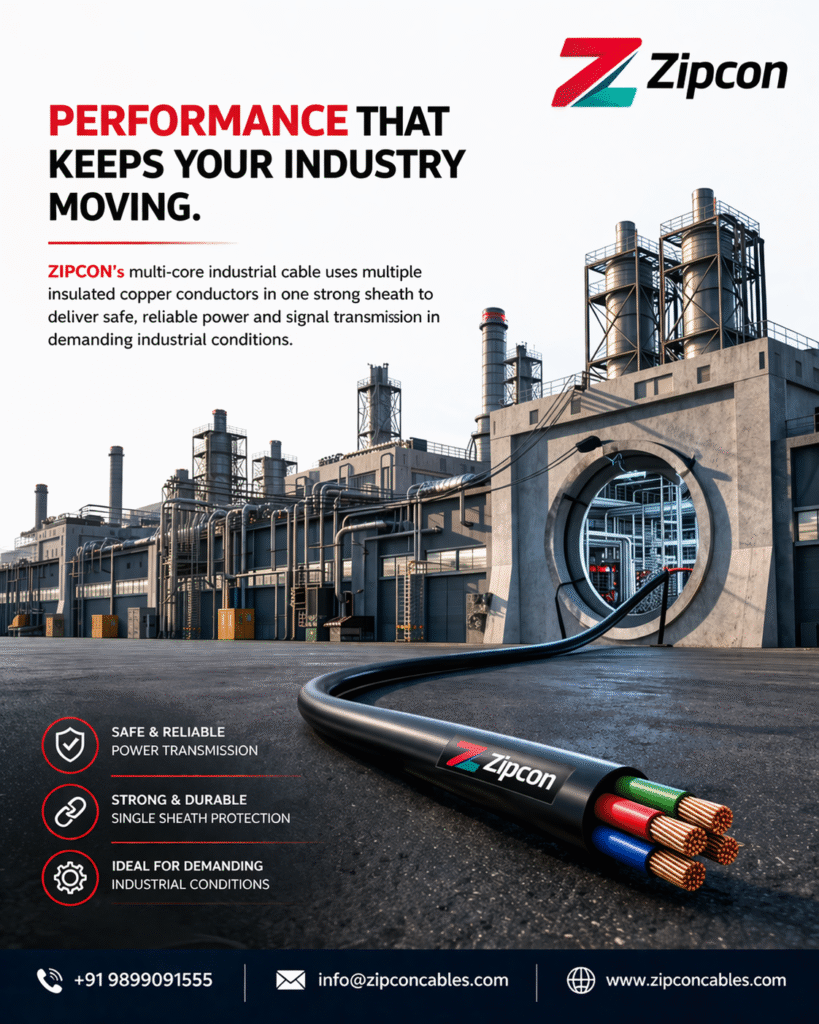
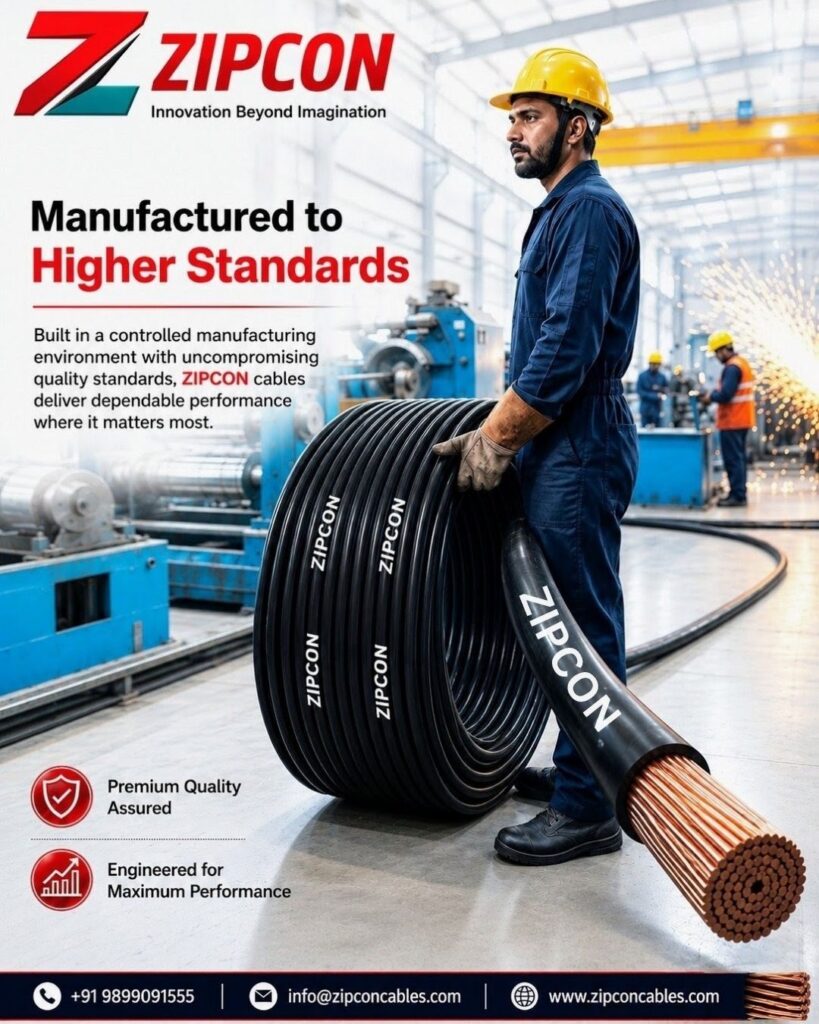
The best industrial power cable in Kozhikode is essential for maintaining safe, stable and efficient electrical systems. Industrial facilities handle higher electrical loads than residential buildings, making cable quality, insulation, conductor performance and installation standards critical for long-term reliability.
A suitable industrial power cable should withstand continuous electrical loads, temperature variations, mechanical stress and demanding operating environments. The right cable also helps reduce voltage drop, overheating risks, power losses and unexpected maintenance issues.
For industries, workshops, commercial buildings, pumping systems and heavy electrical installations, Zipcon Cables offers dependable cable solutions designed around performance, durability and safe power transmission.
For inquiries or assistance:– https://zipconcables.com/contact-us/
Why Industrial Power Cable Quality Matters
Industrial electrical systems often operate continuously and power equipment such as motors, pumps, compressors, machinery, control panels and production systems. A cable that is poorly selected for the application can experience excessive heating, insulation damage and premature failure.
High-quality industrial cables provide better electrical conductivity and insulation performance. Correct cable selection also ensures that the conductor can safely carry the required current without excessive voltage drop.
For example, a cable selected for a heavy motor load needs different considerations from one used for a lighting circuit. Load current, installation distance, ambient temperature and installation method all influence the appropriate cable specification.
What Makes a Good Industrial Power Cable?
1. High-Quality Conductors
The conductor is responsible for carrying electrical current. Copper and aluminium are commonly used depending on the application, installation requirements and project specifications.
A good industrial cable should provide consistent conductor quality and appropriate cross-sectional area. Proper conductor sizing helps maintain current-carrying capacity and reduces unnecessary electrical losses.
2. Reliable Insulation
Industrial cables need insulation that can withstand electrical stress and operating temperatures. Quality PVC or other application-specific insulation materials help protect the conductor from short circuits, moisture and external influences.
The insulation should remain stable during regular operation instead of becoming brittle, cracked or damaged prematurely.
3. Strong Mechanical Protection
Industrial environments can expose cables to vibration, movement, abrasion, moisture and accidental physical stress. Depending on the installation, cables may require additional protection or suitable construction for demanding conditions.
Selecting the correct cable construction is therefore as important as selecting the conductor size.
4. Better Heat Resistance
Electrical cables generate heat when carrying current. Excessive temperature can accelerate insulation ageing and reduce cable service life.
A suitable industrial power cable should be selected according to its current rating, installation environment and permissible operating temperature.
5. Consistent Manufacturing Quality
Manufacturing consistency matters because industrial electrical systems depend on predictable cable performance. Uniform conductor construction, insulation thickness and dimensional accuracy contribute to reliable installation and operation.
For industrial projects, choosing cables from an established manufacturer can provide greater confidence in product consistency and technical specifications.
Industrial Power Cable Applications in Kozhikode
The right industrial cable depends on where and how it will be installed. Common applications include:
Manufacturing Units
Factories require reliable power distribution for production machinery, motors, control panels and other electrical equipment. Industrial-grade cables help support continuous operation and stable power transmission.
Commercial Buildings
Large commercial buildings may have higher electrical loads from HVAC systems, elevators, pumps, lighting and other equipment. Properly selected power cables help distribute electricity safely throughout the facility.
Water Pumping Systems
Industrial and commercial pumping systems require cables capable of handling motor loads. Cable selection should consider motor power, cable length, installation conditions and voltage drop.
Workshops and Small Industries
Welding equipment, compressors, motors and heavy machinery can create demanding electrical conditions. Correctly sized industrial cables help reduce overheating and electrical performance problems.
Infrastructure Projects
Construction sites and infrastructure projects often require temporary or permanent electrical distribution. Cable selection should account for environmental exposure, mechanical protection and expected load.
How to Select the Best Industrial Power Cable
Check the Electrical Load
Start by calculating the expected current demand of the equipment or electrical system. Cable size should be selected according to the actual load rather than simply choosing a larger or smaller cable based on appearance.
For motor applications, starting current and operating conditions should also be considered.
Consider Cable Length
Long cable runs can result in voltage drop. A cable that is suitable for a short installation may not provide the same performance over a substantially longer distance.
For long industrial cable routes, voltage-drop calculations should be included during cable selection.
Choose the Correct Conductor Material
Copper generally provides high electrical conductivity and is widely used where conductivity and compact installation are important. Aluminium can be useful for applications where weight and cost considerations are significant.
The choice should be based on project requirements rather than price alone.
Evaluate the Installation Environment
Consider whether the cable will be installed indoors, outdoors, underground, in conduits, cable trays or exposed industrial areas.
Temperature, moisture, chemicals, mechanical stress and installation conditions can influence the appropriate cable construction.
Verify Technical Specifications
Before purchasing an industrial power cable, check important specifications such as:
- Conductor material
- Cross-sectional area
- Number of cores
- Voltage rating
- Insulation material
- Current-carrying capacity
- Temperature rating
- Cable construction
- Applicable standards and certifications
- Installation requirements
Industrial Cable Size and Application Example
Cable size should never be selected only by looking at the equipment’s rated power. Electrical load, supply voltage, cable length, installation method, ambient temperature and permissible voltage drop all influence the final selection.
For example, a motor installed close to a distribution panel may require a different cable arrangement from the same motor installed several hundred metres away. The longer installation can experience greater voltage drop, requiring engineering calculations and potentially a different conductor size.
For this reason, industrial projects should use cable sizing based on electrical calculations and applicable installation standards.
Why Choose Zipcon Cables for Industrial Applications?
Zipcon Cables can be considered for industrial power distribution where dependable construction and consistent electrical performance are important.
The brand’s cable solutions are suitable for applications where safety, durability and reliable power transmission are key requirements. Choosing the appropriate Zipcon cable specification according to the application’s load and installation conditions can help create a dependable electrical system.
For industrial buyers in Kozhikode, working with a reliable cable supplier also makes it easier to select the appropriate conductor size, core configuration and cable construction for a specific project.
Examples of Industrial Power Cable Selection
Example 1: Factory Motor
A manufacturing unit installing a high-power motor should consider motor load, starting current, cable length, installation method and ambient temperature before selecting the cable.
A properly sized industrial power cable can help maintain stable motor operation and minimize excessive heating.
Example 2: Commercial Building
A commercial building may require separate cable systems for elevators, HVAC equipment, pumps, lighting and general power distribution.
Each circuit should be evaluated according to its expected load instead of using one generic cable size for the entire building.
Example 3: Industrial Pump
For a pump installed at a considerable distance from the electrical control panel, voltage drop becomes an important consideration. The cable size should therefore be determined using the motor load and cable length together.
Expert Tips for Buying Industrial Power Cable in Kozhikode
- Calculate the load before purchasing. Cable size should match the electrical requirement.
- Consider voltage drop for long cable runs. Distance can significantly affect electrical performance.
- Choose the correct number of cores. The core configuration should match the electrical system.
- Consider the installation environment. Outdoor, underground and industrial installations may have different requirements.
- Don’t select cables only by price. Conductor quality and insulation performance directly affect reliability.
- Buy from a reliable manufacturer or supplier. Consistent manufacturing quality is important for industrial applications.
- Follow applicable electrical standards. Installation should be carried out according to relevant codes and professional recommendations.
- Use qualified electrical professionals. Proper sizing, termination and installation are essential for safe operation.
Common Mistakes When Choosing Industrial Power Cables
Choosing the Cable Based Only on Price
The cheapest cable may not provide the required conductor quality, insulation performance or service life. Initial savings can become expensive if premature cable failure leads to downtime or replacement.
Ignoring Voltage Drop
For longer installations, ignoring voltage drop can affect the performance of motors and other equipment. Cable selection should therefore consider both current capacity and installation distance.
Using an Incorrect Cable Size
An undersized cable can operate at excessive temperatures and may create serious reliability and safety concerns. Oversizing can also increase project costs unnecessarily.
Ignoring Installation Conditions
A cable installed underground or outdoors may face very different conditions from one installed inside a protected electrical room. Environmental factors should be considered before selecting the cable.
Poor Termination
Even a high-quality cable can perform poorly if terminals, glands, joints or connections are installed incorrectly. Proper termination is an important part of the overall electrical system.
Why Local Industries in Kozhikode Need Reliable Cable Solutions
Kozhikode has a diverse mix of commercial establishments, workshops, manufacturing facilities, infrastructure projects and electrical installations. These applications require cables that can deliver reliable performance under different load and environmental conditions.
For industrial users, choosing a suitable power cable is not simply a purchasing decision. It is part of an overall electrical safety and reliability strategy.
A dependable product such as the appropriate Zipcon industrial power cable can be evaluated based on conductor quality, insulation, electrical rating, installation requirements and project-specific performance needs.
Conclusion
The best industrial power cable in Kozhikode is not necessarily the cheapest or the largest cable. It is the cable that correctly matches the electrical load, voltage, installation distance, environmental conditions and safety requirements of the project.
For factories, commercial buildings, workshops, pumping systems and industrial installations, Zipcon Cables offers a reliable option to consider when selecting power cables. Always verify the required specifications and use professional electrical calculations before finalizing the cable.
Choose the right cable today for safer power distribution, dependable equipment performance and long-term electrical reliability with Zipcon Cables.
Top 5 FAQs
1. Which is the best industrial power cable in Kozhikode?
The best industrial power cable depends on the application’s load, voltage, cable length, installation environment and required cable construction. Zipcon Cables can be considered for industrial power transmission applications where reliable performance and durability are required.
2. How do I choose the correct industrial cable size?
Cable size should be selected based on current capacity, voltage drop, cable length, installation method, ambient temperature and applicable electrical requirements. Professional cable-sizing calculations are recommended for industrial installations.
3. Are industrial power cables suitable for heavy machinery?
Yes, appropriately specified industrial power cables can be used for heavy machinery, motors, pumps and other high-load equipment. The cable must be correctly sized according to the equipment’s electrical characteristics and installation conditions.
4. Why is voltage drop important in industrial cable selection?
Voltage drop increases as current travels through cable resistance, particularly over longer cable distances. Excessive voltage drop can affect equipment performance, making it an important consideration when selecting cables for industrial installations.
5. Why choose Zipcon Cables for industrial electrical applications?
Zipcon Cables focuses on cable solutions designed for reliable electrical performance and demanding applications. For industrial projects, the appropriate Zipcon cable should be selected according to conductor size, core configuration, electrical load and installation requirements.