
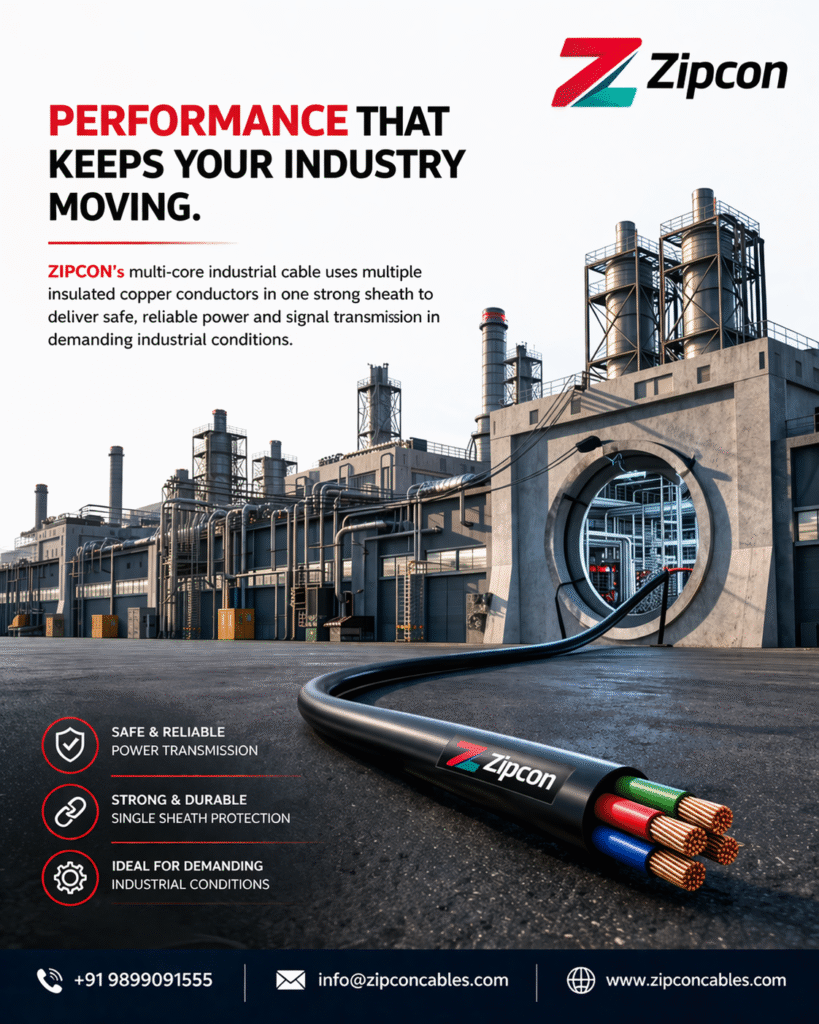
Industrial electrical systems in Kochi require cables that can handle continuous power transmission, demanding operating conditions, moisture, heat, mechanical stress, and long working hours. Choosing the best industrial power cable in Kochi is therefore important for maintaining electrical safety, stable performance, and reliable power distribution.
Industrial power cables are used across manufacturing plants, commercial facilities, construction projects, warehouses, infrastructure sites, pumping systems, and heavy-duty electrical installations. A properly selected cable helps reduce power losses, overheating, insulation failures, and unexpected downtime.
For projects where durability and dependable performance matter, Zipcon Cables offers industrial cable solutions designed for demanding electrical applications. The right cable depends on voltage, current capacity, installation environment, load type, cable construction, and required protection.
For inquiries or assistance:– https://zipconcables.com/contact-us/
What Is an Industrial Power Cable?
An industrial power cable is an electrical cable designed to transmit and distribute electrical power in industrial, commercial, and infrastructure applications. Compared with cables intended for light domestic applications, industrial power cables are selected to withstand higher electrical loads and tougher installation environments.
A typical power cable consists of a conductor, insulation, protective layers, and, depending on the design, additional bedding, shielding, armour, or an outer sheath. Copper and aluminium are commonly used as conductors because they provide the required combination of electrical conductivity, strength, and practical installation characteristics.
The cable specification must match the electrical system. Selecting a cable simply by physical thickness or price can result in voltage drop, excessive heating, insulation deterioration, or reduced service life.
Why Industrial Power Cable Selection Matters in Kochi
Kochi’s industrial and commercial installations can expose electrical cables to moisture, humidity, heat, dust, chemicals, mechanical movement, and other environmental stresses. A cable suitable for a controlled indoor installation may not provide the same performance in an exposed industrial environment.
The installation method also affects cable selection. Cables installed underground, inside cable trays, in ducts, on industrial machinery, or in outdoor areas can experience different thermal and mechanical conditions.
A correctly specified industrial power cable provides:
- Reliable power transmission
- Better insulation protection
- Improved resistance to operating stresses
- Reduced risk of overheating
- Stable performance under continuous loads
- Longer service life when properly installed
- Greater electrical safety
Key Features of a Quality Industrial Power Cable
High-Quality Conductors
The conductor is responsible for carrying electrical current. Copper offers high conductivity and is commonly selected where compact cable construction and excellent conductivity are important. Aluminium can provide a lighter and often more economical alternative for suitable power distribution applications.
The conductor size must be selected according to the expected current, installation conditions, permissible voltage drop, and applicable electrical standards.
Reliable Insulation
Insulation separates the conductor from other conductors and surrounding components. Quality insulation helps withstand electrical stress and protects against short circuits and leakage.
For industrial installations, insulation should be appropriate for the operating voltage, temperature, installation environment, and expected mechanical conditions.
Durable Outer Sheath
The outer sheath protects the cable from external conditions such as abrasion, moisture, dirt, and mechanical contact. The required sheath properties depend on where the cable will be installed.
For example, an outdoor industrial installation may require stronger environmental protection than a protected indoor cable-tray installation.
Flexible and Strong Construction
Some industrial applications require cables to accommodate movement or tight routing. Machinery connections, control panels, and certain equipment installations may benefit from cables with suitable flexibility.
For fixed power distribution, construction strength and appropriate mechanical protection may be more important than flexibility.
Types of Industrial Power Cables
Single-Core Power Cable
Single-core cables contain one insulated conductor. They are commonly used in power distribution systems where individual conductors are installed together according to the electrical system design.
They can be suitable for high-current applications, but installation arrangement, spacing, current-carrying capacity, and thermal conditions must be considered carefully.
Multi-Core Power Cable
Multi-core cables combine multiple insulated conductors within a single cable construction. They can simplify installation by carrying multiple phases or circuits in one cable.
They are widely considered for industrial power distribution, machinery connections, commercial electrical systems, and other applications where consolidated cable routing is beneficial.
Flexible Industrial Cable
Flexible cables are designed for applications where movement or repeated bending may occur. They can be useful around machinery and equipment where a rigid fixed cable would not be appropriate.
Flexibility should always be evaluated alongside current capacity, insulation properties, operating temperature, and mechanical requirements.
Industrial Applications of Power Cables
Industrial power cables are used in a wide range of applications, including:
- Manufacturing plants
- Electrical distribution systems
- Industrial machinery
- Commercial buildings
- Warehouses and logistics facilities
- Construction projects
- Water pumping systems
- Infrastructure projects
- Control and power panels
- Motors and industrial equipment
- Renewable energy installations
- Utility and power distribution networks
For example, a manufacturing facility may require power cables for its main distribution system, motor loads, machinery, lighting, and auxiliary equipment. Each circuit may require a different cable specification based on its electrical load and installation conditions.
How to Choose the Best Industrial Power Cable in Kochi
1. Determine the Electrical Load
Start by calculating the expected current and power requirement. The cable should have an appropriate current-carrying capacity without operating continuously beyond its permissible thermal limits.
Oversizing may increase project costs, while undersizing can create overheating and voltage-drop problems.
2. Check the Operating Voltage
Cable voltage rating must match or exceed the requirements of the electrical system. Industrial power cables are available for different voltage classes, so the correct specification should be confirmed before purchasing.
3. Consider Installation Conditions
Identify whether the cable will be installed underground, inside a conduit, on a tray, in a duct, outdoors, or near machinery.
Ambient temperature, grouping with other cables, ventilation, moisture, and installation depth can affect cable performance and ampacity.
4. Evaluate Voltage Drop
Long cable runs can experience voltage drop. Excessive voltage drop can affect motors, machinery, lighting, and other electrical equipment.
Cable size should therefore be selected not only according to current capacity but also according to the permissible voltage drop for the specific installation.
5. Select the Appropriate Conductor
Copper and aluminium have different electrical, weight, cost, and installation characteristics. The correct conductor depends on project requirements and engineering specifications.
6. Check Environmental Requirements
Kochi installations may experience humid and moisture-prone conditions. Where the installation environment demands additional protection, the cable’s insulation and sheath properties should be evaluated carefully.
7. Verify Cable Quality and Compliance
A low-cost cable is not necessarily a cost-effective cable. Check manufacturer specifications, applicable standards, construction details, conductor size, insulation type, voltage rating, and quality certifications before making a purchase.
Industrial Power Cable vs Regular Electrical Cable
| Feature | Industrial Power Cable | Regular Building Wire |
|---|---|---|
| Typical application | Industrial power distribution | Residential/light commercial wiring |
| Load requirements | Generally higher | Generally lower |
| Construction | Application-specific | Comparatively simpler |
| Mechanical protection | May include armour/protection | Usually limited |
| Installation | Plants, machinery, infrastructure | Buildings and internal wiring |
| Environmental requirements | Often demanding | Usually controlled |
| Selection factors | Load, voltage, environment, installation | Load, circuit type, building requirements |
The important point is that cable selection should be based on application requirements rather than simply choosing the thickest or most expensive option.
Why Choose Zipcon Cables for Industrial Applications?
Zipcon Cables focuses on cable solutions designed for dependable electrical performance across demanding applications. For industrial projects, the cable should be selected according to the required electrical rating, construction, installation method, and environmental conditions.
Zipcon industrial cable solutions can be considered for projects where reliable power transmission, durable construction, and consistent performance are important. Buyers should match the specific Zipcon cable specification with their project’s engineering requirements before installation.


Examples: Choosing the Right Industrial Power Cable
Example 1: Manufacturing Plant
A manufacturing plant operating multiple motors and machines may have substantial continuous electrical loads. The cable selection should consider current capacity, motor starting conditions, voltage drop, ambient temperature, and cable grouping.
In this situation, an appropriately rated industrial power cable can provide reliable power distribution while reducing the risk of overheating caused by an undersized conductor.
Example 2: Underground Industrial Power Distribution
For an underground cable installation, mechanical protection, moisture exposure, installation depth, soil conditions, and thermal dissipation become important factors.
An appropriately designed armoured power cable may be considered where additional mechanical protection is required.
Example 3: Commercial-Industrial Facility
A large commercial facility may have separate requirements for HVAC systems, pumps, lifts, machinery, lighting, and general power distribution.
Instead of using one cable specification everywhere, each circuit should be evaluated according to its load and installation conditions.
Expert Tips for Buying Industrial Power Cable in Kochi
- Calculate the actual electrical load before selecting cable size.
- Consider voltage drop for long-distance cable runs.
- Check ambient temperature and cable grouping conditions.
- Select insulation according to the operating environment.
- Consider mechanical protection for underground or exposed installations.
- Do not select cables only on price.
- Purchase from a reliable cable manufacturer or supplier.
- Verify technical specifications and applicable standards.
- Use qualified electricians or electrical engineers for installation.
- Inspect cable condition before installation for visible damage or deformation.
Common Mistakes When Selecting Industrial Power Cables
Choosing the Cable Only by Price
The cheapest cable may not provide the required conductor size, insulation quality, mechanical protection, or long-term reliability. Initial savings can become expensive if premature cable failure causes repairs or production downtime.
Ignoring Installation Conditions
A cable’s current capacity depends partly on how and where it is installed. Ignoring ambient temperature, cable grouping, ventilation, and installation method can lead to incorrect sizing.
Using an Undersized Cable
An undersized cable can operate at excessive temperature when carrying continuous loads. This can accelerate insulation deterioration and increase electrical safety risks.
Ignoring Voltage Drop
For long cable routes, selecting a cable only according to ampacity can be insufficient. Voltage-drop calculations should also be considered for the specific circuit.
Mixing Different Cable Specifications Without Engineering Review
Industrial systems often contain different circuits with different loads. Using the same cable specification without evaluating each circuit can result in inefficient or unsuitable installations.
Why Local Availability Matters
Choosing an industrial cable supplier in Kochi with access to suitable cable specifications can simplify procurement, technical discussions, and project planning. Faster availability can also be important when projects operate under strict installation schedules.
For contractors, electrical consultants, builders, industrial operators, and procurement teams, working with an established cable brand can make it easier to identify suitable products based on conductor size, number of cores, voltage rating, construction, and application.
Conclusion
Selecting the best industrial power cable in Kochi requires more than comparing prices or cable thickness. Current capacity, voltage rating, conductor material, insulation, installation method, voltage drop, environmental exposure, mechanical protection, and applicable standards all influence cable performance.
For industrial and commercial projects, Zipcon Cables can be considered when reliable and durable cable solutions are required. Before purchase, match the exact Zipcon cable specification with the electrical load and installation conditions to achieve safe, efficient, and long-lasting performance.
Top 5 FAQs
1. What is the best industrial power cable in Kochi?
The best industrial power cable depends on the project’s voltage, current, installation method, environmental conditions, voltage-drop requirements, and mechanical protection needs. A suitable Zipcon cable should be selected according to these technical requirements.
2. Where are industrial power cables commonly used?
Industrial power cables are used in manufacturing plants, warehouses, commercial facilities, construction projects, machinery, pumping systems, infrastructure installations, and electrical distribution networks.
3. How do I select the correct industrial cable size?
Cable size should be determined using current-carrying capacity, voltage drop, installation conditions, ambient temperature, cable grouping, conductor material, and applicable electrical requirements.
4. Are armoured cables suitable for industrial applications?
Armoured cables can be suitable where additional mechanical protection is required, including certain underground, outdoor, and industrial installations. The specific armour and cable construction should match the installation conditions.
5. Why choose Zipcon Cables for industrial power applications?
Zipcon Cables provides cable solutions for demanding electrical applications. The appropriate Zipcon product should be selected based on the required voltage, conductor size, construction, installation environment, and project specifications.