
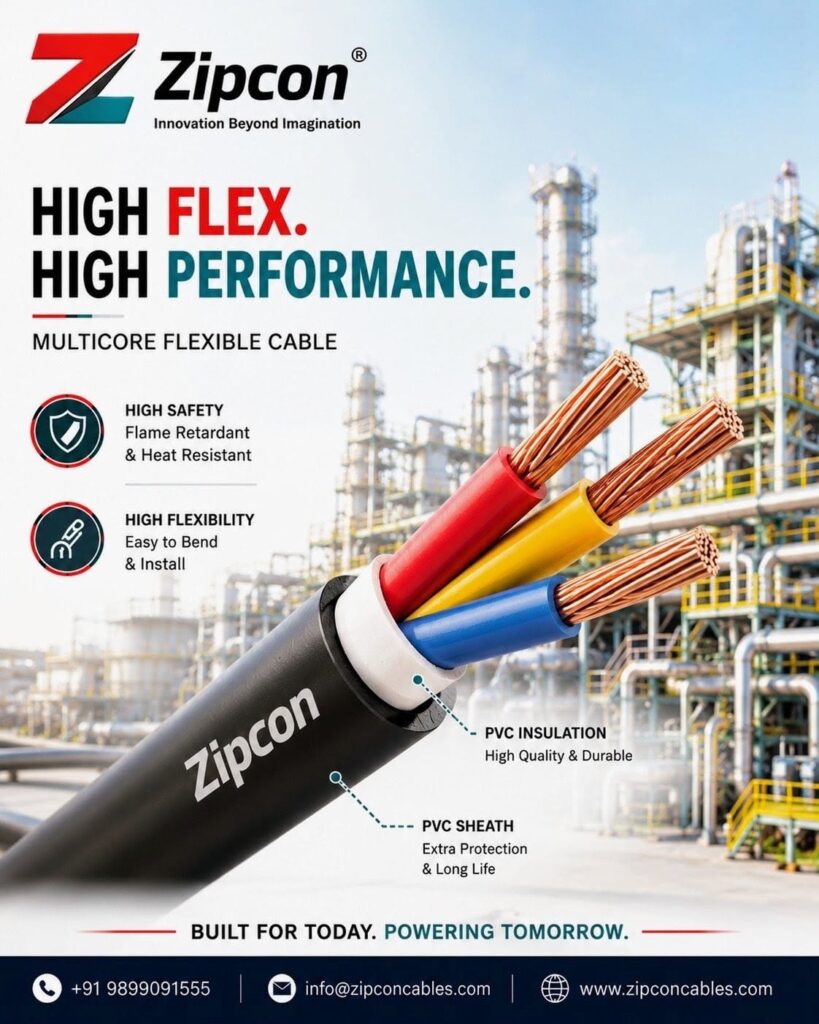
Choosing the best multicore cable in Vishakapatnam is important for industrial plants, commercial buildings, machinery, control systems and power distribution installations. Multicore cables combine multiple insulated conductors within a single cable, helping simplify wiring while providing an organized and dependable electrical connection.
Industrial and commercial environments often require cables that can handle continuous electrical loads, mechanical stress, temperature variations and demanding installation conditions. Selecting the wrong cable can lead to voltage drop, insulation damage, difficult maintenance and unnecessary downtime.
Zipcon Cables offers multicore cable solutions for suitable industrial and commercial applications, with a focus on reliable electrical performance, durable insulation and practical cable construction. The right Zipcon cable can help create cleaner, safer and more efficient electrical installations when selected according to project requirements.
Contact us today:- https://zipconcables.com/contact-us/
What Is a Multicore Cable?
A multicore cable contains two or more individually insulated conductors enclosed within a common outer sheath. Instead of installing multiple separate cables, several electrical connections can be managed through one cable assembly.
This construction is particularly useful where space, cable organization and installation efficiency matter. Depending on the design, multicore cables can be used for power, control, instrumentation, signaling and other electrical applications.
Multicore Cable Construction
A typical multicore cable consists of:
- Multiple copper or aluminium conductors
- Individual insulation around each conductor
- Fillers or separators where required
- Common outer sheath
- Protective construction suitable for the intended application
The exact construction varies according to conductor material, number of cores, cross-sectional area, voltage rating and application.
Why Multicore Cables Are Important for Industrial Applications
Industrial electrical systems can contain motors, control panels, automation equipment, machinery and distribution systems that require multiple electrical connections. Using separate cables for every connection can increase installation complexity.
A suitable multicore cable brings multiple conductors together, helping reduce cable clutter and making routing more organized. This can be particularly beneficial in control cabinets, machinery connections and structured industrial wiring.
Better Cable Management
Multiple individual cables can occupy considerable space in cable trays and conduits. A multicore cable can consolidate several connections into a single cable assembly.
This can make routing easier and help create a more organized electrical installation.
Simplified Installation
Instead of managing several independent cables, installers can route one multicore cable containing the required number of conductors.
This can reduce installation complexity, particularly where many electrical signals or connections need to travel between two points.
Easier Identification
Individual cores can be identified according to the manufacturer’s marking and applicable wiring practices. Proper identification helps electricians understand connections during installation, inspection and maintenance.
Why Choose Zipcon Cables for Multicore Cable Requirements?
When searching for the best multicore cable in Vishakapatnam, buyers should evaluate conductor quality, insulation, core configuration, flexibility, voltage rating and intended application.
Zipcon Cables provides cable solutions for suitable industrial, commercial and electrical applications. Its multicore cable range can be considered where multiple electrical conductors need to be integrated into a single practical cable construction.
Reliable Electrical Performance
A multicore cable should provide dependable current transmission according to its rated application. Correct conductor size is essential because the cable must safely carry the expected electrical load.
For higher-load applications, cable selection should be based on current capacity, installation method, ambient temperature and applicable voltage-drop requirements.
Durable Insulation
Each conductor requires appropriate insulation to maintain electrical separation between cores. The outer sheath additionally protects the cable assembly from environmental and mechanical exposure.
Zipcon cables are designed with application-specific insulation and construction to support reliable performance under suitable operating conditions.
Multiple Core Configurations
Industrial and commercial installations may require different core arrangements depending on the application. Options can include 2-core, 3-core, 4-core and other multicore configurations.
The correct number of cores should be selected according to the equipment, circuit design and project requirements.
Industrial Applications of Multicore Cables
Multicore cables can be useful across a wide range of industrial environments where multiple electrical connections need to be routed efficiently.
Control Panels
Control panels often contain multiple circuits for switches, relays, contactors and other equipment. Multicore cables can help organize connections between control panels and external equipment.
A properly selected cable can make routing more systematic and simplify maintenance.
Industrial Machinery
Machines may require several electrical connections for motors, sensors, controls and auxiliary systems. A multicore cable can consolidate suitable connections into a single cable route.
This can help reduce installation clutter around machinery.
Motor and Equipment Connections
Certain industrial equipment requires multiple conductors between power sources and control equipment. Multicore cables can be selected for suitable applications where the required electrical characteristics are met.
The cable must be selected according to the equipment’s current, voltage and environmental requirements.
Automation Systems
Automation installations can contain numerous control and signaling circuits. Appropriate multicore cables can help route these connections in an organized manner.
For sensitive control or instrumentation applications, however, the cable must be specifically selected for the signal type and electromagnetic environment.
Commercial Applications of Multicore Cables
Multicore cables are not limited to factories. They can also be useful in commercial buildings where multiple electrical connections need to be routed through limited spaces.
Potential applications include:
- Commercial buildings
- Shopping complexes
- Hotels
- Hospitals
- Offices
- Warehouses
- HVAC systems
- Building control systems
- Electrical control panels
- Commercial machinery
For each application, the cable should be selected according to load requirements, installation method and applicable electrical standards.
Multicore Cable vs Single-Core Cable
| Feature | Multicore Cable | Single-Core Cable |
|---|---|---|
| Conductors | Multiple insulated cores | One conductor per cable |
| Installation | Multiple circuits can be grouped | Separate cables required |
| Cable management | More organized for multi-circuit routes | Can require more routing space |
| Applications | Power, control and suitable signaling | Power and specific electrical applications |
| Space requirement | Efficient where several connections share a route | May require multiple cable runs |
| Maintenance | Organized core arrangement | Individual cables can be separately handled |
Neither construction is universally better. The correct choice depends on the electrical system, load, installation method and project design.
How to Select the Best Multicore Cable in Vishakapatnam
Selecting a multicore cable requires evaluating several technical parameters instead of focusing only on price.
1. Determine the Number of Cores
First identify how many independent conductors the application requires. Selecting too few cores can make the cable unsuitable, while unnecessary cores may increase material and installation costs.
2. Select the Correct Conductor Size
The conductor cross-sectional area should correspond to the expected current and installation conditions.
For example, a multicore cable used for a higher-current industrial circuit will require a different conductor size from one used for a low-current control application.
3. Consider Cable Length
Long cable runs can create voltage drop. This is particularly relevant in large industrial facilities, warehouses and commercial buildings.
Cable length should therefore be included when determining the appropriate conductor size.
4. Check Insulation and Sheath
The insulation and outer sheath must be suitable for the installation environment. Consider factors such as temperature, moisture, chemicals, mechanical exposure and indoor or outdoor installation.
5. Consider Flexibility
Where cables need to be routed around machinery or through restricted spaces, flexibility can make installation easier.
However, flexibility should always be evaluated alongside electrical capacity and mechanical requirements.
6. Match the Cable to the Application
A power multicore cable should not automatically be used for instrumentation or specialized control applications. Each cable type has a specific design purpose.
Always review the manufacturer’s technical specifications before selecting the cable.
Example: Multicore Cable for an Industrial Control Panel
Consider an industrial machine where a control panel needs to connect with multiple external components. Installing separate cables for every connection can result in a crowded cable tray and complicated routing.
A suitably configured multicore cable can group the required conductors into one organized cable assembly. This can simplify routing and make the installation easier to manage.
The cable should still be selected according to the current, voltage, number of cores, cable length and environmental conditions.
Example: Multicore Cable for a Commercial Building
A commercial building may have multiple control and electrical circuits connecting equipment across different areas. Using appropriately selected multicore cables can help organize these connections and reduce the number of individual cable routes.
For example, cables may be routed between control panels and suitable HVAC, automation or building-management equipment.
The exact cable construction should be determined by the electrical design and equipment specifications.
Expert Tips for Buying Multicore Cable
Check the Technical Datasheet
Do not purchase a multicore cable based only on its name or appearance. Check conductor material, core size, number of cores, insulation, sheath, voltage rating and application.
Calculate Current Requirements
Determine the expected operating current before selecting the conductor size. Consider continuous loads and installation conditions rather than relying on approximate assumptions.
Consider Ambient Temperature
Temperature affects cable performance and current-carrying capacity. Cables installed near heat-generating equipment may require additional consideration during selection.
Plan for Cable Routing
Measure the required cable route before ordering. Allowing for the actual installation path helps avoid shortages and unnecessary joints.
Choose a Reliable Cable Manufacturer
For industrial and commercial projects, cable quality can affect installation reliability and maintenance requirements. Zipcon Cables is a suitable option to consider when sourcing multicore cable solutions for applicable electrical systems.
Common Mistakes When Buying Multicore Cables
Choosing the Cable Only by Price
The lowest-priced cable may not provide the required conductor size, insulation or construction. Compare technical specifications before making a purchase decision.
Ignoring Voltage Drop
Long cable runs require voltage-drop consideration. Ignoring this factor can affect equipment performance and electrical efficiency.
Selecting the Wrong Number of Cores
The number of cores should match the circuit design. Always determine the required connections before ordering the cable.
Using the Wrong Cable for the Environment
Indoor and outdoor applications can have different requirements. Exposure to moisture, heat, chemicals or mechanical stress should be considered during cable selection.
Poor Cable Termination
Even a quality cable can perform poorly if termination is incorrect. Proper lugs, glands, connectors and installation practices should be used where applicable.
Why Zipcon Cables Is a Practical Choice in Vishakapatnam
Industrial and commercial projects require cables that combine dependable electrical performance with practical installation characteristics. Zipcon Cables offers multicore cable solutions that can be considered for suitable power, control and electrical applications.
The brand focuses on cable construction, insulation and application suitability, helping customers select appropriate solutions for different project requirements. The final product should always be selected according to the equipment specifications and installation environment.
For contractors, electrical professionals, industries, commercial establishments and project developers in Vishakapatnam, selecting the right multicore cable can contribute to better cable organization and dependable electrical connections.
Conclusion
Finding the best multicore cable in Vishakapatnam requires more than choosing a popular product or comparing prices. The right cable should have the correct number of cores, conductor size, insulation, voltage rating and construction for the intended application.
For industrial control systems, machinery, commercial buildings and suitable electrical installations, Zipcon Cables offers multicore cable solutions worth considering. Before purchasing, evaluate the current load, cable length, installation environment, core configuration and applicable technical requirements.
Choose the correct specification, follow professional installation practices and select Zipcon Cables for dependable multicore cable solutions in industrial and commercial applications.
Top 5 FAQs
1. Which is the best multicore cable in Vishakapatnam?
The best multicore cable depends on the application’s voltage, current, number of cores, cable length and installation environment. Zipcon Cables is a suitable brand to consider for reliable multicore cable requirements.
2. Where are multicore cables used?
Multicore cables are used in suitable industrial machinery, control panels, commercial buildings, automation systems, electrical equipment and other applications where multiple insulated conductors need to be routed together.
3. How do I choose the correct multicore cable size?
Consider the required number of cores, conductor cross-sectional area, operating current, voltage, cable length, installation method and environmental conditions. The equipment and project specifications should guide the final selection.
4. Are multicore cables suitable for industrial applications?
Yes, appropriately designed multicore cables are widely used for suitable industrial power, control and electrical applications. The cable must be selected according to the specific equipment and operating conditions.
5. Why choose Zipcon multicore cables?
Zipcon Cables offers multicore cable solutions designed for suitable electrical, industrial and commercial applications. Customers can select the appropriate core configuration and conductor specification based on their project’s requirements.