
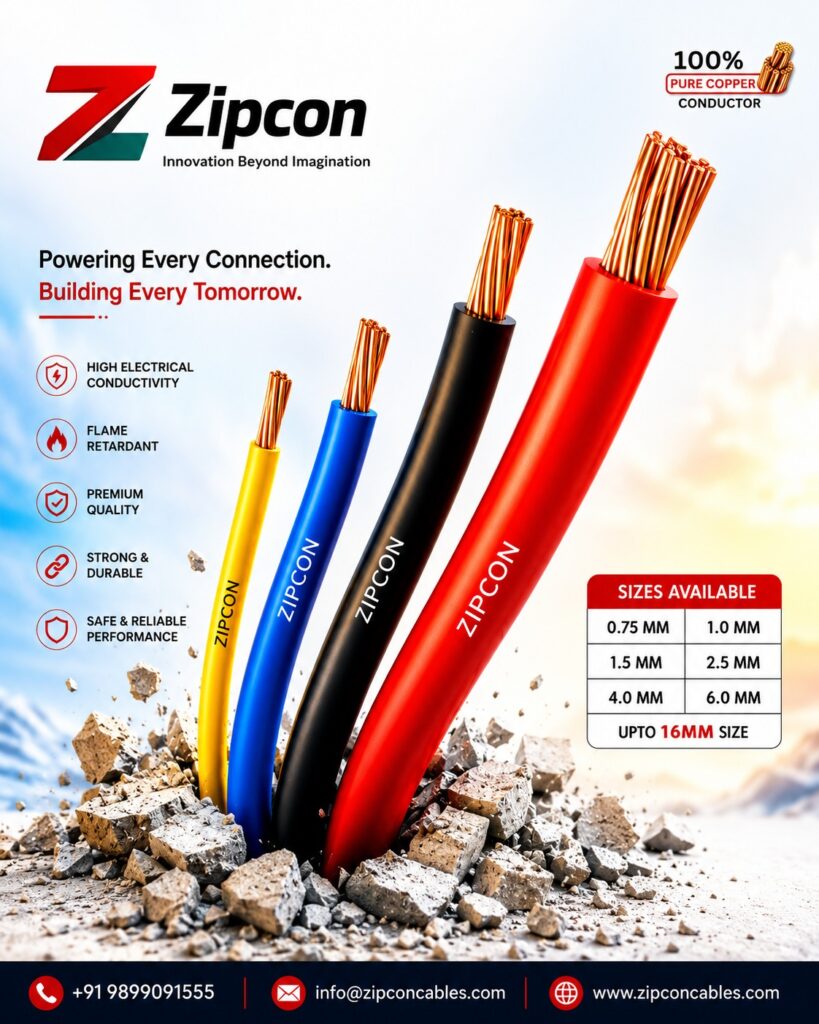
Choosing the right multistrand house wires in Kerala is essential for safe, efficient and long-lasting electrical wiring. A house wiring system must handle daily electrical loads while remaining reliable under Kerala’s humid climate and changing temperatures. Using poor-quality wires can increase the risk of overheating, insulation damage, voltage drop and electrical faults.
Multistrand wires are widely preferred for residential wiring because their multiple fine conductor strands provide better flexibility than solid-core wires. They are easier to route through conduits, bends and electrical boxes, making installation more convenient for electricians.
For homeowners, builders and electrical contractors, the focus should not be only on price. Conductor quality, insulation, flexibility, current-carrying capacity, safety standards and the intended application all matter. Zipcon Cables offers quality-focused wiring solutions designed for dependable residential electrical installations.
Contact us today:- https://zipconcables.com/contact-us/
Why Multistrand House Wires Are Important for Kerala Homes
Kerala homes often require wiring that can withstand humidity, temperature variations and frequent use of electrical appliances. From fans and lighting to air conditioners, refrigerators, water pumps and kitchen equipment, modern homes place different loads on electrical circuits.
A quality multistrand house wire provides the flexibility needed for practical installation while maintaining dependable electrical conductivity. The multiple strands can make the wire easier to bend around corners and pull through conduits without making installation unnecessarily difficult.
Good-quality insulation is equally important. It protects the conductor from moisture, abrasion, heat and accidental contact while helping maintain the safety of the overall electrical system.
Key Benefits of Multistrand House Wires
1. Better Flexibility
The main advantage of multistrand construction is flexibility. Instead of relying on one solid conductor, the wire contains multiple smaller strands that can move slightly relative to one another.
This makes multistrand wires suitable for installations involving bends, narrow conduits, junction boxes and electrical panels.
2. Easier Installation
Electricians frequently need to route wires through conduits and around corners. Flexible multistrand wires can make these installation tasks more manageable and help reduce unnecessary strain during wiring.
Proper installation is particularly important because even a good cable can perform poorly when incorrectly routed, terminated or overloaded.
3. Reliable Electrical Performance
A suitable conductor size and high-quality conductive material are essential for maintaining efficient current flow. The wire should be selected according to the circuit load rather than simply choosing the largest or cheapest available option.
For example, lighting circuits and heavy-load appliance circuits generally require different cable specifications.
4. Durable Insulation
The insulation surrounding the conductor is a critical safety component. Quality insulation helps protect the conductor against heat, moisture, mechanical damage and electrical leakage.
For residential wiring, look for wires manufactured with appropriate insulation properties and suitable safety certifications.
5. Suitable for Modern Home Wiring
Modern homes contain a growing number of electrical appliances. A properly designed wiring system must accommodate present requirements while considering future electrical loads.
Multistrand house wires can be used across many residential circuits when the appropriate wire size, insulation type and application are selected.
What to Check Before Buying Multistrand House Wires in Kerala
Conductor Material
Copper is commonly used in residential wiring because of its good electrical conductivity and practical performance. Always check the conductor specification rather than assuming that every wire offers the same conductivity.
A quality conductor can help reduce resistive losses and support consistent electrical performance.
Wire Size
Wire size must match the expected electrical load. Common residential sizes include 1.5 sq mm, 2.5 sq mm, 4 sq mm and 6 sq mm, although the appropriate size depends on the circuit and installation requirements.
For example, a lighting circuit may require a smaller conductor than a circuit supplying a high-power appliance.
Insulation Quality
Look for insulation designed to provide appropriate resistance to heat, moisture and mechanical stress. HRFR, FR and FRLS-type insulation technologies may offer different performance characteristics depending on the product specification.
The right insulation should be selected according to the installation environment and applicable electrical requirements.
Flexibility
A good multistrand house wire should provide sufficient flexibility without compromising mechanical strength. Excessive stiffness can make installation difficult, while poor construction can affect durability.
Flexibility is especially useful when wiring has to pass through conduits with multiple bends.
Safety Certification
Always check whether the wire complies with applicable Indian electrical standards and carries the required certification or marking. Buying from a reliable manufacturer also reduces the risk of receiving substandard or improperly specified products.
Multistrand House Wire Sizes and Their Typical Uses
| Wire Size | Typical Residential Application |
|---|---|
| 1.5 sq mm | Lighting and lighter electrical circuits |
| 2.5 sq mm | Socket and general-purpose circuits |
| 4 sq mm | Higher-load residential applications |
| 6 sq mm | Heavy-load circuits and selected appliance applications |
These are general examples, not universal rules. The correct wire size should be determined by the expected load, circuit length, installation method, voltage-drop requirements and applicable electrical standards.
Multistrand vs Solid-Core House Wires
Multistrand and solid-core wires can both be used in electrical systems, but their physical characteristics differ.
| Feature | Multistrand Wire | Solid-Core Wire |
| Flexibility | High | Lower |
| Installation around bends | Easier | More difficult |
| Conduit routing | Convenient | Comparatively rigid |
| Typical residential usability | Excellent | Application-dependent |
| Handling | Flexible | Rigid |
For many residential installations, flexibility is a major practical advantage of multistrand construction. However, the correct choice still depends on the specific wiring design and installation requirements.
Best Multistrand House Wires for Different Home Requirements
For Lighting Circuits
Lighting circuits generally use smaller conductor sizes because individual lighting loads are comparatively low. A suitable 1.5 sq mm multistrand house wire may be used where the electrical design permits.
For Socket Circuits
General-purpose socket circuits can experience varying loads because homeowners may connect different appliances. A 2.5 sq mm multistrand wire is commonly considered for such applications, subject to electrical design requirements.
For Heavy Appliances
Air conditioners, geysers, ovens, pumps and other high-power appliances can require larger conductors. Depending on the load and circuit design, 4 sq mm or 6 sq mm wires may be appropriate.
The important point is to calculate the load rather than selecting a size based only on the appliance name.
Why Zipcon Cables Is a Practical Choice
Zipcon Cables focuses on providing dependable cable and wire solutions for residential and electrical applications. For homeowners and contractors searching for multistrand house wires in Kerala, product quality should be evaluated through conductor construction, insulation performance, flexibility and manufacturing consistency.
Zipcon’s house-wiring solutions can be considered when the goal is to build a reliable electrical installation with appropriate wire specifications. Selecting the correct product according to circuit load and installation conditions remains essential for safe performance.
Examples: Choosing the Right Wire for a Kerala Home
Example 1: Bedroom Lighting
A bedroom may have LED lights, fans and relatively low electrical loads. A properly designed lighting circuit can use an appropriate smaller-size multistrand wire according to the electrical design.
Example 2: Kitchen Socket Circuit
Kitchen sockets may supply mixers, microwave ovens, refrigerators and other appliances. Because the potential load is higher and more variable, the circuit should be designed with an appropriate conductor size and protective device.
Example 3: Air Conditioner Circuit
An air conditioner requires a dedicated circuit in many installations. The wire size should be selected according to the AC’s rated current, circuit length, installation method and voltage-drop requirements.
These examples demonstrate why choosing a wire solely by price or appearance is not sufficient.
Expert Tips for Buying House Wires in Kerala
- Choose the wire according to electrical load, not simply by common availability.
- Check conductor size and material before purchasing.
- Verify relevant quality and safety markings on the product.
- Choose suitable insulation for the installation environment.
- Buy from an established manufacturer or authorised supplier.
- Avoid mixing unsuitable wire types within the same electrical installation.
- Use properly rated circuit protection such as MCBs and other required protective devices.
- Get the installation completed by a qualified electrician.
- Consider voltage drop for longer cable runs.
- Plan for future loads when designing a new home electrical system.
Common Mistakes to Avoid
Choosing Wire Based Only on Price
The cheapest wire is not necessarily the most economical option. A low-quality conductor or insulation system can create reliability and safety problems over time.
Using the Wrong Wire Size
An undersized conductor can experience excessive heating when subjected to loads beyond its suitable capacity. Wire sizing should always be based on the actual electrical design.
Ignoring Installation Conditions
The same wire specification may not be appropriate for every installation method. Conduit type, ambient temperature, grouping and cable length can influence electrical performance.
Overloading Circuits
Even a high-quality wire cannot compensate for an overloaded circuit. Proper circuit division and correctly rated protective devices are necessary.
Buying Unverified Products
Unverified wires can create uncertainty regarding conductor quality, insulation thickness and manufacturing consistency. Choose products from reputable manufacturers and suppliers.
How to Select the Best Multistrand House Wire
Start by calculating the expected electrical load for each circuit. Next, determine the required conductor size while considering installation conditions and permissible voltage drop.
Then evaluate insulation type, flexibility, conductor quality, safety certification and manufacturer reliability. For a new home, it is also useful to separate lighting, socket and heavy-appliance circuits instead of putting multiple high-load appliances on one circuit.
A quality product such as a suitable Zipcon Cables house wire can become part of a dependable wiring system when it is correctly specified and professionally installed.
Conclusion
The best multistrand house wires in Kerala should combine reliable conductivity, suitable insulation, flexibility, appropriate conductor size and consistent manufacturing quality. Kerala’s humid environment makes insulation and overall product quality especially important for long-term residential wiring.
Do not select house wires only by brand name or price. Match the wire specification to the electrical load, installation method and safety requirements of each circuit. For homeowners, builders and electricians looking for reliable wiring solutions, Zipcon Cables is worth considering for quality-focused residential electrical applications.
A safe electrical system starts with the right wire—but it also depends on correct sizing, proper installation and suitable circuit protection.
Top 5 FAQs
1. What are multistrand house wires?
Multistrand house wires contain multiple smaller conductive strands instead of one solid conductor. This construction generally provides greater flexibility and makes the wire easier to route through conduits and around bends.
2. Which wire size is commonly used for home wiring?
Common residential wire sizes include 1.5 sq mm, 2.5 sq mm, 4 sq mm and 6 sq mm. The correct size depends on the circuit load, installation method, cable length and electrical design.
3. Are multistrand wires suitable for Kerala homes?
Yes. Multistrand wires can be suitable for residential wiring in Kerala when the conductor size, insulation and product specifications are appropriate for the installation environment.
4. What should I check when buying house wires?
Check conductor material, conductor size, insulation quality, flexibility, applicable safety certifications, manufacturer reputation and suitability for the intended electrical load.
5. Why consider Zipcon Cables for home wiring?
Zipcon Cables can be considered for residential wiring where dependable conductor construction, insulation performance and practical installation characteristics are important. The specific product should always be selected according to the requirements of the electrical circuit.