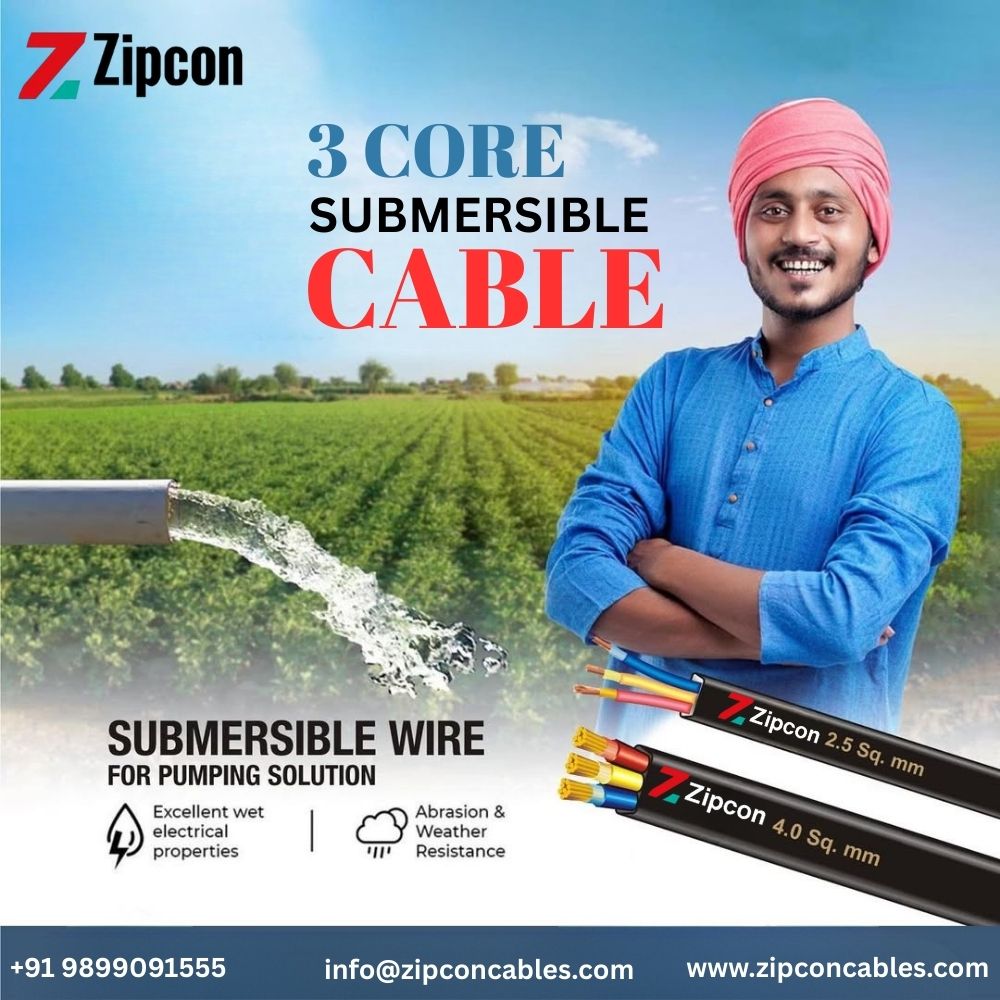
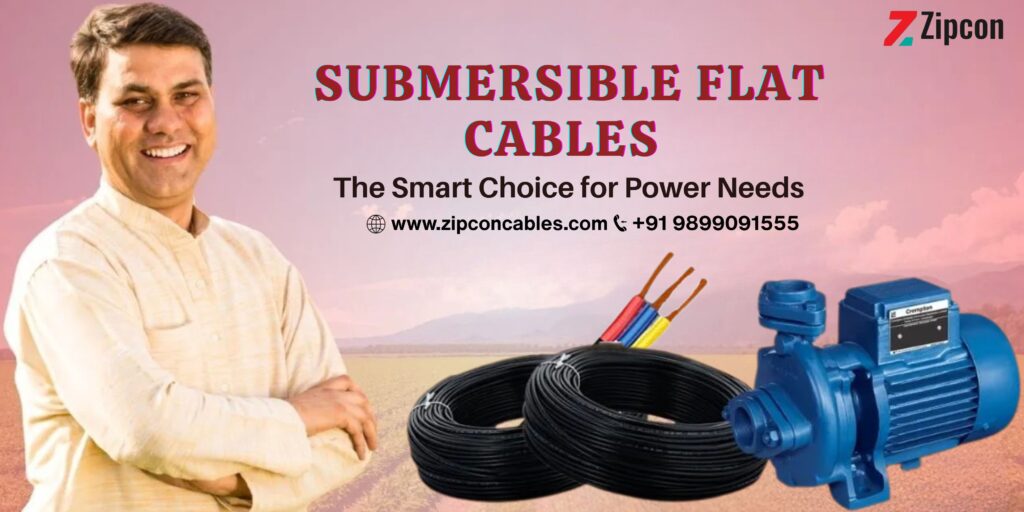
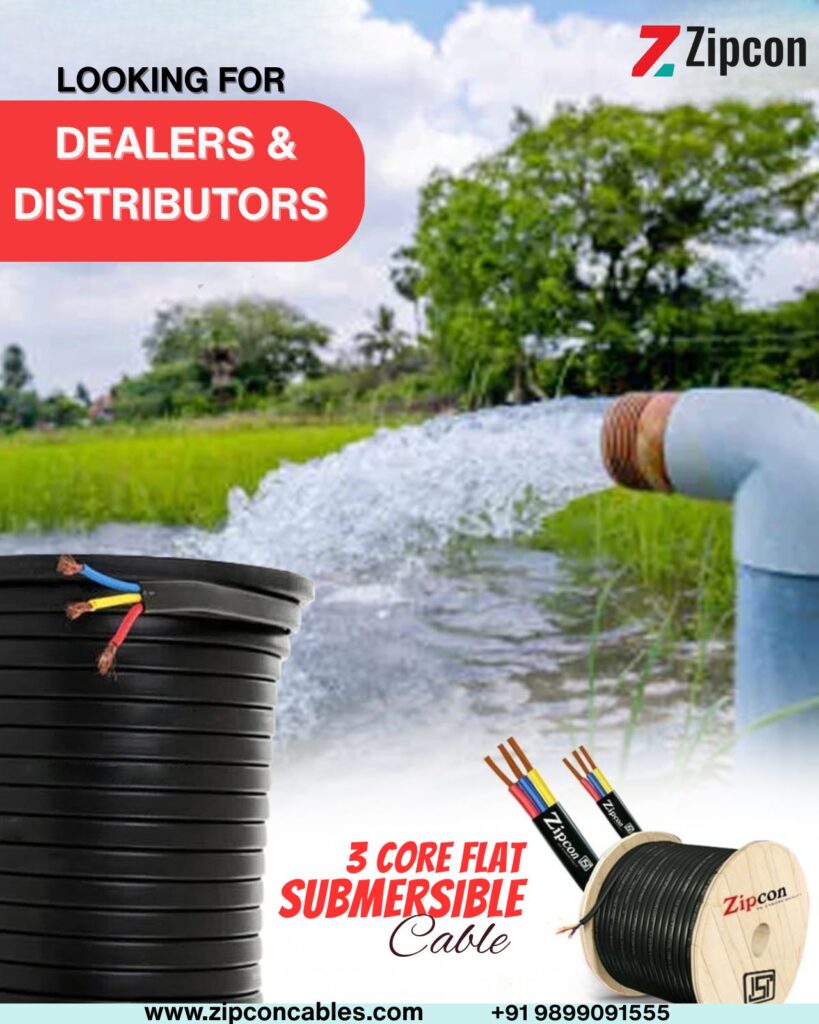
Submersible flat cables are a core part of water supply systems across Haryana, especially in agriculture, borewells, and industrial pumping. The cable you choose directly affects how efficiently your pump runs, how much power it consumes, and how long the system lasts without breakdowns. With rising groundwater usage, the demand for the best submersible flat cable in Haryana has increased significantly.
ZIPCON Cables has built a strong reputation in this space by focusing on real-world performance. Their cables are designed to handle underwater pressure, voltage fluctuations, and long operational hours without compromising safety or efficiency.
A submersible flat cable is built to operate fully immersed in water while supplying consistent power to pumps. Its performance depends on three main factors: conductor quality, insulation strength, and overall construction.
High-quality copper ensures smooth current flow with minimal energy loss. Insulation materials like PVC or XLPE protect the cable from moisture, abrasion, and chemicals present in groundwater. The flat design plays a practical role as well, making installation easier and preventing twisting inside narrow borewells.
ZIPCON combines these elements with strict quality checks, so the cable performs reliably even under continuous load and unstable voltage conditions.
Key Features of ZIPCON Submersible Flat Cables
High Conductivity Copper
ZIPCON uses high-purity copper conductors that improve efficiency and reduce heat generation. This becomes important in Haryana, where pumps often run for extended irrigation cycles.
Strong Insulation and Sheathing
The cables come with multi-layer insulation that protects against water, oil, and mechanical damage. This helps maintain performance even in deep borewell setups.
Flat Design for Stability
The flat structure keeps the cable aligned and prevents twisting during installation. This reduces stress on the cable and improves long-term durability.
Resistance to Voltage and Temperature Fluctuations
Power supply inconsistencies are common in many areas. ZIPCON cables are designed to handle these fluctuations without affecting motor performance.
Applications in Haryana
Submersible flat cables are widely used across different environments where water and electricity need to work together reliably.
Agricultural borewells used for irrigation
Domestic water pumping systems
Industrial setups requiring continuous water supply
Construction sites for dewatering purposes
In districts like Hisar, Karnal, and Rohtak, where farming depends heavily on groundwater, cable quality directly impacts productivity and system reliability.
Why ZIPCON Cables Stands Out in Haryana
ZIPCON focuses on how cables perform in actual conditions rather than just lab specifications. Their products are tested for flexibility, insulation durability, and resistance to water pressure over time.
Consistent copper quality helps maintain stable current flow, reducing the risk of motor damage. The insulation remains intact even after long-term exposure to water, avoiding common issues like cracking or peeling. Easy availability across Haryana also makes it a practical choice for farmers, contractors, and industrial users.
How to Choose the Right Submersible Flat Cable
Match with Motor Capacity
Selecting the right cable size is critical. A smaller cable than required can cause overheating and voltage drop, which affects pump efficiency.
Check Insulation Quality
Not all PVC or XLPE insulation performs the same. It is better to choose cables that are tested for waterproofing and durability.
Go with a Trusted Brand
Reliable manufacturers like ZIPCON ensure consistency in material and performance, which matters over the long term.
Focus on Flexibility
A flexible cable is easier to install and less likely to get damaged during handling or fitting.
Example Use Case
A farmer in Karnal replaced a low-grade cable with a ZIPCON submersible flat cable for a 5 HP pump. Earlier, the system faced frequent overheating and unstable performance. After switching, the pump started running smoothly with fewer interruptions and lower maintenance.
In Faridabad, an industrial unit faced repeated cable failures due to heavy load conditions. After installing ZIPCON cables, the system achieved stable operation with no insulation-related issues.
Expert Tips
Always align cable length and thickness with borewell depth
Avoid joints inside borewells to prevent moisture entry
Use proper clamps to reduce mechanical stress
Check for IS standards and certifications before buying
Common Mistakes to Avoid
Going for low-cost cables with poor copper quality
Overlooking insulation strength and durability
Choosing incorrect cable size for the motor
Poor installation leading to bending or internal damage
Conclusion
Choosing the best submersible flat cable in Haryana comes down to reliability and long-term performance. A good cable keeps your pump running efficiently, reduces maintenance, and prevents costly breakdowns.
ZIPCON Cables offers a dependable solution built for real conditions. Whether it is agriculture, domestic use, or industrial applications, the focus on durability and consistent performance makes it a solid choice for anyone looking for a reliable submersible cable.
Top 5 SEO FAQs
Which is the best submersible flat cable in Haryana?
ZIPCON Cables is a preferred option due to its strong insulation, high conductivity, and reliable performance in local conditions.
What size cable should be used for a submersible pump?
The size depends on motor load, voltage, and installation depth. Proper matching ensures efficient operation.
How long does a submersible flat cable last?
A high-quality cable can last several years with proper installation and usage.
Why are flat cables used in submersible pumps?
They prevent twisting and allow smoother installation inside borewells.
Which insulation is better for submersible cables?
PVC and XLPE are commonly used, with XLPE offering better resistance to heat and moisture.
Submersible flat cables are essential components in a range of applications, particularly in environments where traditional cables might fail due to exposure to water or harsh conditions. These cables are specifically designed to perform reliably in submerged or wet environments, making them a preferred choice for industries ranging from water pumping to marine installations. This article covers the key aspects of submersible flat cables, including conductivity, durability, weight, cost, safety, installation, and typical use cases.
When considering submersible flat cables, electrical conductivity is a critical factor. These cables are often made from either copper or aluminum. Copper cables have superior conductivity compared to aluminum, making them the better option for applications requiring high efficiency, such as powering water pumps in deep wells or high-performance underwater lighting systems. The excellent conductivity of copper ensures minimal power loss, particularly important in submerged installations where efficiency is crucial.
Aluminum, on the other hand, is a more cost-effective alternative. While it doesn’t match copper’s conductivity, it still provides adequate performance in less demanding applications. Additionally, aluminum is lighter, which can be an advantage in situations where the weight of the cable needs to be minimized.
Durability: Designed for Harsh Environments
Submersible 3 core flat cables are built to withstand tough environments, especially underwater. The key to their durability lies in their robust construction, which typically includes multiple layers of insulation and coatings designed to protect against corrosion, wear, and mechanical damage. Most submersible cables feature a layer of rubber or thermoplastic material that resists water ingress and protects the wire inside.
In addition to their resistance to water, these cables are often coated with materials that prevent degradation caused by UV radiation, chemicals, and extreme temperatures. This makes them ideal for underwater pumps, fountains, and marine applications, where cables must be exposed to water for extended periods without suffering performance loss.
Weight: Lightweight for Easy Handling
One of the significant advantages of submersible flat cables is their lightweight nature. Compared to round cables, flat cables are easier to handle and install. Their flat design allows for more compact storage and efficient placement, reducing the overall footprint of the installation. This is particularly useful in underwater installations or in tight spaces where a bulky round cable might be difficult to manage.
However, this lightweight feature comes with some trade-offs. While the reduced weight of flat cables makes installation easier, it can also impact the strength of the cable. For instance, a round cable might be more durable in areas where the cable needs to bear heavy loads or endure rough handling. For most submersible applications, however, the lightweight nature of flat cables is a benefit.
Cost: Value for Money
In terms of cost, submersible flat cables can be more affordable than round cables, especially when opting for aluminum over copper. While copper cables offer superior conductivity, they come at a higher price point. Aluminum cables are more economical, making them a popular choice for non-critical installations where weight and conductivity are less of a concern.
For high-performance applications, such as in deep-sea or critical underwater installations, the extra investment in copper cables may be worth it due to their superior conductivity and longer lifespan. On the other hand, aluminum cables are often chosen for residential applications or projects where cost is a bigger factor than performance.
Safety: Electrical and Environmental Protection
Safety is a top priority when it comes to submersible cables. These cables are designed with features that help prevent electrical faults and reduce the risk of fire and other hazards. The insulation used in submersible flat cables is often fire-resistant, ensuring that the cable remains safe even in the event of electrical failure.
In underwater installations, one of the main safety considerations is the risk of electrical shock. High-quality submersible flat cables are equipped with insulation that prevents the cable from becoming a hazard when exposed to water. Furthermore, some cables feature additional protective layers that resist external pressure, further enhancing safety in submerged environments.
Installation Needs: Simple and Efficient
Installing submersible flat cables is generally straightforward, especially when compared to round cables. Their flat design makes them easier to lay out, minimizing the need for special tools. They can be installed in trenches, along walls, or even within ducts, depending on the application. This flexibility makes them ideal for a variety of installations, including water pumps, marine applications, and other submerged systems.
However, it is important to note that proper sealing and waterproofing are essential to ensure the longevity of the cable. Special connectors and junction boxes are often required to maintain the waterproof integrity of the installation.
Typical Use Cases: Where Submersible Flat Cables Excel
Submersible flat cables are commonly used in various industrial and residential applications where exposure to water or moisture is a concern. Some of the most typical use cases include:
Water Pumps: Submersible flat cables are often used to power water pumps in wells, fountains, and wastewater treatment plants. Their ability to withstand constant submersion in water makes them ideal for these environments.
Underwater Lighting: These cables are also used in marine and pool lighting systems, where durability and water resistance are essential.
Marine Applications: In boats, ships, and other maritime vessels, submersible flat cables provide reliable electrical connections in harsh, submerged environments.
In each of these use cases, the durability, conductivity, and cost-effectiveness of submersible flat cables make them the preferred choice.
Copper vs. Other Materials: When to Choose What?
When deciding between copper and other materials like aluminum, it’s essential to consider the specific requirements of the installation. Copper excels in applications requiring high conductivity, such as powering pumps and equipment in deep-water or critical installations. Its superior electrical performance ensures minimal energy loss, making it ideal for energy-efficient systems.
Aluminum, while not as conductive as copper, is a viable alternative for applications where weight is a concern or where the power demands are lower. It’s also more affordable, making it a popular choice for general residential and commercial installations.
Comparisons and Recommendations
Submersible flat cables outperform round cables in specific scenarios, particularly in underwater or submerged installations. Their lighter weight, ease of handling, and compactness make them ideal for applications such as water pumps, underwater lighting, and marine projects. However, round cables may be more appropriate in situations requiring higher tensile strength or where the cable will be subject to heavy handling.
For high-performance and critical applications, copper submersible flat cables are the best choice due to their superior conductivity. In contrast, aluminum cables offer a more budget-friendly option for less demanding installations.
Conclusion
Submersible flat cables are a reliable, cost-effective solution for applications that require robust, water-resistant wiring. Their excellent conductivity, durability, and ease of installation make them a versatile choice for engineers, electricians, and businesses dealing with submerged or harsh environments. When choosing between copper and aluminum, consider the specific demands of your project to ensure the best performance and value for money. Choose Zipcon Cables for high-quality submersible flat cables that meet the rigorous standards of industrial and residential applications, ensuring a long-lasting, reliable solution for your next project.
Why Choose Submersible Flat Cables for Reliable Power Solutions?
Submersible flat cables have emerged as one of the most reliable power solutions for environments exposed to water and moisture. Their evolution reflects the growing demand for safer, more efficient electrical systems in agriculture, residential, and industrial sectors.
Earlier, conventional round cables were commonly used, but they often failed to perform well in wet or submerged conditions. Submersible flat cables were developed to overcome these limitations. Their water-resistant construction, combined with a flat design, makes them ideal for moisture-dominated and underwater applications.
In agriculture, the introduction of submersible flat cables transformed irrigation systems by providing stable power to submersible pumps. This improvement helped farmers achieve better water management and higher crop productivity. Similarly, industries operating in high-moisture environments rely on these cables for uninterrupted and safe power supply. Submersible flat cables are also widely used in residential borewell installations to ensure consistent electricity flow.
Modern manufacturing advancements by leading electrical cable manufacturers in India have further enhanced the durability, flexibility, and efficiency of these cables. Choosing a high-quality submersible flat cable from a trusted manufacturer like Zipcon Cables ensures long-term performance, safety, and productivity.
What Are Submersible Flat Cables?
Submersible flat cables are specially designed electrical cables used in underwater and moisture-prone environments. Their flat structure allows better heat dissipation, flexibility, and easier installation compared to traditional round cables.
Because of their robust insulation and water-resistant properties, these cables are widely preferred in agriculture, industries, and residential setups where electrical systems are exposed to water or humidity.
Why Choose Submersible Flat Cables?
Submersible flat cables offer several advantages that make them the ideal choice for wet and submerged applications:
1. Waterproof Design
Submersible flat cables feature advanced insulation that protects conductors from water ingress, ensuring reliable performance even under continuous submersion.
2. High Durability and Long Life
The use of high-quality aluminium or copper conductors enhances mechanical strength, making these cables resistant to wear, corrosion, and environmental stress.
3. Efficient Power Transmission
Designed to minimize power loss, submersible flat cables maintain stable electrical flow. Their heat-resistant structure ensures consistent performance despite temperature fluctuations.
4. Easy Installation
The flat design simplifies installation in borewells, pipelines, and confined spaces, making them suitable for both agricultural and industrial applications.
Zipcon Cables India: A Trusted Manufacturer
Zipcon Cables is among the leading electrical wire and cable manufacturers in India, specializing in high-quality submersible flat cables. Along with submersible cables, the company also manufactures copper flexible cables, telephone cables, and multi-strand cables, meeting diverse electrical requirements.
Key Features and Product Description
Submersible flat cables are engineered using advanced insulation and protective layers to ensure safety and performance in demanding environments.
Conductor: High-grade copper or aluminium for superior electrical conductivity
Insulation: PVC insulation that protects against moisture, short circuits, and corrosion
Outer Sheath: A strong protective layer that safeguards against chemicals, heat, and harsh environmental conditions
These features make submersible flat cables ideal for agricultural, industrial, and residential electrical installations.
Applications of Submersible Flat Cables
Submersible flat cables are widely used across various sectors, including:
Agriculture (irrigation systems and submersible pumps)
Industrial environments with high moisture levels
Residential borewell and water pump installations
Why Are Submersible Flat Cables Essential for Submersible Pumps?
Submersible pumps operate under extreme conditions, making safety and reliability crucial.
Water-resistant insulation protects conductors and ensures uninterrupted power supply
Superior conductivity from copper or aluminium minimizes power loss and enhances pump efficiency
Choosing the Right Submersible Flat Cable
Selecting the right cable depends on application requirements, efficiency needs, and durability expectations.
Factor
Multistrand Cables
Copper Flexible Cables
Key Features
High mechanical strength
High conductivity and efficiency
Ideal For
Flexible and durable installations
High-performance electrical systems
Conductor Quality
Aluminium or copper
Copper
Insulation Material
PVC or thermoplastic elastomer
PVC or elastomer
Durability
Good resistance to wear
Excellent resistance to chemicals and moisture
Always assess your specific needs before making a final selection.
Why Are Submersible Flat Cables in High Demand?
Submersible flat cables are increasingly popular due to their:
Excellent underwater performance
Reliability in rugged environments
Thermal stability and long service life
Conclusion
Choosing the right submersible flat cable is essential for the safety, efficiency, and durability of electrical systems. Zipcon Cables manufactures high-quality, water-resistant submersible flat cables that meet national and international standards. In addition to submersible cables, Zipcon is also a trusted submersible flat cable manufacturer in India, delivering advanced solutions for modern communication needs.
The best submersible flat cable in India must deliver reliable electrical performance in demanding environments where moisture, water pressure, heat and continuous operation are common. A submersible pump cable is not an ordinary electrical wire—it is designed specifically to operate with pumps installed inside borewells, water tanks and other wet environments.
Choosing the right flat submersible cable can directly affect pump performance, electrical safety and service life. Cable construction, conductor quality, insulation, voltage rating, flexibility and resistance to moisture should all be considered before installation.
Zipcon Cables offers submersible flat cables designed for dependable electrical connectivity in water-pump applications. For residential, agricultural, commercial and industrial pumping systems, selecting the right cable specification is essential for safe and consistent operation.
A submersible flat cable is a specially constructed electrical cable used to supply power to submersible pumps operating underwater or in wet environments. Its flat profile makes it suitable for installations where the cable needs to run alongside the pump and fit efficiently within borewell or water-system arrangements.
Unlike conventional house wires, submersible pump cables are manufactured with insulation and construction suitable for exposure to moisture. They need to maintain electrical integrity even when installed in challenging conditions for extended periods.
A good-quality flat submersible cable combines electrical conductivity, mechanical strength and insulation protection. This makes cable selection particularly important for borewell pumps, agricultural irrigation systems and water-supply installations.
Why Choose a Flat Submersible Cable for Pump Applications?
1. Designed for Wet Environments
Submersible pumps operate in environments where water and moisture are unavoidable. The cable therefore needs suitable insulation and construction to reduce the risk of electrical leakage and insulation deterioration.
A properly selected submersible cable helps maintain dependable electrical performance throughout the pump’s operating cycle.
2. Space-Efficient Flat Construction
The flat profile is one of the major advantages of this cable design. It allows the cable to be installed efficiently alongside a submersible pump, particularly in borewell applications where available space can be limited.
This construction can also help provide an organised installation compared with using unsuitable conventional cables.
3. Reliable Power Transmission
The conductor is responsible for carrying electrical current from the power source to the pump motor. Using a suitable conductor size helps minimise voltage drop and supports stable pump operation.
For this reason, cable size should always be selected according to the pump’s power requirement, installation distance and electrical specifications.
4. Better Mechanical Suitability
A submersible cable may experience pulling, bending and movement during installation and maintenance. A purpose-built cable is better suited to these conditions than a standard indoor electrical wire.
The right combination of conductor and insulation helps provide the mechanical performance required for pump installations.
Key Features to Look for in the Best Submersible Flat Cable
Choosing a cable based only on price can lead to poor long-term results. Before purchasing, evaluate the following specifications.
High-Quality Conductors
The conductor should provide efficient current carrying capacity with dependable electrical conductivity. Copper conductors are widely preferred for applications where good conductivity and flexibility are required.
The conductor size should correspond to the pump load rather than being selected simply because it is commonly used.
Suitable Insulation
Insulation is particularly important for submersible applications because the cable operates in a moisture-rich environment.
Look for cable insulation designed for the intended operating conditions and voltage rating. Good insulation should maintain its properties during continuous service.
Correct Voltage Rating
A cable’s voltage rating should match the electrical system in which it will be installed. For example, 1100 V submersible cables are used in suitable higher-voltage applications where the specification calls for that rating.
Always check the manufacturer’s technical specification before installation.
Flexibility
Pump cables need to be manageable during installation, especially when lowering a pump into a borewell. Adequate flexibility makes routing and installation easier while reducing unnecessary mechanical stress.
Resistance to Moisture and Environmental Stress
A submersible cable should be designed for the environmental conditions of its application. Water exposure, temperature variations and mechanical movement can all affect cable performance over time.
A cable intended specifically for submersible pump applications is therefore a better choice than a general-purpose electrical cable.
Submersible Flat Cable vs Regular Electrical Wire
Feature
Submersible Flat Cable
Regular Electrical Wire
Wet-area application
Designed for suitable submersible applications
Generally intended for dry/appropriate indoor installations
Construction
Flat, pump-oriented construction
Varies by application
Moisture exposure
Designed according to specified application
May not be suitable
Pump installation
Suitable when specifications match
Not automatically suitable
Flexibility
Designed for installation requirements
Depends on cable type
Borewell use
Commonly used for suitable pump systems
Should not be substituted without manufacturer approval
The important point is that not every flexible electrical wire is a submersible pump cable. The cable must be selected according to its construction, rating and intended application.
Choosing the Right Submersible Flat Cable Size
Cable size should be selected based on the complete electrical installation rather than the pump name alone.
Important factors include:
Pump motor power
Operating voltage
Full-load current
Cable length
Installation depth
Allowable voltage drop
Installation conditions
Ambient and water temperature
Applicable electrical standards
Example
Suppose a borewell pump is installed at significant depth and requires a long cable run. Selecting a cable solely based on conductor size without considering the installation distance can result in excessive voltage drop.
A professional installer should calculate the required cable size using the pump’s electrical specifications and the actual installation conditions.
Where Are Submersible Flat Cables Used?
Borewell Pumps
Borewell pumping systems commonly require cables that can operate reliably alongside submerged pump motors. The cable must be appropriate for the depth, electrical load and environmental conditions.
Agricultural Irrigation
Farm irrigation systems often depend on submersible pumps for groundwater extraction. Reliable pump cabling helps support consistent operation during repeated pumping cycles.
Residential Water Supply
Homes using borewell or underground-water pumps also require suitable submersible pump wiring. Correct cable selection becomes especially important when the pump is installed deep below ground level.
Commercial Water Systems
Commercial buildings, institutions and other facilities may use submersible pumps for water supply and drainage. The cable should be selected according to the motor rating and installation requirements.
Industrial Applications
Industrial pumping systems can place higher demands on electrical infrastructure. Cable selection should therefore consider continuous operation, load characteristics, installation environment and applicable standards.
Why Zipcon Cables for Submersible Flat Cable Applications?
Zipcon Cables focuses on cable solutions designed around practical electrical installation requirements. Its submersible cable range can be considered for applications where dependable pump connectivity and suitable insulation are essential.
For buyers comparing submersible cable manufacturers in India, the key evaluation should go beyond brand name. Examine conductor construction, insulation quality, available sizes, voltage ratings, technical specifications and suitability for the intended pump installation.
For a submersible flat cable, choosing the correct specification is ultimately more important than selecting the cheapest available option.
Examples of Submersible Flat Cable Selection
Example 1: Residential Borewell
A residential borewell pump may have a relatively moderate motor rating but a considerable cable length. In this situation, the installer should consider the pump’s full-load current and voltage drop before selecting the cable size.
Example 2: Agricultural Pump
An agricultural pump may operate for long periods during irrigation. Cable selection should therefore account for the motor load, operating duration, borewell depth and environmental conditions.
Example 3: Deep-Borewell Installation
A deep-borewell pump requires a cable long enough to reach the motor while maintaining acceptable electrical performance. A technically appropriate conductor size becomes particularly important as cable length increases.
Expert Tips for Buying the Best Submersible Flat Cable in India
Check the pump’s rated current first. Cable selection should begin with the motor’s electrical requirements.
Consider total cable length. Longer cable runs can increase voltage drop and may require a larger conductor size.
Verify the voltage rating. Never assume that every submersible cable has the same voltage rating.
Check insulation construction. The cable must be appropriate for continuous exposure to the intended environment.
Buy from a reliable manufacturer. Consistent manufacturing quality matters for electrical cables used in demanding installations.
Do not compromise conductor size for price. An undersized cable can negatively affect electrical performance and operating efficiency.
Follow professional installation practices. Correct cable selection and correct installation are equally important.
Common Mistakes When Buying Submersible Flat Cable
Choosing Cable Only by Price
The cheapest cable may not provide the construction or specifications required for a particular pump installation. Compare technical specifications rather than focusing only on the initial purchase price.
Using Ordinary House Wire
House wires and submersible pump cables serve different applications. A conventional house wire should not automatically be used for submerged pump installations.
Ignoring Voltage Drop
Cable length affects electrical performance. Ignoring voltage drop can lead to an inappropriate cable selection, especially in deep-borewell or long-distance installations.
Selecting the Wrong Cross-Section
Choosing a smaller conductor than required can create electrical and performance issues. Always match cable size with the motor load and installation conditions.
Skipping Technical Specifications
A professional cable purchase should involve checking conductor material, cross-sectional area, insulation, voltage rating and intended application.
Conclusion
The best submersible flat cable in India is not simply the cable with the lowest price or the thickest appearance. It is the cable whose conductor size, insulation, voltage rating, flexibility and construction match the requirements of the pump and installation.
For borewell pumps, agricultural irrigation, residential water systems and commercial applications, Zipcon Cables can be considered for dependable submersible cable solutions. Before purchasing, verify the pump load, cable length, voltage requirement and installation conditions to select the correct specification.
Choose the right cable for the right pump—and build your electrical installation for reliable long-term performance with Zipcon Cables.
Top 5 FAQs
1. What is the best submersible flat cable in India?
The best submersible flat cable is one that matches the pump’s current, voltage, cable length and installation environment. Conductor quality, insulation and manufacturing consistency should also be evaluated before purchase.
2. What is a submersible flat cable used for?
Submersible flat cables are primarily used to provide electrical power to pumps installed underwater or in wet environments, including borewells, water tanks and agricultural pumping systems.
3. Can normal house wire be used for a submersible pump?
Normal house wire should not be used for a submersible pump unless its technical specifications explicitly make it suitable for that application. Purpose-designed submersible pump cable is generally the appropriate choice.
4. How do I select the correct submersible cable size?
Select the cable size based on pump power, full-load current, operating voltage, cable length, voltage-drop requirements and installation conditions. A qualified electrical professional should verify the final selection.
5. Why is flat cable used for submersible pumps?
The flat construction provides a practical profile for routing alongside submerged pump installations. It can be particularly useful where space around the pump and borewell installation is limited.