
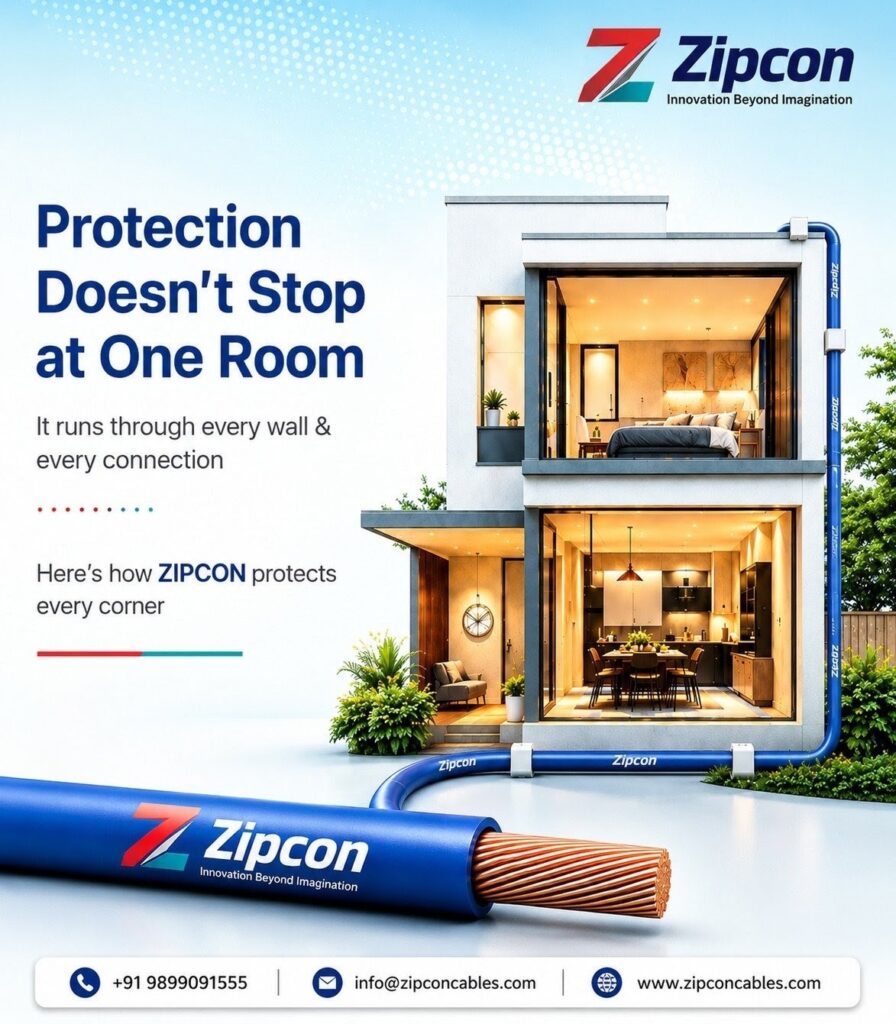
Electrical wiring is one of the most important parts of any building because its quality directly affects electrical safety and long-term performance. Choosing the best FRLS house wires in Indore can be especially important for homes, offices, apartments, shops, and commercial buildings where reliable wiring is required every day.
FRLS stands for Flame Retardant Low Smoke. These wires are designed to reduce flame propagation and limit smoke generation under fire conditions compared with ordinary wires that do not have the same flame-retardant and low-smoke characteristics. This makes FRLS wires a suitable choice for applications where fire safety and reduced smoke are important considerations.
For customers looking for dependable house wiring solutions, Zipcon Cables offers FRLS house wires designed for modern electrical installations. Selecting the correct wire size, insulation, current capacity, and application is essential for achieving safe and reliable performance.
For inquiries or assistance, visit: 👉https://zipconcables.com/contact-us/
What Are FRLS House Wires?
FRLS house wires are insulated electrical wires manufactured with insulation materials formulated to provide flame-retardant and low-smoke properties. Their purpose is to help control flame spread and reduce smoke during a fire-related event.
This characteristic can be valuable inside buildings because excessive smoke can reduce visibility and make evacuation more difficult. FRLS wiring therefore provides an additional safety consideration alongside correct electrical design, installation, protection devices, and building fire-safety measures.
How FRLS Technology Works
The insulation formulation used in FRLS wires is designed to resist flame propagation and produce comparatively less smoke under specified fire conditions. The exact performance depends on the wire’s construction, material formulation, and applicable test requirements.
FRLS does not mean a wire is fireproof. Instead, it describes specific fire-performance characteristics that should be verified against the manufacturer’s technical specifications and relevant standards.
Why Choose FRLS House Wires in Indore?
Indore has a wide range of residential, commercial, and industrial construction projects. Electrical wiring in these buildings must handle continuous loads while remaining protected from common installation stresses.
Choosing suitable FRLS house wires can provide several practical advantages.
1. Improved Fire Safety Characteristics
FRLS wires are designed to offer flame-retardant properties. In a fire situation, this can help reduce the contribution of the cable insulation to flame propagation when compared with wiring without equivalent flame-retardant characteristics.
2. Reduced Smoke Generation
Low-smoke characteristics are an important consideration in enclosed spaces. Less smoke can help improve visibility during emergency situations, depending on the specific cable’s tested performance.
3. Suitable for Modern Buildings
Homes, apartments, offices, hospitals, schools, retail spaces, and other buildings can benefit from wiring solutions that consider electrical performance as well as fire-related characteristics.
4. Reliable Electrical Performance
A quality house wire should provide consistent conductivity, appropriate insulation, and adequate mechanical strength. FRLS properties are only one part of overall cable quality.
5. Long-Term Wiring Solution
When the correct wire size and specification are selected for the load, quality house wires can support dependable electrical performance over the service life of the installation.
Key Features to Look for in FRLS House Wires
Buying FRLS wire should not be based only on the FRLS label. Several technical characteristics influence whether a wire is suitable for a particular installation.
Conductor Quality
The conductor is responsible for carrying electrical current. Copper is widely used in house wiring because of its high electrical conductivity and flexibility.
A good-quality conductor should have consistent dimensions and electrical properties. The appropriate conductor size must be selected according to the expected load and installation conditions.
Insulation Quality
The insulation protects the conductor and helps prevent accidental electrical contact. For FRLS wires, the insulation formulation also contributes to their specified flame-retardant and low-smoke characteristics.
Quality insulation should be appropriate for the operating temperature, voltage rating, and intended application.
Current-Carrying Capacity
Every electrical wire has a current-carrying capacity based on factors such as conductor size, insulation, installation method, ambient temperature, and grouping.
Using a wire that is too small for the connected load can cause excessive heating. Proper electrical calculations should therefore be completed before selecting the wire.
Flexibility
House wiring often requires wires to pass through conduits, bends, junction boxes, and electrical panels. Suitable flexibility can make installation easier while reducing unnecessary strain on the conductor and insulation.
FRLS House Wires vs Ordinary House Wires
| Feature | FRLS House Wires | Conventional House Wires |
|---|---|---|
| Flame-retardant characteristics | Designed for specified flame-retardant performance | Depends on wire type |
| Smoke characteristics | Designed for lower smoke generation under specified tests | Depends on insulation material |
| Residential suitability | Suitable when specified for the application | Commonly used depending on requirements |
| Fire-safety consideration | Higher focus on flame and smoke behavior | Varies by construction |
| Selection criteria | Size, load, insulation, standards and fire performance | Size, load, insulation and standards |
The important point is that FRLS should be viewed as one part of a complete electrical safety strategy rather than a replacement for proper circuit protection and installation practices.
Applications of FRLS House Wires
FRLS house wires can be used in various building wiring applications when their technical specifications match the project requirements.
Residential Wiring
Homes require wiring for lighting, fans, sockets, appliances, air conditioners, water heaters, and other electrical loads. Selecting the appropriate wire size for each circuit helps maintain safe operation.
Apartments and Housing Projects
Large residential developments require consistent wiring specifications across numerous flats and common areas. FRLS wires can be considered where flame-retardant and low-smoke characteristics are required.
Offices and Commercial Buildings
Offices contain computers, lighting systems, air-conditioning equipment, networking equipment, and other electrical loads. Reliable wiring is important for maintaining continuous operations.
Schools and Institutions
Buildings with many occupants require careful attention to electrical and fire safety. Appropriate FRLS wiring can form part of a broader safety-focused electrical design.
Shops and Retail Spaces
Retail environments often contain lighting, displays, air-conditioning systems, refrigeration equipment, and other electrical loads. Correctly specified wiring helps support these installations.
How to Select the Right FRLS House Wire
Selecting a wire should start with the electrical load rather than the brand or price.
Step 1: Calculate the Electrical Load
Identify the appliances and equipment connected to each circuit. The expected current should be considered before selecting the conductor size.
Step 2: Select the Appropriate Wire Size
Common house-wire sizes include different cross-sectional areas for lighting, socket, and higher-load circuits. The correct size depends on the actual load and applicable electrical requirements.
Step 3: Consider Installation Conditions
Conduit type, ambient temperature, number of loaded circuits, cable grouping, and installation method can affect current-carrying capacity.
Step 4: Check Voltage Rating and Standards
Verify that the wire is suitable for the intended electrical system and complies with the applicable Indian standards and project requirements.
Step 5: Choose a Reliable Manufacturer
Consistent conductor quality and insulation performance are important for electrical reliability. Choose a manufacturer that provides clear technical specifications and product information.
Why Choose Zipcon Cables for FRLS House Wires?
Zipcon Cables provides house-wire solutions for customers seeking dependable electrical wiring products. Its FRLS house wires can be considered for residential and commercial installations where appropriate flame-retardant and low-smoke characteristics are required.
For buyers in Indore, the right product should be selected according to conductor size, load requirement, voltage rating, installation method, and applicable standards. A reliable brand combined with correct installation provides a stronger foundation for long-term electrical performance.
When safety, electrical reliability, and wiring quality are priorities, Zipcon Cables is a practical brand to consider for FRLS house-wire requirements.
Examples: Choosing FRLS House Wires
Example 1: Bedroom and Lighting Circuit
A bedroom lighting circuit generally carries a lower load than an air-conditioning circuit. The wire size should therefore be selected according to the circuit’s actual load and electrical design.
Using the same wire size throughout a building without considering individual circuit requirements is not a reliable selection method.
Example 2: Kitchen Wiring
Kitchens can contain several high-power appliances, such as induction cooktops, ovens, refrigerators, and microwave ovens. These loads may require dedicated circuits and appropriately sized conductors.
FRLS house wires can be considered where their specifications meet the requirements of the installation.
Example 3: Office Wiring
An office may have lighting, computers, printers, air conditioners, networking equipment, and other loads. Proper circuit segregation and correctly sized FRLS wires can help create a more organized electrical installation.
Expert Tips for Buying FRLS House Wires in Indore
- Check the conductor material: Verify whether the wire uses the conductor material required for your project.
- Select the correct cross-section: Wire size should match the expected current and installation conditions.
- Verify FRLS performance: Look for relevant technical specifications and test compliance rather than relying only on the FRLS label.
- Check insulation quality: Ensure the insulation is suitable for the expected operating conditions.
- Buy from an established manufacturer: Product consistency and technical documentation matter for electrical installations.
- Avoid mixing specifications unnecessarily: Maintain appropriate and clearly documented wiring specifications throughout the project.
- Use qualified electricians: Correct installation is essential even when high-quality wire is used.
- Inspect before installation: Check the wire for visible damage, deformation, or other issues before use.
Common Mistakes to Avoid
Choosing the Cheapest Wire
Price alone does not indicate electrical quality. A lower initial cost can become expensive if the product is unsuitable for the application or results in installation problems.
Using Undersized Wires
An undersized conductor can overheat when subjected to excessive current. Always select wire size according to load calculations and applicable requirements.
Assuming FRLS Means Fireproof
FRLS wires are designed to provide specified flame-retardant and low-smoke characteristics. They should not be treated as completely fireproof cables.
Ignoring Installation Conditions
The same wire may have different permissible current capacities depending on installation conditions. Conduit arrangement, ambient temperature, grouping, and routing should be considered.
Poor Termination
Loose or improperly made electrical connections can create resistance and localized heating. Proper termination is just as important as choosing quality wire.
Mixing Low-Quality Accessories
Even good-quality house wires can be compromised by poor-quality switches, sockets, connectors, distribution equipment, or protective devices. The complete electrical system should be selected carefully.
Conclusion
Choosing the best FRLS house wires in Indore requires more than selecting a popular product. Conductor quality, wire size, insulation, current-carrying capacity, voltage rating, fire-performance characteristics, installation conditions, and compliance with applicable standards should all be evaluated.
For homeowners, builders, contractors, electricians, and commercial projects, Zipcon Cables offers FRLS house-wire solutions worth considering for reliable and safety-focused electrical installations.
Choose the wire according to the actual electrical load, use appropriate circuit protection, and ensure professional installation. A properly designed wiring system combined with quality FRLS house wires can provide dependable performance while supporting better fire-safety planning.
Top 5 FAQs
1. What does FRLS mean in house wires?
FRLS stands for Flame Retardant Low Smoke. It describes wire insulation designed to provide specified resistance to flame propagation and lower smoke generation under defined test conditions.
2. Are FRLS house wires suitable for residential buildings?
Yes, FRLS house wires can be suitable for residential wiring when their technical specifications match the electrical system and applicable requirements. They can be considered where flame-retardant and low-smoke characteristics are important.
3. How do I choose the right FRLS wire size?
Wire size should be selected according to the expected electrical load, installation method, ambient conditions, circuit length, voltage drop considerations, and applicable electrical requirements.
4. Are FRLS wires completely fireproof?
No. FRLS means the wire has specified flame-retardant and low-smoke characteristics. It does not mean the wire is completely fireproof or that it can prevent an electrical fire caused by faults, overloads, or poor installation.
5. Why choose Zipcon Cables for FRLS house wiring?
Zipcon Cables offers FRLS house-wire solutions designed for electrical installations where reliable performance and specified flame-retardant, low-smoke characteristics are required. The appropriate Zipcon product should be selected according to the project’s load, size, voltage, installation conditions, and technical requirements.