
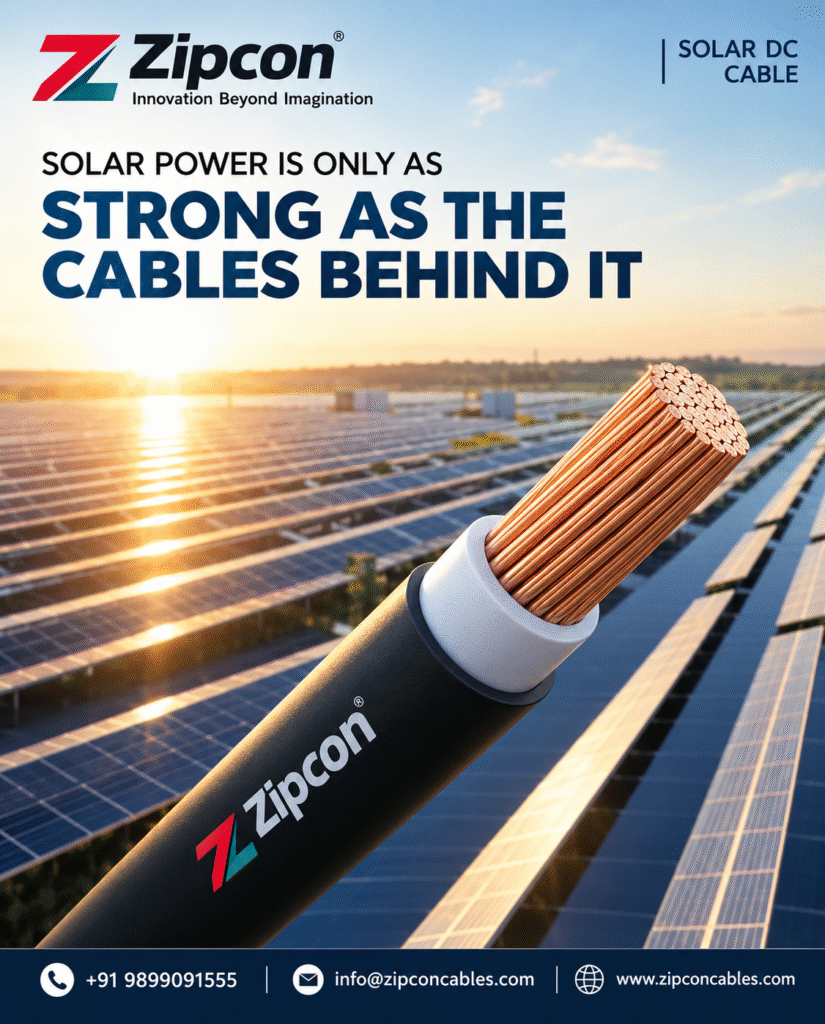
Choosing the best solar cable in Noida is essential for maintaining safe and reliable power transmission in a solar PV system. Solar cables continuously face sunlight, temperature fluctuations, moisture, outdoor exposure, and electrical stress, so ordinary electrical wires are not always suitable for photovoltaic installations.
ZIPCON Cables provides solar cable solutions for residential rooftop systems, commercial projects, industrial installations, and large solar farms. Selecting the correct conductor size, insulation, voltage rating, and cable construction helps minimise electrical losses and supports dependable long-term solar system operation.
For inquiries or assistance:– https://zipconcables.com/contact-us/
What Is a Solar Cable?
A solar cable, also called a PV cable or solar DC cable, is designed specifically for electrical connections within photovoltaic systems. It is commonly used to connect solar panels with other components such as combiner boxes, DC isolators, charge controllers, and inverters.
Unlike general-purpose wiring, a solar cable must be suitable for demanding outdoor conditions. Its insulation and sheath should provide appropriate resistance to factors such as UV exposure, temperature changes, moisture, and mechanical stress.
Why Quality Solar Cable Matters in Noida
Solar installations in Noida are exposed to intense sunlight, high summer temperatures, dust, seasonal moisture, and outdoor operating conditions. These factors make cable construction an important part of overall PV system reliability.
A properly selected solar cable helps maintain electrical continuity between solar modules and the rest of the system. Using a cable with suitable specifications can also help reduce avoidable electrical losses and installation-related problems.
Key Benefits of a Suitable Solar Cable
- Designed for photovoltaic electrical connections
- Suitable for demanding outdoor installations
- Appropriate insulation helps protect conductors
- Available in different conductor sizes
- Supports reliable DC power transmission
- Suitable for rooftop, commercial and utility-scale applications
- Helps maintain organised solar-panel wiring
Applications of Solar Cable in Noida
Residential Rooftop Solar
Homeowners installing rooftop solar systems need cables that can handle outdoor exposure and the DC electrical characteristics of the PV installation. Solar cables are commonly used between panels, junctions, DC protection equipment, and the inverter.
For residential systems, cable sizing should be based on system voltage, current, cable length, installation method, and applicable electrical requirements.
Commercial Solar Systems
Commercial buildings often have larger rooftop installations with longer cable routes. Cable selection becomes more important because increased cable length can contribute to voltage drop and electrical losses.
A properly specified solar DC cable can help create a more dependable connection between PV modules and the inverter system.
Industrial Solar Projects
Industrial facilities may install solar systems to support their energy requirements and reduce dependence on conventional grid power. These installations can involve large numbers of solar modules, longer cable routes, and more demanding operating conditions.
The cable should therefore be selected according to the complete electrical design rather than simply choosing the most commonly used size.
Solar Farms
Large-scale solar farms involve extensive DC cabling between rows of photovoltaic modules, combiner equipment, and inverter stations. Cable durability, electrical capacity, routing, and environmental suitability become critical at this scale.
A consistent cable specification across the project can also simplify procurement, installation, inspection, and maintenance.
How to Choose the Best Solar Cable in Noida
The best solar cable depends on the design and operating requirements of the PV system. Consider the following factors before purchasing.
1. Conductor Material
Copper is commonly selected for solar cable applications because of its electrical conductivity and reliable performance. Conductor construction and quality should be verified against the requirements of the solar installation.
2. Cable Size
Solar cables are available in different cross-sectional areas, including commonly used sizes such as 4 sq mm and 6 sq mm. The correct size depends on current, cable length, voltage drop, installation conditions, and system design.
A larger cable is not automatically better. The objective is to select a conductor that provides the required electrical performance without unnecessary material and installation costs.
3. DC Voltage Rating
Solar PV systems can operate at substantial DC voltages. The cable’s voltage rating must be appropriate for the maximum system voltage and the complete installation design.
4. UV and Weather Resistance
Solar cables are frequently installed outdoors and may remain exposed to sunlight for many years. Appropriate UV and weather resistance is therefore important for maintaining insulation and sheath performance.
5. Temperature Performance
PV cables can experience significant temperature variation. The selected cable should have suitable temperature characteristics for the expected installation environment.
6. Flexibility and Installation
Solar cables often need to be routed around panels, mounting structures, junction boxes, and other equipment. Suitable flexibility can make installation easier while helping installers maintain proper cable routing.
Solar Cable vs Ordinary Electrical Wire
| Feature | Solar Cable | Ordinary Electrical Wire |
|---|---|---|
| Primary application | Photovoltaic systems | General electrical applications |
| Outdoor exposure | Designed for suitable PV environments | Depends on wire type |
| UV exposure | Suitable PV cables are designed accordingly | Not universally suitable |
| DC solar systems | Specifically intended for PV connections | Application-dependent |
| Temperature conditions | Designed according to cable specification | Varies |
| Solar-panel connectivity | Suitable | Not automatically suitable |
The important point is application suitability. A wire that works well inside a building should not automatically be used for exposed photovoltaic DC connections.
Solar Cable Sizes: 4 Sq Mm vs 6 Sq Mm
4 Sq Mm Solar Cable
A 4 sq mm solar DC cable is commonly considered for suitable residential and commercial PV applications where the electrical design supports that conductor size. Its suitability depends on current, cable length, voltage drop, temperature, and installation method.
6 Sq Mm Solar Cable
A 6 sq mm solar cable provides a larger conductor cross-section and may be selected where the system requires greater current-carrying capacity or where cable length and voltage-drop considerations justify the larger size.
The correct choice should always come from the PV system design rather than selecting a cable based solely on panel capacity or common market usage.
Examples of Solar Cable Selection
Example 1: Residential Rooftop System
A homeowner installs solar panels on a rooftop with the inverter located a moderate distance from the array. The installer evaluates the expected DC current, cable length, voltage drop, outdoor exposure, and installation route before selecting the appropriate cable size.
Example 2: Industrial Rooftop Installation
An industrial building has a larger solar array with several strings and longer cable routes. The electrical design considers current capacity, cable grouping, ambient temperature, voltage drop, routing, and protection before finalising the solar DC cable specification.
Example 3: Solar Farm
A utility-scale solar farm requires extensive DC cabling across multiple module rows. Cable selection must account for the project’s electrical architecture, environmental conditions, mechanical installation, cable lengths, and maintenance requirements.
Expert Tips for Buying Solar Cable
- Select cable size according to current and voltage-drop calculations.
- Check the cable’s DC voltage rating.
- Verify conductor material and cross-sectional area.
- Choose insulation and sheath construction suitable for the installation environment.
- Consider UV, moisture, temperature, and mechanical exposure.
- Use compatible PV connectors and termination components.
- Keep positive and negative DC cables properly routed and secured.
- Avoid unnecessary cable length because excessive length can increase electrical losses.
- Follow applicable electrical, PV-system, and installation standards.
- Purchase from a manufacturer that provides clear technical specifications.
Common Mistakes When Choosing Solar Cables
Using Ordinary Electrical Wire
One of the most common mistakes is assuming that any electrical wire can be used for solar-panel connections. PV installations have specific environmental and DC electrical requirements.
Selecting Cable Size by Guesswork
Choosing 4 sq mm or 6 sq mm simply because it is commonly available may result in an unsuitable installation. Current, distance, temperature, voltage drop, and system design should determine the conductor size.
Ignoring Cable Routing
Poor routing can expose cables to unnecessary mechanical stress, abrasion, heat, or water accumulation. Proper securing and routing are important for long-term cable performance.
Mixing Incompatible Connectors
PV connectors and cable terminations should be properly matched. Poorly compatible connections can create resistance, heating, and reliability problems.
Buying Only on Price
Solar cables remain part of the electrical infrastructure for years. Focusing only on the initial price can overlook conductor quality, insulation performance, environmental suitability, and long-term reliability.
Why Choose ZIPCON Solar Cables?
ZIPCON Cables offers solar DC cable solutions for different photovoltaic applications, including residential rooftops, commercial installations, industrial projects, and solar farms.
For customers in Noida, the focus should be on selecting a cable that matches the actual PV system requirements. ZIPCON can be considered when evaluating solar cable options based on conductor size, construction, voltage rating, environmental conditions, and intended application.
Solar Cable Selection Checklist
Before ordering solar cable, verify:
System voltage → Operating current → Cable length → Voltage drop → Conductor size → Insulation → Sheath → UV exposure → Temperature → Installation method → Connector compatibility
Following this checklist helps avoid common cable-selection errors and supports a more reliable photovoltaic installation.
Conclusion
The best solar cable in Noida is not simply the cable with the largest conductor or lowest price. It is the cable whose electrical rating, conductor size, insulation, environmental resistance, and construction match the requirements of the PV system.
Whether the installation is a home rooftop, commercial building, industrial facility, or solar farm, proper solar cable selection can contribute to reliable DC power transmission and long-term system performance. ZIPCON Cables provides solar cable solutions that can be evaluated according to the technical requirements of each project.
Top 5 FAQs
1. What is a solar cable used for?
Solar cables are primarily used for electrical connections in photovoltaic systems, including connections between solar modules, junction equipment, DC protection devices, and inverters.
2. Which solar cable is better, 4 sq mm or 6 sq mm?
Neither size is universally better. The appropriate size depends on current, cable length, voltage drop, temperature, installation method, and the overall PV system design.
3. Can ordinary electrical wire be used for solar panels?
Ordinary electrical wire should not automatically be substituted for a cable specifically suitable for photovoltaic applications. Solar-panel connections require cable construction appropriate for the system’s electrical and environmental conditions.
4. What should I check before buying solar cable in Noida?
Check conductor material, cross-sectional area, voltage rating, insulation, sheath, temperature characteristics, environmental suitability, cable length, voltage drop, and compatibility with the intended PV installation.
5. Where can solar cables be used?
Solar cables can be used in residential rooftop systems, commercial solar installations, industrial PV projects, and utility-scale solar farms when the cable specifications match the application.