
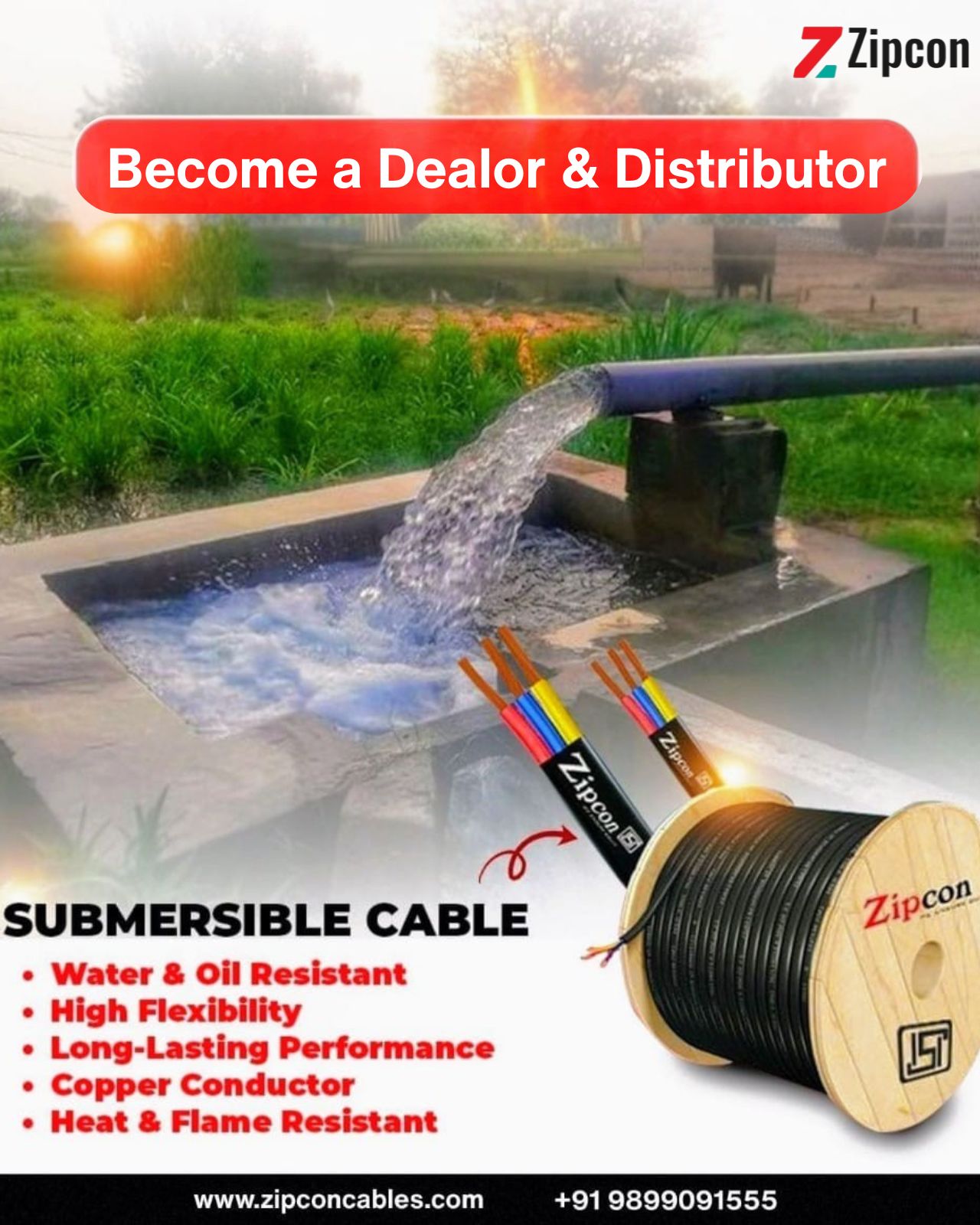
Choosing the best submersible cable manufacturer in India is important when a cable has to operate continuously in water, borewells, pumps, and demanding electrical environments. A submersible cable must provide dependable power transmission while handling moisture, mechanical stress, temperature changes, and long operating hours.
A poor-quality cable can lead to insulation damage, electrical leakage, voltage-related performance issues, pump downtime, and costly replacement. For this reason, buyers should evaluate the conductor quality, insulation, flexibility, voltage rating, construction, manufacturing standards, and application suitability before selecting a supplier.
ZIPCON Cables focuses on dependable wires and cables designed for residential, agricultural, commercial, and industrial electrical requirements. Its submersible cable range is designed to provide reliable connectivity for applications where durability and insulation performance are critical.
Contact us today:- https://zipconcables.com/contact-us/
What Is a Submersible Cable?
A submersible cable is an electrical cable specially designed for equipment that operates in or around water. It is commonly used to connect submersible pumps installed inside borewells, water tanks, agricultural wells, and other water-handling systems.
Unlike ordinary electrical wires, submersible pump cables need insulation and construction suitable for wet environments. The cable must maintain electrical integrity even when exposed to moisture for extended periods.
For example, a cable installed with a borewell pump may remain underground and submerged for years. Therefore, selecting a suitable submersible pump wire is not simply about choosing the required conductor size; the cable’s overall construction matters.
Why Choosing the Right Submersible Cable Manufacturer Matters
The manufacturer plays an important role in determining the consistency and reliability of the finished cable. A reliable manufacturer should maintain proper control over conductor quality, insulation materials, dimensional accuracy, electrical performance, and production processes.
A high-quality cable can help reduce unexpected failures and maintenance requirements. It also provides better confidence when cables are installed in difficult-to-access locations such as deep borewells.
Key benefits of choosing a reliable manufacturer
- Consistent conductor quality
- Reliable insulation performance
- Better flexibility during installation
- Suitable electrical and voltage performance
- Improved resistance to moisture
- Better mechanical durability
- Consistent cable dimensions
- Reduced chances of premature cable failure
For contractors, dealers, pump installers, and end users, these factors can directly affect installation quality and long-term operating costs.
Important Features of a High-Quality Submersible Cable
Not every cable marketed as a submersible cable offers the same level of performance. Before purchasing, evaluate the following characteristics.
1. Quality Conductors
The conductor is responsible for carrying electrical current to the pump. High-quality conductor material and consistent construction help maintain reliable current transmission.
Conductor size should also match the pump’s electrical requirements, installation distance, and operating conditions. Undersized cables can contribute to voltage drop and excessive heating.
2. Reliable Insulation
Insulation is one of the most important components of a submersible cable. Since the cable may remain in a wet or submerged environment, the insulation must provide effective electrical separation and withstand the intended operating conditions.
Good insulation also helps protect the conductor from environmental exposure and physical damage.
3. Flexibility
Submersible cables are often installed alongside pumps and through borewell systems. Excessively rigid cables can make installation difficult and may experience unnecessary mechanical stress during handling.
A properly designed flexible cable makes routing and installation easier while maintaining the required electrical performance.
4. Moisture Resistance
Water exposure is the defining challenge of a submersible cable application. The cable construction should therefore be appropriate for wet and submerged environments.
Moisture-resistant insulation and suitable cable construction help reduce the risk of insulation deterioration and electrical leakage.
5. Mechanical Strength
During installation, the cable may experience pulling, bending, rubbing, and handling stress. A dependable cable should have sufficient mechanical strength for its intended application.
This becomes particularly important in deep borewell installations where cable replacement can involve significant labour and equipment costs.
6. Appropriate Voltage Rating
The cable’s voltage rating must be compatible with the electrical system in which it will be installed. A suitable rating provides an appropriate safety and performance margin for the intended application.
Always match the cable specification with the pump manufacturer’s requirements and the applicable electrical standards.
Types of Submersible Cables Used in India
Different pump installations may require different cable configurations. Common options include 3 core flat submersible cable, 4-core cables, and other configurations selected according to the pump and electrical system.
3 Core Flat Submersible Cable
A 3 core flat submersible cable is widely used with three-phase submersible pumps. Its flat construction can make it convenient for installations where the cable needs to be positioned alongside a pump pipe.
ZIPCON Cables offers 3-core flat submersible cable options designed for applications where reliable pump connectivity and flexible installation are required.
4 Core Submersible Cable
Four-core configurations may be selected for applications requiring four conductors. The correct configuration depends on the pump design, control arrangement, and electrical connection requirements.
The cable should always be selected based on the pump manufacturer’s recommended wiring configuration rather than simply choosing a cable by appearance.
Where Submersible Cables Are Commonly Used
Submersible pump cables are used across several sectors where electrical equipment operates in wet or underground environments.
Agricultural Applications
Farmers commonly use borewell and submersible pumps for irrigation. In these installations, the cable must support reliable pump operation over extended periods.
A dependable submersible pump wire can help reduce the likelihood of electrical problems that may interrupt irrigation schedules.
Domestic Water Supply
Submersible pumps are frequently used to supply water to homes, apartments, and residential buildings. Cable reliability becomes particularly important because the pump may operate repeatedly throughout the year.
Commercial Buildings
Hotels, institutions, offices, and other commercial facilities may use underground water systems and pumping equipment. Cable selection should account for the expected load and installation conditions.
Industrial Applications
Industrial pumping systems can place additional demands on cables because of longer operating cycles and demanding environments. Proper conductor sizing, insulation, voltage rating, and mechanical construction become especially important.
How to Select the Best Submersible Cable
Choosing the right cable involves more than selecting a recognised brand. Consider the complete application before placing an order.
Check the Pump Specification
Start with the pump’s rated voltage, current, power, phase configuration, and manufacturer’s cable recommendations. These specifications establish the basic cable requirements.
Select the Correct Conductor Size
Cable size should be selected according to the electrical load and installation conditions. For longer cable runs, voltage drop should also be considered.
For example, a pump operating at a substantial distance from the electrical supply may require a different conductor size from an otherwise identical pump installed nearby.
Consider Installation Depth
Deep borewell installations may expose the cable to greater mechanical and environmental demands. The cable construction should therefore be suitable for the intended depth and installation method.
Evaluate Cable Construction
Compare flat and round designs, conductor configuration, insulation material, flexibility, and overall construction. The best option depends on the pump system rather than a one-size-fits-all approach.
Buy From an Established Manufacturer
A dependable manufacturer should be able to provide clear product specifications and consistent cable quality. This is particularly important for projects where cable failure would be difficult or expensive to rectify.
Examples: Choosing a Submersible Cable
Example 1: Agricultural Borewell
Consider a farm using a three-phase submersible pump inside a deep borewell. The cable will run from the pump to the electrical control system over a considerable distance.
In this situation, the buyer should evaluate the pump’s current requirements, cable length, conductor size, voltage drop, insulation performance, and mechanical requirements before selecting the cable.
Example 2: Residential Borewell
A residential borewell may have a smaller pump and a shorter cable run. While the electrical load may be lower, the cable still needs suitable insulation and construction for a submerged environment.
Choosing an ordinary household wire simply because it appears to have the required conductor size can create unnecessary risks.
Example 3: Commercial Water System
A commercial building may operate its pump frequently throughout the day. Here, durability and consistent electrical performance become important because unexpected pump downtime can affect the building’s water supply.
The cable should be selected according to the pump load, installation environment, operating cycle, and applicable standards.
Submersible Cable vs Ordinary Electrical Wire
| Feature | Submersible Cable | Ordinary Electrical Wire |
|---|---|---|
| Wet environment | Designed for suitable wet applications | Usually not intended for prolonged submersion |
| Pump applications | Suitable for appropriate pump systems | Generally unsuitable |
| Insulation requirements | Designed around demanding environments | Depends on wire type |
| Mechanical demands | Application-specific construction | Varies |
| Borewell installation | Common application | Not normally recommended |
| Flexibility | Available in suitable flexible designs | Depends on construction |
The key difference is application suitability. A wire that performs well inside a dry building installation should not automatically be used in a submerged pump environment.
Why ZIPCON Cables Is a Strong Choice
ZIPCON Cables is focused on manufacturing and supplying wires and cables for diverse electrical applications. Its product portfolio includes submersible cables designed for pump and water-related installations.
The company emphasises practical cable requirements such as reliable connectivity, appropriate insulation, flexibility, and application-oriented construction. For dealers, contractors, pump installers, and project buyers, this makes product specification and application matching important parts of the purchasing decision.
ZIPCON’s submersible cable solutions can be considered for agricultural borewells, domestic water systems, commercial installations, and suitable industrial pumping applications.
Expert Tips for Buying Submersible Pump Cable
1. Never select cable size by guesswork.
Calculate the electrical requirement based on the pump specification, cable length, and installation conditions.
2. Consider voltage drop for long installations.
A long cable run can affect electrical performance. The conductor size should be evaluated accordingly.
3. Don’t compromise on insulation quality.
The cable operates in a demanding environment, so suitable insulation is essential.
4. Check the complete cable specification.
Look beyond the brand name and compare conductor, cores, insulation, voltage rating, construction, and applicable standards.
5. Follow the pump manufacturer’s recommendation.
The pump manufacturer’s electrical specifications should remain the starting point for cable selection.
6. Purchase through reliable channels.
Authentic products from established manufacturers provide better traceability and specification clarity.
Common Mistakes to Avoid
Choosing the Cheapest Cable
Initial price should not be the only purchasing factor. A cable failure inside a borewell can make replacement significantly more expensive than the original cable purchase.
Using Ordinary House Wire
House wires are designed for their intended electrical installations. They should not automatically be substituted for cables designed for submersible applications.
Ignoring Cable Length
The same pump can require different cable considerations depending on whether the installation distance is short or extensive. Cable length should always be part of the selection process.
Selecting the Wrong Core Configuration
A pump requiring a particular conductor configuration should be paired with the appropriate cable. Incorrect core selection can create installation and operational problems.
Overlooking Installation Conditions
Borewell depth, temperature, moisture, mechanical handling, and routing conditions can all affect cable selection. These factors should be assessed before purchase.
Conclusion
The best submersible cable manufacturer in India should offer more than a cable that meets a basic size requirement. Reliable manufacturing, suitable conductor construction, dependable insulation, flexibility, mechanical strength, and application-specific specifications all contribute to long-term cable performance.
For agricultural pumps, residential borewells, commercial water systems, and suitable industrial applications, ZIPCON Cables provides submersible cable solutions designed around reliable electrical connectivity and demanding installation environments.
Before purchasing, match the cable with the pump specification, conductor requirement, cable length, voltage rating, installation depth, and operating conditions. A correctly selected cable can improve installation reliability, reduce maintenance concerns, and support consistent pump performance.
Top 5 FAQs
1. Which is the best submersible cable manufacturer in India?
The best manufacturer is one that consistently provides application-suitable cables with reliable conductors, insulation, construction, and documented specifications. ZIPCON Cables is a suitable option to consider for submersible pump cable requirements.
2. Which cable is best for a submersible pump?
The appropriate cable depends on the pump’s voltage, current, phase, power, cable length, installation depth, and manufacturer recommendations. 3-core flat submersible cables are commonly used with suitable three-phase pump systems.
3. Can ordinary electrical wire be used for a submersible pump?
Ordinary electrical wire should not be used simply because its conductor size appears suitable. Submersible pump installations require cable construction and insulation appropriate for wet or submerged conditions.
4. What factors should be checked before buying a submersible cable?
Check conductor material and size, number of cores, insulation, voltage rating, flexibility, mechanical construction, cable length, installation conditions, and the pump manufacturer’s requirements.
5. Why is cable quality important in a borewell pump?
A borewell cable can remain in a difficult-to-access environment for a long period. Reliable insulation and suitable cable construction help support electrical performance and reduce the risk of premature cable-related problems.