
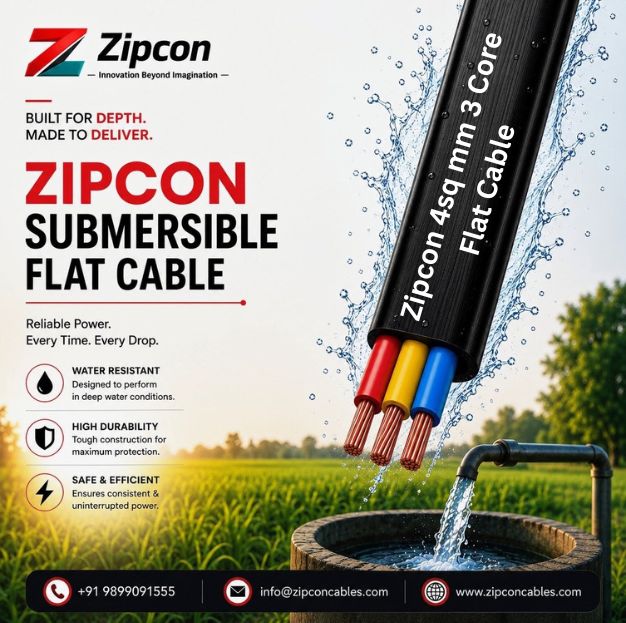
A borewell pump depends on a reliable electrical connection to deliver consistent water flow. Choosing a trusted submersible cable for borewell pumps in Kochi is therefore essential for safe operation, stable power transmission, and long-term performance. The cable must withstand moisture, continuous electrical loads, bending, and installation conditions inside or around a borewell.
Kochi’s humid and moisture-rich environment makes cable selection even more important. A cable designed specifically for submersible pump applications can provide better suitability than ordinary electrical wires when used according to its rated specifications.
Zipcon Cables offers submersible cable solutions for borewell pumps and water-pumping applications, with options designed around important requirements such as insulation, flexibility, conductor performance, and durability.
For inquiries or assistance: https://zipconcables.com/contact-us/
Why Submersible Cable Quality Matters for Borewell Pumps
A borewell pump may operate for several hours at a time, placing a continuous electrical load on its cable. The cable carries power from the electrical supply to the submerged motor, so its conductor size and insulation must be appropriate for the pump’s requirements.
A poor-quality or incorrectly sized cable can contribute to voltage drop, overheating, insulation damage, or unreliable pump operation. Replacing a cable installed deep inside a borewell can also involve additional labor and equipment.
For this reason, cable selection should be treated as part of the complete pump system rather than as a low-cost accessory.
What Is a Submersible Cable?
A submersible cable is an electrical cable designed for applications where the cable may be exposed to water or high-moisture conditions. It is commonly used to connect submersible pump motors with their electrical supply.
Unlike standard house wiring, submersible cables are constructed with insulation and cable characteristics appropriate for their intended application. The exact suitability depends on the cable’s voltage rating, conductor size, insulation system, construction, and manufacturer’s specifications.
For borewell pumps, the cable should be selected according to the pump’s electrical characteristics and installation requirements.
Why Kochi Requires Reliable Borewell Pump Cables
Kochi’s coastal environment creates conditions where moisture management is an important consideration for electrical installations. Borewell pumps themselves operate in wet environments, making suitable cable insulation essential.
A borewell pump cable in Kochi should be selected based on more than the local climate. The pump’s depth, cable length, power rating, current requirement, voltage, and installation method all influence the appropriate cable specification.
Choosing a cable that matches these conditions can help maintain dependable pump performance and reduce unnecessary maintenance.
Key Features of a Reliable Submersible Cable
1. Quality Conductors
The conductor is responsible for carrying electrical power to the pump motor. Appropriate conductor material and cross-sectional area are essential for efficient power transmission.
Cable sizing should be based on the motor’s rated current, cable length, voltage, and applicable electrical requirements. A larger cable is not automatically better; the correct size is the one appropriate for the specific installation.
2. Effective Insulation
Insulation separates the electrical conductor from the surrounding environment. For submersible applications, the insulation must be suitable for prolonged exposure to moisture and the operating conditions specified by the manufacturer.
Good insulation helps maintain electrical integrity and reduces the risk of leakage or insulation-related failure when the cable is correctly installed.
3. Water Resistance
A borewell pump cable can remain in a wet environment for extended periods. Its construction should therefore be suitable for the intended water-exposure conditions.
This is one of the key reasons why ordinary electrical wire should not be substituted for a properly specified submersible cable.
4. Flexibility
Cable flexibility matters during installation because the cable may need to follow the pump assembly through a borewell.
A 3 core flat submersible cable, for example, can provide a practical flat construction for compatible pump installations where cable positioning and available space are considerations.
5. Mechanical Strength
During installation, the cable can experience pulling, bending, and other mechanical stresses. A suitable cable construction can help withstand these conditions when handled and installed correctly.
The cable should also be protected from sharp edges, excessive bending, and other mechanical hazards during installation.
Types of Submersible Cables for Borewell Pumps
Different pump systems require different cable configurations. The correct choice depends on the motor and electrical system.
3 Core Flat Submersible Cable
A 3 core flat submersible cable is commonly used for compatible three-conductor pump systems. Its flat profile can be useful for certain borewell installations.
Available conductor sizes can vary depending on the product range. Options such as 2.5 sq mm, 4 sq mm, and 6 sq mm may be used for different applications, but the correct size must be determined from the pump’s electrical requirements.
3 Core Round Submersible Cable
A 3 core round submersible cable provides a round cable construction for compatible pump applications. It can be considered when the installation configuration and equipment requirements favor a round design.
The conductor size and voltage rating should always match the pump specifications.
Multi-Core Submersible Cable
Multi-core cables combine multiple conductors within one cable construction. They can be useful for systems that require several conductors for power or associated control requirements.
The required number of cores should be determined from the pump and control system rather than selected based on appearance or availability.
How to Choose a Borewell Pump Cable in Kochi
Check Motor Power
Start by checking the pump motor’s horsepower or kilowatt rating. Also note the rated voltage, current, and phase configuration.
These specifications provide the basic information required to determine a suitable cable.
Calculate the Total Cable Length
Cable length should include the complete distance between the electrical supply point and the pump.
Longer cable runs can increase voltage drop, making conductor sizing particularly important for deep borewell installations.
Consider Voltage Drop
Voltage drop occurs when electrical resistance in the cable causes the voltage available at the motor to decrease.
For example, a cable that is suitable for a short installation may not be appropriate for a significantly longer borewell. The cable size should therefore be selected based on the complete installation rather than pump power alone.
Match the Cable to the Pump
A cable should be compatible with the pump’s voltage, current, phase, installation conditions, and manufacturer’s requirements.
Do not select a cable solely because its conductor size appears suitable. The complete cable specification matters.
Consider Installation Conditions
Borewell depth, water exposure, cable routing, temperature, mechanical stress, and installation method can all affect cable selection.
Professional installation can help prevent damage caused by improper handling or excessive bending.
Why Choose Zipcon Cables for Borewell Pumps?
Zipcon Cables provides cable solutions for water-pumping and electrical applications where dependable performance is important. Its submersible cable range can be considered for compatible borewell pump installations in residential, agricultural, commercial, and other water-pumping applications.
For buyers searching for a trusted submersible cable in Kochi, Zipcon provides an option to evaluate based on cable specifications, construction, conductor size, insulation, and application suitability.
The right Zipcon cable should be selected according to the pump manufacturer’s recommendations and the actual installation requirements.
Submersible Cable vs Ordinary Electrical Wire
| Feature | Submersible Cable | Ordinary Electrical Wire |
|---|---|---|
| Intended application | Suitable for compatible wet/submersible applications | General electrical applications |
| Water exposure | Designed for specified water-exposure conditions | Usually not designed for submerged use |
| Insulation | Application-specific | Depends on wire type |
| Pump connection | Suitable for compatible submersible pumps | Generally unsuitable |
| Borewell installation | Designed for relevant applications | Not normally recommended |
| Construction | Available in suitable flat/round configurations | Primarily intended for general wiring |
The important point is application suitability. A wire designed for household wiring should not be treated as an equivalent replacement for a submersible pump cable.
Example: Choosing Cable for a Deep Borewell
Consider a residential building using a submersible pump installed deep inside a borewell. The pump operates several hours each day to fill an overhead water tank.
Before selecting the cable, the installer should identify the motor’s power, rated current, operating voltage, phase configuration, and total cable length. The required conductor size can then be evaluated based on these factors and the applicable electrical requirements.
If the cable length is substantial, voltage drop becomes particularly important. Selecting the appropriate cable size can help ensure that the pump receives suitable operating voltage.
This example demonstrates why the best borewell pump cable cannot be determined by cable size or price alone.
Benefits of Using a Properly Selected Submersible Cable
Reliable Power Transmission
A correctly specified cable provides an appropriate electrical path between the power supply and pump motor.
Suitable Moisture Protection
Application-specific insulation helps the cable operate in the wet conditions for which it is designed.
Better Pump Performance
Correct cable sizing can help reduce excessive voltage drop and support stable motor operation.
Reduced Replacement Requirements
A suitable cable combined with correct installation can help reduce premature cable-related problems.
Long-Term Cost Efficiency
A reliable cable can reduce the frequency of maintenance and replacement, helping improve the overall value of the pumping system.
Expert Tips for Buying Submersible Cable in Kochi
- Check the motor nameplate first: Note horsepower, voltage, current, and phase before buying the cable.
- Measure the complete cable route: Do not use borewell depth alone when calculating cable length.
- Consider voltage drop: Long-distance installations require careful cable-size selection.
- Use application-specific cable: Do not replace a submersible cable with ordinary house wire.
- Verify the conductor size: Confirm whether the required application calls for 2.5 sq mm, 4 sq mm, 6 sq mm, or another size.
- Inspect insulation before installation: Avoid cables showing cuts, cracks, abrasions, or other visible damage.
- Follow proper installation practices: Prevent excessive bending, pulling, or mechanical damage during installation.
- Choose a reliable manufacturer: Consider product specifications and manufacturing consistency along with price.
Common Mistakes When Buying Borewell Pump Cable
Buying Based Only on Price
A lower purchase price does not necessarily mean better value. Cable construction, electrical capacity, insulation, and suitability should be evaluated first.
Selecting the Wrong Cable Size
An undersized cable can increase voltage drop and heating. Cable sizing should be calculated according to the actual installation.
Ignoring Cable Length
Deep borewell installations often require long cable runs. Ignoring cable length can result in an inappropriate cable selection.
Using House Wire for a Submersible Pump
Standard house wires are not automatically suitable for submerged environments. Always use a cable specifically rated for the intended application.
Ignoring Manufacturer Recommendations
The pump manufacturer provides important electrical specifications. These should be checked before selecting the cable.
Improper Cable Installation
Even a good cable can be damaged by excessive pulling, sharp bends, abrasion, or improper handling. Installation quality is therefore as important as cable selection.
Why Zipcon Is a Practical Choice for Kochi Borewell Applications
A reliable borewell pumping system requires every component to match the operating conditions, and the cable is a critical part of that system.
Zipcon Cables offers submersible cable options that can be evaluated for compatible borewell and water-pumping applications. Customers can compare conductor sizes, core configurations, insulation, voltage ratings, and application requirements to select the appropriate product.
For Kochi’s residential, agricultural, commercial, and water-pumping requirements, choosing a properly specified Zipcon submersible cable can provide a practical solution for establishing a dependable connection to the pump.
Conclusion
Selecting a trusted submersible cable for borewell pumps in Kochi requires more than comparing prices or cable sizes. Pump power, current, voltage, cable length, installation depth, voltage drop, insulation, and environmental conditions should all be considered before purchase.
Zipcon Cables provides submersible cable solutions for compatible borewell and water-pumping applications. By choosing the correct cable specification and following proper installation practices, users can support reliable power transmission and consistent pump operation.
For your next borewell installation, start with the pump manufacturer’s electrical specifications, calculate the complete cable requirement, and select a Zipcon submersible cable that matches the application.
Top 5 FAQs
1. Which submersible cable is best for borewell pumps in Kochi?
The best cable depends on the pump’s power, voltage, current, phase, cable length, and installation conditions. Zipcon Cables offers submersible cable options that can be evaluated for compatible borewell pump applications.
2. Can I use ordinary house wire for a borewell pump?
Ordinary house wire should not be used simply because it fits the required conductor size. Borewell pumps require cables specifically suitable for the intended wet or submersible application and compatible with the pump manufacturer’s specifications.
3. What size cable is required for a submersible pump?
Cable size depends on the motor’s rated current, voltage, power, cable length, voltage-drop requirements, and installation conditions. Sizes such as 2.5 sq mm, 4 sq mm, and 6 sq mm may be suitable for different systems, but the correct size must be determined for the specific pump.
4. Is a 3 core flat cable suitable for a borewell pump?
A 3 core flat submersible cable can be suitable for compatible three-conductor pump systems. Its suitability depends on the motor configuration, conductor size, voltage rating, and installation requirements.
5. Why is cable length important when selecting a submersible cable?
Longer cable runs can produce greater voltage drop because of electrical resistance. Deep borewell installations therefore require careful cable sizing to ensure appropriate voltage reaches the pump motor.