
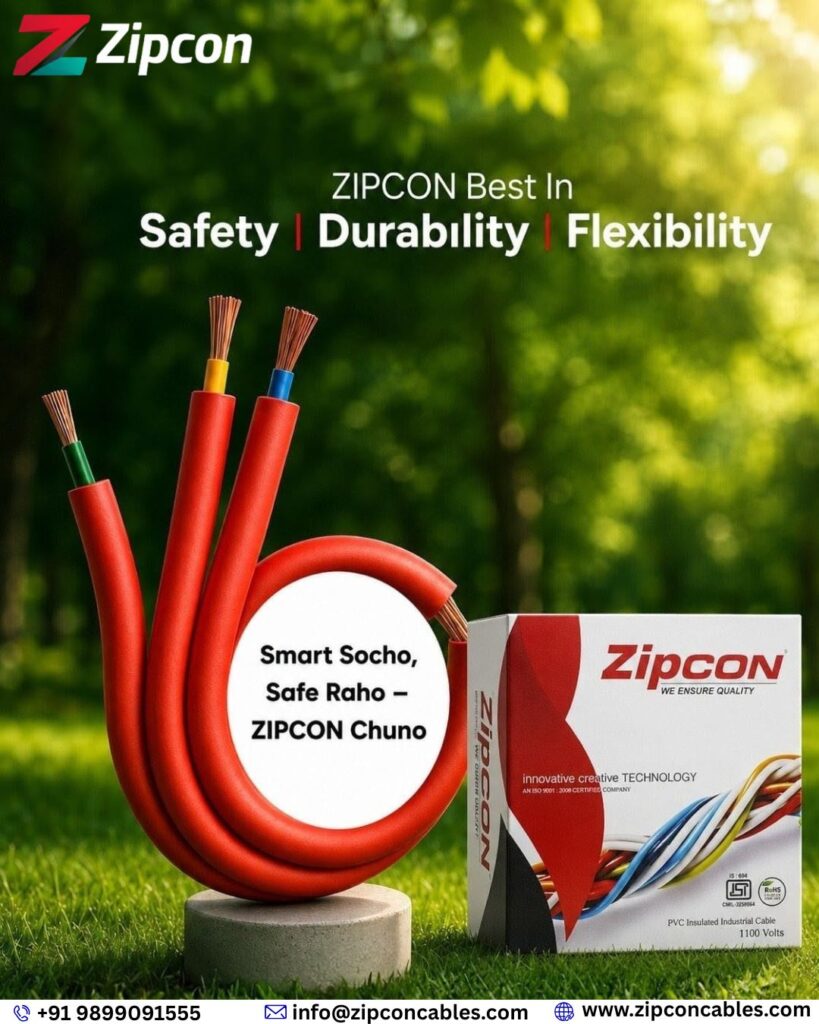
flexible cable in Bhopal is important when electrical wiring needs to handle movement, bending, equipment connections, or confined installation spaces. A cable that combines suitable flexibility with dependable insulation and conductor quality can make installation easier while supporting reliable electrical performance.
Flexible cables are commonly used where rigid wiring is inconvenient or where equipment and connections require controlled movement. Their construction typically uses finely stranded conductors, allowing the cable to bend more easily than comparable solid-conductor wiring.
For homes, offices, commercial spaces, machinery, appliances, and suitable industrial applications, Zipcon Cables offers electrical cable solutions designed for dependable performance. The correct cable should always be selected according to current capacity, voltage, installation conditions, temperature, and the specific application.
For inquiries or assistance:– https://zipconcables.com/contact-us/
What Is a Flexible Cable?
A flexible cable is an electrical cable designed to bend more readily than conventional rigid cable constructions. Its flexibility is generally achieved through the use of stranded conductors made from multiple smaller wires.
The conductors are individually insulated and enclosed within an outer protective layer, depending on the cable design. This construction allows the cable to accommodate movement and routing requirements without making installation unnecessarily difficult.
Flexible cables are available in different conductor materials, core configurations, sizes, insulation types, and voltage ratings. The correct specification depends on where and how the cable will be used.
Why Flexible Cables Are Important for Electrical Wiring
Electrical installations do not always involve straight, fixed cable routes. Wiring may need to pass around corners, connect moving equipment, or fit into restricted spaces.
A suitable flexible cable can make these installations easier to manage. Its ability to bend helps reduce unnecessary routing difficulties while keeping the electrical connection organized.
However, flexibility alone does not determine cable quality. Conductor capacity, insulation, sheath construction, temperature rating, mechanical strength, and application suitability are equally important.
Key Benefits of Flexible Cables
- Easier routing around bends
- Suitable for applications involving controlled movement
- Convenient connections to electrical equipment
- Reduced installation difficulty in confined areas
- Multiple conductor and size options
- Suitable for residential, commercial, and industrial applications
- Reliable performance when correctly selected and installed
How Flexible Cable Construction Works
Stranded Conductors
The conductor in a flexible cable generally consists of multiple fine strands rather than one solid piece. These strands can move slightly relative to one another, allowing the overall conductor to bend more easily.
The number and size of strands can vary depending on the cable’s construction and intended application. Conductor design should be considered alongside the cable’s electrical rating.
Insulation
Insulation surrounds each conductor and provides electrical separation. It helps prevent unwanted contact between conductors and protects the conductor from external influences.
The insulation material must be suitable for the cable’s voltage, temperature, and intended environment.
Outer Sheath
Many flexible cable constructions include an outer sheath that protects the internal conductors. Depending on the cable type, the sheath may provide protection against mechanical stress and environmental exposure.
The cable should be selected according to the conditions it will encounter during installation and operation.
Where Flexible Cables Are Used
Home Electrical Applications
Flexible cables can be useful for suitable appliance connections, equipment wiring, extension arrangements, and other applications where flexibility is required.
For fixed house wiring, the cable type should be selected according to the electrical installation design rather than using flexible cable simply because it is easier to bend.
Commercial Buildings
Offices, shops, hotels, and other commercial spaces can contain electrical equipment requiring flexible connections. A suitable cable can simplify equipment routing and maintenance.
Industrial Equipment
Industrial machinery may involve vibration or controlled movement. Flexible cables designed for the specific application can help accommodate such movement.
The cable’s flexibility rating and mechanical characteristics should be verified before use in continuously moving applications.
Electrical Panels and Equipment
Equipment connections can involve restricted spaces and multiple bends. Flexible cable can provide practical routing where the cable specification permits its use.
Flexible Cable vs Rigid Cable
Both flexible and rigid cables have important applications. The appropriate choice depends on installation requirements.
| Feature | Flexible Cable | Rigid Cable |
|---|---|---|
| Conductor construction | Usually stranded | Often solid or less-flexible stranded |
| Bending | Easier | More limited |
| Moving equipment | Suitable for specified applications | Generally less suitable |
| Fixed installation | Application-dependent | Common in suitable fixed wiring |
| Equipment connections | Convenient | May be less convenient |
| Routing | Useful around bends | Better for planned fixed routes |
The key is not to treat flexible cable as universally better. It should be selected when its characteristics match the electrical and mechanical requirements of the installation.
How to Choose the Right Flexible Cable in Bhopal
1. Check the Electrical Load
Determine the expected current before choosing the cable. The conductor’s cross-sectional area should be suitable for the load and installation conditions.
An undersized cable can experience excessive heating and voltage drop. Cable selection should therefore be based on proper electrical calculations.
2. Select the Correct Voltage Rating
The cable should have a voltage rating appropriate for the electrical system. Using a cable outside its intended rating can compromise safety and performance.
Always check the manufacturer’s specifications before installation.
3. Consider Cable Length
Longer cable runs can increase voltage drop. If the cable is carrying significant current over a longer distance, conductor sizing should account for the expected voltage drop.
4. Consider Movement
Not every flexible cable is designed for continuous movement. If the cable will repeatedly flex, twist, or move with machinery, choose a cable specifically rated for that duty.
For normal equipment connections, a standard flexible cable may be sufficient if its specifications match the application.
5. Check Insulation and Sheath
The cable’s insulation and outer sheath should be suitable for the operating temperature, environment, and mechanical conditions.
Outdoor, industrial, wet, or high-temperature installations may require cable constructions specifically designed for those environments.
6. Choose a Reliable Manufacturer
Consistent manufacturing quality is important for electrical cables. Zipcon Cables can be considered for flexible cable requirements where reliable construction and application suitability are priorities.
Examples of Flexible Cable Applications
Example 1: Home Appliance Connection
A home appliance may require a cable that can be routed around furniture or connected within a restricted space. A suitably rated flexible cable can make the connection easier to manage.
The cable must still match the appliance’s current, voltage, temperature, and installation requirements.
Example 2: Electrical Equipment
Electrical equipment may have terminals located in areas where rigid wiring is difficult to route. A flexible cable can provide a more practical connection.
Proper termination is important because loose or poorly fitted connections can create resistance and heating.
Example 3: Small Machinery
A machine may experience controlled movement or vibration during operation. A flexible cable suitable for that specific application can accommodate the movement better than a rigid cable.
For repeated or continuous flexing, however, a cable specifically designed for dynamic applications should be used.
Example 4: Confined Wiring Area
An electrical panel or equipment enclosure may have limited space for cable routing. Flexible construction can make it easier to position the conductors without forcing sharp bends.
The manufacturer’s minimum bending radius should always be respected.
Why Consider Zipcon Cables for Flexible Wiring?
Zipcon Cables provides cable solutions for residential, commercial, and industrial electrical applications. For flexible cable requirements, the appropriate product should be selected according to conductor size, number of cores, voltage rating, insulation, flexibility requirements, and operating environment.
For customers looking for a flexible cable in Bhopal, Zipcon Cables can be considered when dependable electrical performance and practical installation are important.
Whether the application is residential equipment, commercial wiring, or machinery, selecting the right cable specification is more important than choosing a product based only on flexibility or price.
Expert Tips for Flexible Cable Selection
- Calculate the expected electrical load before purchasing. Cable size should match the application’s current requirement.
- Check the voltage rating. Ensure the cable is suitable for the electrical system.
- Choose the right number of cores. The cable configuration should match the circuit or equipment connection.
- Check the required flexibility. Normal bending and continuous flexing are different applications.
- Respect the minimum bending radius. Avoid forcing the cable into excessively tight bends.
- Use suitable terminals and connectors. Correct termination helps maintain a reliable electrical connection.
- Consider the environment. Temperature, moisture, chemicals, vibration, and mechanical exposure can affect cable selection.
- Have installation performed professionally. Electrical wiring should follow applicable safety and installation requirements.
Common Mistakes to Avoid
Choosing Only on Flexibility
A highly flexible cable is not automatically suitable for every application. Current capacity, voltage rating, insulation, temperature, and environmental requirements must also be considered.
Using an Undersized Cable
A cable that cannot safely carry the expected load may overheat or experience excessive voltage drop. Correct conductor sizing is essential.
Excessive Bending
Flexible does not mean bendable without limits. Repeated sharp bending can damage conductors or insulation if the cable is not designed for that type of movement.
Using the Wrong Cable for Continuous Movement
Standard flexible cables and continuously flexing cables are not necessarily interchangeable. Machinery applications requiring repeated movement should use an appropriately designed cable.
Ignoring Cable Length
Voltage drop can become significant over longer cable routes. Cable length should be included in the selection process.
Poor Termination
Loose terminals, unsuitable connectors, or damaged conductor strands can create high-resistance connections. Proper stripping and termination techniques are essential.
Flexible Cable for Residential Electrical Safety
Residential wiring supplies power to lighting, fans, appliances, computers, pumps, and other equipment. The cable used for each application should be selected according to the electrical load and installation method.
Flexible cable can be useful for specific equipment connections and applications requiring bending. However, it should not be used indiscriminately as a replacement for every type of fixed house wiring.
A safe electrical installation depends on the complete system—including cable selection, circuit protection, connections, routing, earthing, and professional installation.
Why Reliable Flexible Wiring Matters in Bhopal
Electrical cables in Bhopal homes, businesses, and industrial environments can encounter different operating conditions. Indoor equipment, outdoor connections, machinery, and confined installations each create different cable requirements.
Choosing a cable designed for the actual application can help improve reliability and reduce avoidable maintenance issues. Proper installation also plays a major role in protecting the cable from physical and environmental damage.
For this reason, buyers should evaluate flexible cables based on technical specifications rather than selecting a product simply because it is inexpensive or easy to bend.
Conclusion
Choosing the right flexible cable in Bhopal can improve the practicality and reliability of electrical connections where bending, equipment access, or controlled movement is required. However, flexibility should always be considered alongside conductor size, voltage rating, insulation, sheath construction, cable length, and operating environment.
For residential, commercial, and suitable industrial applications, Zipcon Cables is an option to consider for dependable flexible cable solutions. Select the correct cable according to the electrical requirements and have the installation completed using proper electrical practices.
Choose the right flexible cable with Zipcon Cables for safer connections, easier routing, and dependable electrical performance.
Top 5 FAQs
1. What is a flexible cable?
A flexible cable is an electrical cable designed to bend more easily than rigid cable constructions. It commonly uses stranded conductors that allow the cable to accommodate bending and, for suitable cable types, controlled movement.
2. Is flexible cable suitable for home wiring?
Flexible cable can be suitable for specific residential applications, such as equipment and appliance connections. Fixed house wiring should use a cable type appropriate to the installation design and applicable requirements.
3. What makes a cable flexible?
The use of multiple fine conductor strands generally gives a cable greater flexibility than a solid conductor. The cable’s insulation, sheath, strand construction, and overall design also affect its flexibility.
4. How do I select the right flexible cable?
Consider the electrical load, voltage rating, conductor size, number of cores, cable length, temperature, installation environment, and amount of movement. For continuous movement, verify that the cable is specifically designed for dynamic applications.
5. Why choose Zipcon Cables for flexible cable?
Zipcon Cables offers electrical cable solutions for different applications. Customers looking for flexible cable can select the appropriate Zipcon product based on electrical rating, conductor size, construction, flexibility requirements, and installation conditions.