
Industrial and residential solar projects in Gurgaon demand more than just quality panels and inverters. The performance of the entire system depends heavily on the cables that connect modules, combiner boxes, and inverters. In high-temperature conditions, dusty environments, and constant UV exposure typical of North India, selecting the right solar cable directly impacts efficiency, safety, and long-term return on investment.
For EPC contractors and project developers, cable failure is not a minor issue. It can lead to voltage drops, power loss, overheating, and even fire risks. That is why working with a technically strong manufacturer like Zipcon Cables in Gurgaon becomes critical for ensuring consistent performance and compliance in industrial solar installations.
For inquiries or assistance:👉 https://zipconcables.com/contact-us/
What is a Solar Cable?
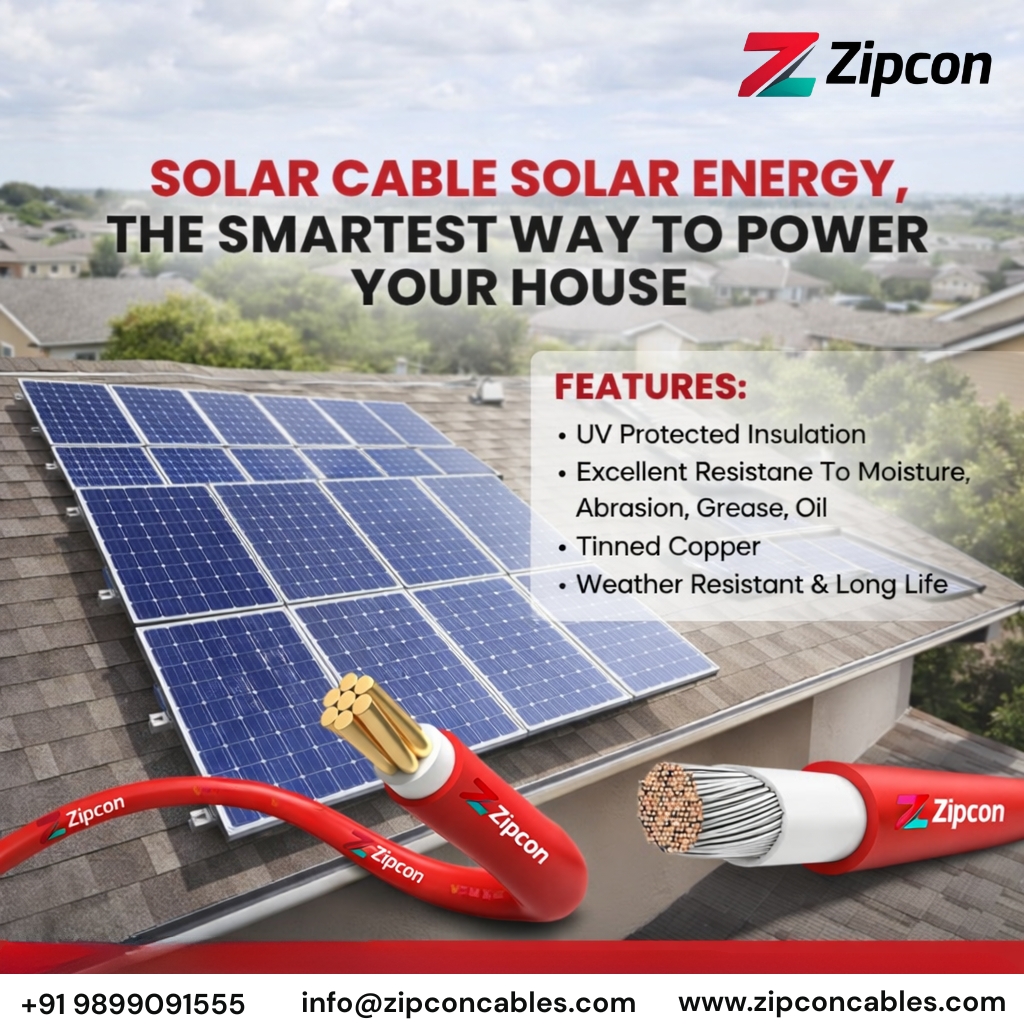
A solar cable is a specially designed DC cable used to connect solar panels and other photovoltaic system components. It is engineered to handle outdoor exposure and high electrical loads over long periods.
Key technical features include:
- Tinned copper conductors that improve corrosion resistance and conductivity.
- UV-resistant outer insulation that protects against sunlight degradation.
- XLPO or XLPE insulation designed for high thermal stability and durability.
- High DC voltage handling capacity, typically up to 1000V or 1500V.
- Temperature resistance ranging from -40°C to +90°C or higher under load.
Unlike standard electrical wires, solar cables are designed specifically for long-term outdoor DC applications.
Key Factors to Consider in Industrial Solar Projects
Conductivity
Higher conductivity means lower energy loss. Copper conductors offer superior conductivity, reducing voltage drop across long cable runs. In large rooftop and ground-mounted installations, this directly affects overall system efficiency and energy yield.
Durability and UV Resistance
In Gurgaon’s climate, cables are exposed to heat, dust, and strong sunlight. Poor-quality insulation can crack or degrade over time. XLPO or XLPE insulation ensures long-term mechanical and thermal stability. This is especially important in ground-mounted solar farms where cables remain exposed for years.
Weight and Handling
Copper cables are heavier, which can increase structural load considerations on rooftops. Aluminium cables are lighter and easier to handle for long runs. However, lighter weight must be balanced against performance requirements.
Cost and Long-Term ROI
Aluminium cables are generally more cost-effective upfront. Copper cables are more expensive but reduce energy losses and maintenance risks. For large-scale projects, lifecycle cost matters more than initial savings.
Safety and Fire Resistance
Industrial installations must minimize fire risk. High-quality solar cables should be flame-retardant, halogen-free, and capable of handling overload conditions. Poor insulation increases the risk of insulation failure and short circuits.
Installation Requirements
Copper cables are easier to terminate and require smaller cross-sections for the same current rating. Aluminium cables require larger cross-sections and proper lugging techniques to avoid loose connections and overheating.
Voltage Drop Performance
In a 1 MW plant, long cable runs are common. Even small voltage drops can result in measurable power loss. Copper’s higher conductivity makes it more efficient for longer distances.
Compliance with Solar Standards
Industrial projects must comply with IEC and relevant Indian standards for solar DC cables. Using certified, tested cables from manufacturers like Zipcon Cables ensures regulatory compliance and reduces project approval issues.
Copper vs Aluminium Solar Cables – Practical Comparison
Electrical Conductivity
Copper: Higher conductivity, lower resistance.
Aluminium: Lower conductivity, requires larger size for same performance.
Weight
Copper: Heavier.
Aluminium: Approximately 30–40% lighter.
Cost
Copper: Higher upfront cost.
Aluminium: More economical initially.
Installation Complexity
Copper: Easier termination, compact design.
Aluminium: Requires larger cross-section and careful jointing.
Long-Term Performance
Copper: Better long-term stability and lower maintenance risk.
Aluminium: Suitable for controlled environments but needs proper installation practices.
Corrosion Resistance
Tinned copper offers excellent corrosion resistance. Aluminium may require additional protection in humid or polluted conditions.
Real-World Scenarios
1 MW Industrial Rooftop Plant
In rooftop installations, cable runs are moderate but structural load and safety are critical. Copper solar cables perform better due to lower voltage drop and easier installation in confined spaces. Tinned copper with UV-resistant insulation is the safer long-term choice.
Large Ground-Mounted Solar Farm
Here, cable lengths are significant. Aluminium cables may be considered for cost efficiency in long AC runs. However, for DC string connections and combiner box connections, copper cables provide better reliability and reduced energy losses.
Commercial Warehouse Installation
For mid-sized commercial rooftops, copper cables are generally preferred. They offer stable performance, better heat handling, and reduced maintenance requirements.
Direct Recommendation Guide
Choose copper solar cable when:
- You are dealing with high-current DC strings.
- Cable runs are long and voltage drop must be minimized.
- The installation is rooftop-based with limited space.
- Long-term performance and minimal maintenance are priorities.
Aluminium may be suitable when:
- Budget constraints are significant.
- Cable runs are extremely long in AC distribution sections.
- Proper installation and termination practices are ensured.
Premium UV-resistant cable is non-negotiable when:
- Cables are exposed directly to sunlight.
- Projects are located in high-temperature zones like Gurgaon.
- Long operational life (20–25 years) is expected.
Why Choose Zipcon Cables in Gurgaon
Zipcon Cables has established itself as a technically reliable manufacturer for industrial and large-scale solar projects. Their solar cables are engineered with high-grade conductors and durable insulation systems designed to handle North Indian climate conditions.
Key strengths include:
- Strict manufacturing quality control.
- High DC voltage-rated cables suitable for industrial applications.
- Robust XLPO/XLPE insulation for UV and heat resistance.
- Consistent performance under harsh outdoor conditions.
- Trusted supply for commercial and industrial solar installations.
For engineers, procurement managers, and EPC contractors in Gurgaon, selecting the right cable is not just a specification decision. It is a performance and risk-management decision. Choosing technically sound solar cables from Zipcon Cables ensures system efficiency, regulatory compliance, and long-term reliability.
In large-scale solar installations, the right cable is not an accessory. It is a core component that determines how efficiently your project performs over the next two decades.