The best industrial cables in India need to deliver consistent electrical performance under demanding operating conditions. Industrial installations can expose cables to heat, moisture, vibration, mechanical stress, chemicals, continuous loads, and frequent movement. A cable selected only by price may not provide the reliability required for such environments.
For factories, machinery, control panels, commercial facilities, infrastructure projects, and power distribution systems, cable selection should consider conductor material, cross-sectional area, insulation, number of cores, voltage rating, flexibility, installation method, and environmental conditions. ZIPCON Cables offers industrial cable solutions designed for dependable electrical connectivity across diverse applications.
For inquiries or assistance:👉 https://zipconcables.com/contact-us/
What Are Industrial Cables?
Industrial cables are electrical cables designed for demanding commercial and industrial environments. They are used to transmit electrical power, connect machinery, operate control systems, and support electrical distribution within industrial facilities.
Unlike basic residential wiring, industrial cables may need to handle higher loads, longer operating periods, mechanical movement, vibration, elevated temperatures, and challenging installation conditions. Their construction therefore needs to match the requirements of the specific application.
Why Industrial Cable Quality Matters
A cable is a critical part of an industrial electrical system. If its conductor, insulation, or construction is unsuitable for the operating environment, the resulting failure can affect machinery, production schedules, maintenance costs, and workplace safety.
High-quality industrial cables provide predictable electrical characteristics and appropriate mechanical protection. Choosing the right cable also helps reduce installation problems and supports reliable operation over the expected service period.
Conductor Quality
The conductor determines how effectively electrical current is carried through the cable. Copper is commonly used where high conductivity and flexibility are required, while aluminium can be suitable for applications where lower weight and cost are important considerations.
Conductor size should be selected according to the expected current, voltage drop, installation conditions, and applicable technical requirements. A larger conductor is not automatically the best choice; the cable should be correctly engineered for the load.
Insulation Performance
Industrial cables can operate in environments that are considerably more demanding than residential spaces. Insulation needs to provide appropriate electrical separation while tolerating the temperatures and environmental conditions expected during operation.
The insulation material and construction should therefore be selected according to voltage, temperature, moisture exposure, mechanical requirements, and the intended application.
Mechanical Durability
Industrial cables can encounter pulling forces, bending, vibration, abrasion, and movement. Cable construction must be suitable for these stresses to prevent premature deterioration.
For applications involving machinery or repeated movement, a suitable flexible cable can offer better handling and operational suitability than a cable designed primarily for fixed installation.
Types of Industrial Cables
Different industrial systems require different cable constructions. Selecting the appropriate type can improve installation efficiency and system reliability.
Industrial Power Cables
Industrial power cables are used for electrical power transmission and distribution in factories, commercial facilities, equipment installations, and infrastructure projects.
The required cable size depends on factors such as load current, voltage, cable length, installation method, ambient temperature, and voltage-drop requirements.
Multicore Industrial Cables
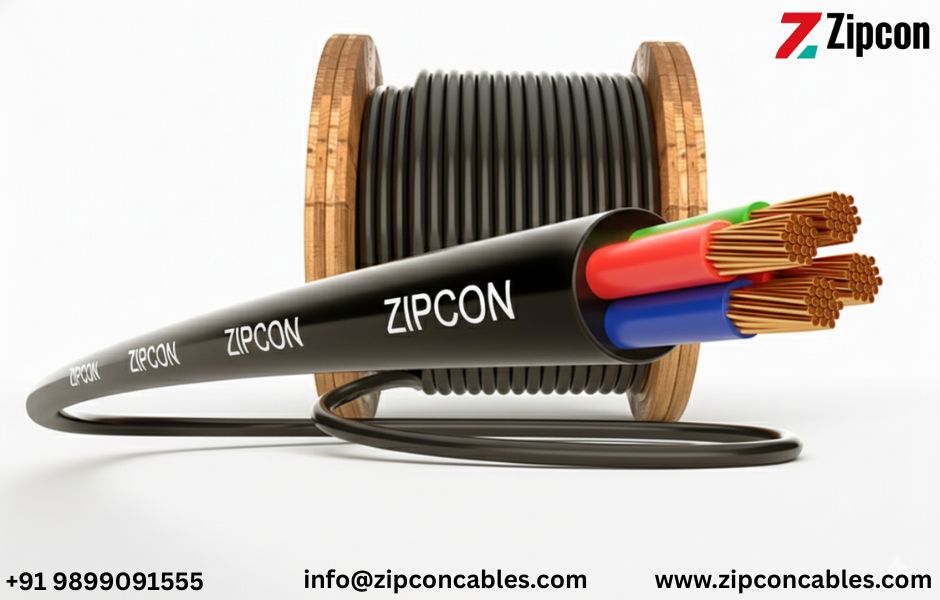
Multicore cables contain several individually insulated conductors within a common outer sheath. They can reduce the number of separate cables required for equipment and control connections.
They are particularly useful where multiple electrical circuits need to be routed together, including control panels, machinery, instrumentation, and industrial equipment.
Flexible Industrial Cables
Flexible cables are designed for installations where bending or movement is part of normal operation. They can be used around machinery, control equipment, electrical panels, and other systems where cable routing requires flexibility.
When choosing a flexible industrial cable, consider the number of cores, conductor size, voltage rating, bending requirements, operating temperature, and frequency of movement.
Control Cables
Control cables are used to transmit signals and control functions between industrial equipment, panels, machines, and automation systems.
Correct selection requires attention to the number of cores, conductor construction, insulation, shielding requirements where applicable, and the electrical characteristics of the control system.
Special-Purpose Industrial Cables
Certain industrial environments require cables designed for specific conditions such as high temperatures, outdoor exposure, moisture, continuous movement, or other demanding operating factors.
The cable should always be selected based on its specified application rather than adapting a general-purpose cable to an environment for which it was not designed.
How to Choose the Best Industrial Cables in India
Choosing an industrial cable involves more than selecting a conductor size. The complete operating environment should be considered before placing an order.
1. Calculate the Electrical Load
Start by determining the expected current and voltage requirements. The conductor must have suitable current-carrying capacity for the installation.
For example, a cable powering heavy machinery may require a substantially different conductor size from a cable used for a low-power control circuit.
2. Consider Cable Length
Long cable runs can increase voltage drop. This can become important in factories, warehouses, infrastructure projects, and large commercial facilities where equipment may be located far from distribution points.
Cable sizing should therefore consider both current capacity and acceptable voltage drop.
3. Evaluate the Environment
Industrial cables may be exposed to heat, moisture, dust, oil, chemicals, sunlight, vibration, or mechanical impact.
Identify the actual environmental conditions before choosing the insulation and outer sheath. A cable suitable for an indoor control panel may not be suitable for an exposed outdoor installation.
4. Check Flexibility Requirements
If a cable remains fixed throughout its service life, a fixed-installation cable may be appropriate. If it moves repeatedly with machinery, a flexible cable designed for the required movement should be considered.
Ignoring movement requirements can result in excessive bending stress and premature cable damage.
5. Select the Required Number of Cores
The core configuration should match the electrical circuit. Industrial installations may require single-core, multicore, two-core, three-core, four-core, or other configurations depending on the system design.
Choosing the correct core arrangement can simplify installation and reduce unnecessary connections.
Applications of Industrial Cables
Industrial cables support a wide range of electrical and automation systems.
Manufacturing Plants
Factories use cables for machinery power supplies, control panels, production equipment, motors, distribution systems, and internal electrical networks.
Because manufacturing environments can involve continuous operation and machinery movement, cable selection should account for both electrical and mechanical conditions.
Control Panels
Control panels may contain numerous circuits that require organized connections between switches, controllers, sensors, relays, and other equipment.
Multicore and control-oriented cable solutions can simplify routing and help maintain organized electrical installations.
Industrial Machinery
Machinery may require cables capable of handling continuous electrical loads, vibration, movement, or repeated bending.
The cable should be selected according to the machine’s electrical specifications and movement profile rather than using a standard cable as a universal solution.
Commercial Infrastructure
Large buildings, warehouses, commercial facilities, and infrastructure projects can require cables for power distribution, equipment connections, control systems, and other electrical applications.
Proper cable sizing and installation planning become especially important as cable runs and electrical loads increase.
Solar and Renewable Energy Projects
Industrial and commercial solar installations require suitable DC and AC cable systems. Cable selection should account for system voltage, current, cable length, outdoor exposure, temperature, and installation conditions.
Solar-specific cable products should be used where the installation requires them rather than substituting general-purpose electrical wiring.
Examples of Industrial Cable Selection
Example 1: Factory Machinery
A manufacturing unit operating heavy machinery may need power cables with suitable conductor capacity and insulation for continuous operation.
The correct selection would consider machine load, supply voltage, cable length, installation route, ambient temperature, and whether the cable remains fixed or moves with the equipment.
Example 2: Automated Control Panel
An automated production line may require multiple connections between sensors, controllers, relays, and machinery.
A suitable multicore or control cable can help organize these connections and reduce the complexity of routing numerous individual wires.
Example 3: Moving Equipment
A machine with a moving carriage or mechanical arm may repeatedly bend the connected cable.
A flexible industrial cable designed for the required movement pattern is more appropriate than a fixed-installation cable that is not intended for repeated flexing.
Expert Tips for Selecting Industrial Cables
Prioritize application suitability: Select the cable according to the actual operating environment rather than choosing based only on price or appearance.
Check technical specifications: Review conductor size, voltage rating, insulation, number of cores, temperature range, and other relevant specifications before purchase.
Plan for voltage drop: For long cable runs, evaluate voltage drop in addition to current-carrying capacity.
Consider future requirements: If the electrical system may expand, cable infrastructure should be planned with appropriate engineering considerations rather than making assumptions about future loads.
Use appropriate installation practices: Even a high-quality cable can perform poorly when incorrectly routed, excessively bent, improperly terminated, or exposed to conditions outside its intended specification.
Source from reliable manufacturers: Consistent manufacturing and clear product specifications make cable selection easier and reduce uncertainty during procurement.
Common Mistakes When Buying Industrial Cables
Choosing the Cheapest Cable
Price is important in industrial procurement, but it should not be the only selection criterion. A low-cost cable that is unsuitable for the application can increase maintenance and replacement costs.
Using Residential Wires for Industrial Applications
Residential house wires and industrial cables are designed for different operating requirements. Industrial machinery and power systems may require specific cable constructions, sizes, and insulation characteristics.
Ignoring the Installation Environment
Heat, moisture, chemicals, vibration, sunlight, and mechanical stress can affect cable performance. Environmental conditions should always be evaluated before selection.
Selecting the Wrong Cable Size
An incorrectly sized cable can create electrical and operational problems. Cable sizing should account for current, voltage drop, installation method, temperature, and other relevant factors.
Overlooking Mechanical Movement
A cable used with moving machinery must be suitable for the expected bending and movement. Using a cable without considering its flexing requirements can shorten its service life.
Why ZIPCON Cables Is a Suitable Choice for Industrial Applications
For buyers searching for the best industrial cables in India, the right choice should combine product suitability, reliable construction, consistent manufacturing, and application-focused selection.
ZIPCON Cables provides cable solutions across industrial and electrical applications, including flexible cables, multicore round cables, power-oriented cables, house wires, solar cables, and submersible cables. This range allows contractors, manufacturers, electricians, distributors, and project buyers to select products according to their specific requirements.
Rather than treating every industrial application the same, ZIPCON’s product range supports selection based on load, flexibility, core configuration, installation conditions, and intended use.
Conclusion
The best industrial cables in India are not defined by branding alone. Reliable performance depends on selecting the right conductor, insulation, cable size, core configuration, flexibility, and construction for the operating environment.
For factories, machinery, control panels, commercial facilities, infrastructure projects, and specialized installations, ZIPCON Cables offers a range of cable solutions designed for different electrical requirements.
Before purchasing, evaluate the load, voltage, cable length, environmental exposure, mechanical movement, number of cores, and installation method. Then select the ZIPCON cable that matches the technical requirements of the project.
Top 5 FAQs
1. What are the best industrial cables in India?
The best industrial cable depends on the application, electrical load, voltage, installation environment, flexibility requirements, and applicable technical specifications. ZIPCON offers different cable types for industrial and electrical applications.
2. Which cable is suitable for industrial machinery?
The appropriate cable depends on the machinery’s power requirements, voltage, operating environment, cable length, and movement. Flexible industrial cables may be suitable where machinery causes repeated cable movement.
3. How do I select the correct industrial cable size?
Consider current load, voltage, cable length, voltage drop, installation method, ambient temperature, and relevant technical requirements. Cable sizing should be based on the complete installation rather than current alone.
4. Are multicore cables useful for industrial applications?
Yes. Multicore cables can simplify installations where several electrical circuits, control connections, or signals need to be routed together. The required number of cores and cable construction depend on the application.
5. Why is insulation important in industrial cables?
Insulation provides electrical separation and helps protect the conductor from environmental and mechanical conditions. The appropriate insulation must be selected according to voltage, temperature, moisture, movement, and the intended installation environment.