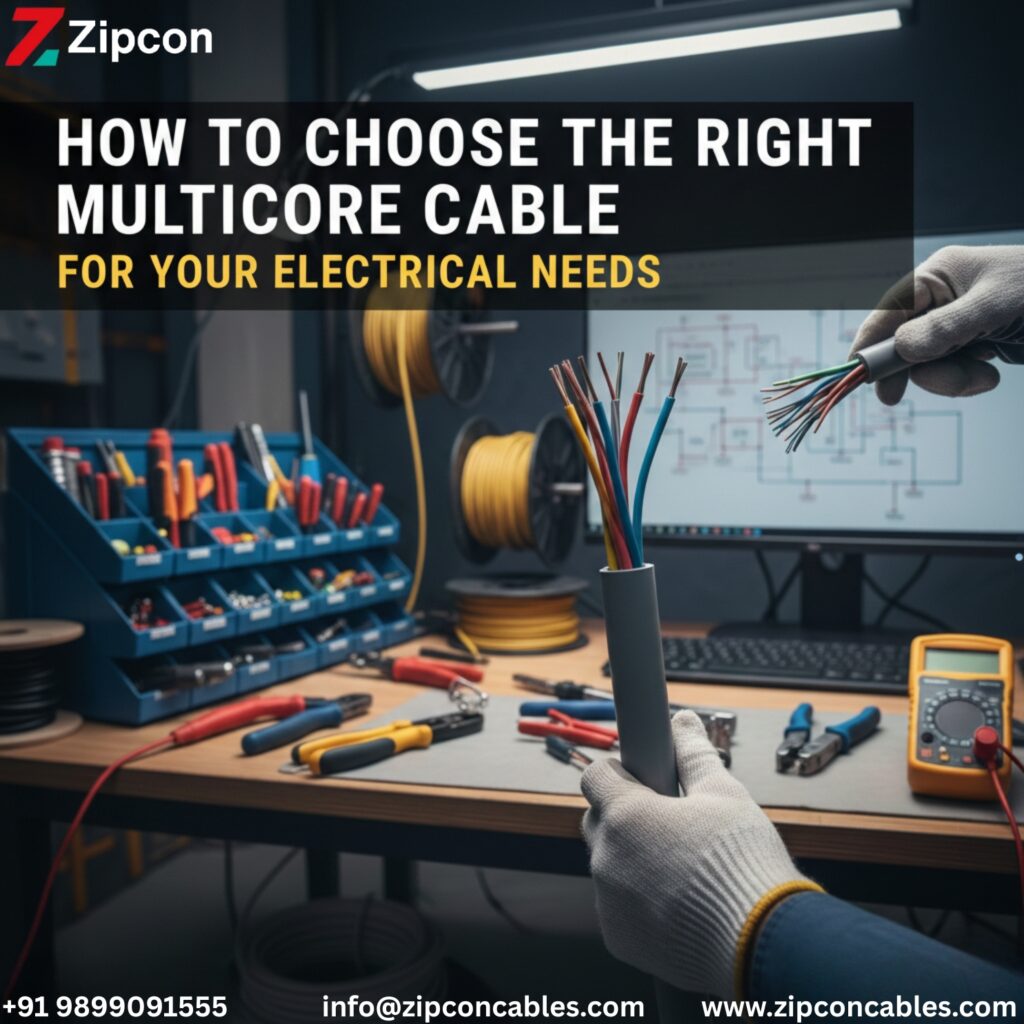
Choosing the right multicore cable manufacturer in india is a critical decision that directly impacts electrical performance, safety, installation efficiency, and long-term operating cost. For engineers, electricians, procurement managers, and industrial buyers, the challenge is not understanding what a multicore cable is—but selecting the right one for the job.
This guide, developed using the practical experience behind Zipcon Cables, is designed to help buyers make confident, application-driven decisions without unnecessary theory or marketing noise.
For inquiries or assistance, visit: 👉https://zipconcables.com/contact-us/
Understanding Multicore Cables in Real Applications
Multicore cables consist of multiple insulated conductors bundled within a single outer sheath. They are used to carry power, control signals, or data where multiple circuits must run together safely and efficiently. The key benefit is simplified installation, better cable management, and reduced risk of wiring errors.
However, these benefits are only realized when the cable is correctly selected for load, environment, and usage conditions—an area where many projects face avoidable failures.
Core Evaluation Factors That Influence Cable Selection
Electrical conductivity and performance efficiency
Conductivity determines how effectively current flows through the cable. Poor conductivity leads to voltage drop, energy loss, and heat buildup. For high-load systems, control panels, and continuous-duty operations, high-conductivity conductors ensure stable performance and energy efficiency. Zipcon Cables designs multicore cables with consistent conductor quality to support reliable current flow under demanding conditions.
Mechanical durability and lifespan
In real-world installations, cables are exposed to bending, vibration, abrasion, and occasional impact. A multicore cable must maintain insulation integrity and conductor alignment throughout its service life. Industrial buyers prioritize durability because cable failure often leads to costly downtime, not just replacement cost.
Weight and handling implications
Cable weight affects installation speed, routing flexibility, and termination quality. Heavier cables require more effort during installation, especially in compact panels or overhead trays. The right balance between conductor material and insulation design helps installers work faster and with fewer errors.
Cost considerations: initial cost vs long-term value
Initial cable cost is only one part of the equation. Maintenance, energy loss, safety risk, and replacement frequency define the true lifecycle cost. Many buyers choose Zipcon Cables because the long-term reliability of a well-built multicore cable outweighs short-term savings.
Safety standards and compliance
Electrical safety is non-negotiable. Compliance with fire resistance, insulation performance, and conductor standards protects both equipment and people. Non-compliant cables can delay approvals and increase liability. Zipcon Cables manufactures multicore cable aligned with relevant safety and quality benchmarks for commercial and industrial use.
Installation requirements
Flexibility, bending radius, sheath quality, and ease of termination all affect installation efficiency. A cable that is difficult to route or terminate increases labor time and error risk, even if its electrical ratings look adequate on paper.
Copper vs Alternative Cable Materials: Practical Comparison
Where copper multicore cables perform best
Copper offers superior electrical conductivity, excellent heat resistance, and consistent mechanical strength. Copper multicore cables from Zipcon Cables are preferred in high-load applications, critical systems, manufacturing plants, and environments where long-term reliability is essential. They handle voltage fluctuations better and maintain performance over extended operating cycles.
Where alternative materials may be suitable
Aluminum or alloy-based conductors are lighter and generally more cost-effective upfront. They may be suitable for short-distance runs, lightweight installations, or projects with strict budget constraints. However, they often require larger conductor sizes and more careful termination practices.
Quick decision view
Copper: higher performance, longer life, higher initial cost
Alternatives: lighter weight, lower upfront cost, limited-duty suitability
Real-World Application Scenarios
Industrial machinery and manufacturing plants
Multicore cables reduce wiring complexity in machines carrying power and control signals together. Copper multicore cables are preferred for their load-handling capability, vibration resistance, and thermal stability—key strengths offered by Zipcon Cables.
Commercial buildings and infrastructure
Used in HVAC systems, elevators, lighting controls, and automation networks. Copper multicore cables are commonly specified for safety compliance, fire resistance, and long-term operational reliability.
Residential wiring and compact installations
Multicore cables help manage space in distribution boards and concealed wiring. While alternative materials may work in low-load residential setups, copper remains the safer choice where durability and future expansion are concerns.
Renewable energy and control panel systems
Solar installations and automation panels rely on multicore cables for stable signal transmission and organized layouts. Copper multicore cables perform better in heat-intensive environments and ensure accurate control and monitoring.
A Clear Decision Framework
To select the right multicore cable, ask:
What is the electrical load and duty cycle?
Higher loads favor copper multicore cables.
What environment will the cable face?
Heat, moisture, vibration, or movement require durable construction.
What safety and compliance level is required?
Commercial and industrial projects typically demand copper-based solutions.
What is the expected lifecycle cost?
Reliable cables reduce maintenance, downtime, and replacement risk.
Final Recommendation
Copper multicore cables are the right choice for industrial machinery, commercial infrastructure, control panels, and any application where performance stability, safety, and service life matter. Alternative materials may suit lightweight, low-load, or cost-sensitive applications with controlled conditions.
Zipcon Cables delivers multicore cable solutions engineered for real operating environments—combining electrical efficiency, mechanical strength, and installation practicality. For buyers who prioritize dependable performance over short-term compromises, choosing the right multicore cable starts with informed selection and a trusted manufacturer.