

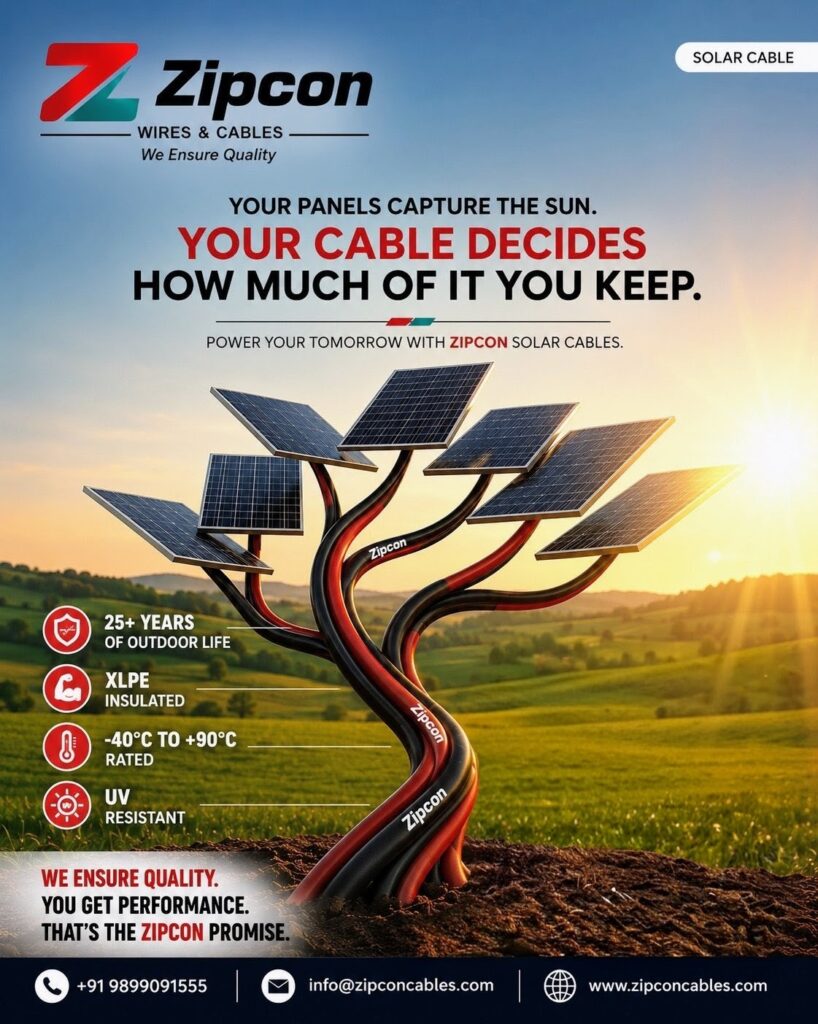
solar cables in Indore is important for getting safe, stable, and long-lasting performance from a solar power system. Solar cables carry electrical power continuously while being exposed to heat, sunlight, moisture, dust, and changing outdoor conditions. A cable that is not designed for these conditions can affect system efficiency and reliability.
For residential rooftops, commercial installations, solar water pumps, and industrial solar projects, cable quality should never be treated as a minor component. Zipcon Cables offers solar cable solutions designed for demanding applications, with emphasis on insulation quality, durability, flexibility, and dependable electrical performance.
The right solar cable helps create a stronger connection between solar panels, inverters, batteries, pumps, and other system components. Selecting the appropriate cable size, insulation, voltage rating, and installation method can also reduce avoidable electrical losses and maintenance requirements.
For inquiries or assistance, visit: 👉https://zipconcables.com/contact-us/
Why Solar Cable Quality Matters in Indore
Indore experiences hot summers, dust, monsoon moisture, and significant temperature variations throughout the year. Solar cables installed outdoors must therefore withstand environmental exposure without quickly losing their insulation properties or flexibility.
Ordinary electrical wires are not always suitable for photovoltaic installations. Solar cables are specifically designed for applications where cables remain exposed to sunlight, temperature fluctuations, moisture, and mechanical stress.
A high-quality solar cable should provide:
- Reliable electrical conductivity
- Strong insulation
- Resistance to heat and sunlight
- Good flexibility for installation
- Protection against moisture and environmental exposure
- Long-term mechanical durability
- Suitable voltage and current handling capacity
These characteristics make cable selection an important part of designing a dependable solar installation.
What Makes the Best Solar Cables in Indore?
Not every cable is suitable for every solar project. The best solar cable depends on the installation type, current capacity, cable length, environmental conditions, and equipment being connected.
1. High-Quality Insulation
Solar cables require insulation that can withstand outdoor operating conditions. Quality insulation helps protect the conductor from moisture, heat, abrasion, and accidental electrical contact.
For rooftop and industrial installations, insulation quality becomes particularly important because cables may remain exposed to environmental conditions for years.
2. Excellent Temperature Resistance
Solar installations can operate under high temperatures, especially during peak summer. Cable materials should be selected according to the expected operating temperature and application requirements.
A cable with suitable temperature resistance can maintain its electrical and physical properties more reliably under continuous solar exposure.
3. Resistance to UV Exposure
Solar cables are frequently routed outdoors, where ultraviolet radiation can gradually deteriorate unsuitable insulation materials.
UV-resistant cable construction helps reduce premature cracking, hardening, and insulation deterioration. This is one reason dedicated solar cables are preferred over ordinary household wires for photovoltaic applications.
4. Flexibility for Easy Installation
Solar projects often require cables to pass through conduits, cable trays, junction boxes, rooftops, and equipment connections. Flexible cables make routing and termination easier.
Good flexibility also helps installers create cleaner cable routes while reducing unnecessary mechanical stress during installation.
5. Appropriate Conductor Size
Cable size directly affects current-carrying capacity and voltage drop. Selecting a cable only by price can lead to an unsuitable conductor size for the system.
For example, a short residential connection may have different requirements from a long industrial solar installation. The cable should therefore be selected based on actual system parameters rather than using the same size for every project.
Solar Cables for Residential Applications in Indore
Residential solar systems generally include rooftop panels, DC cabling, an inverter, AC connections, and sometimes batteries. Each connection needs suitable electrical components designed for its specific purpose.
For rooftop solar installations, cables may be exposed to direct sunlight and high surface temperatures. Proper cable routing, secure connections, and suitable insulation are essential for maintaining system reliability.
Zipcon Cables can be considered for residential solar applications where dependable cable construction and long-term performance are priorities. Homeowners should select the appropriate cable specification based on their solar installer’s design and equipment requirements.
Example: Residential Rooftop Solar
Consider a home installing a rooftop solar system. The solar panels generate DC electricity, which travels through solar cables to the inverter. If the cable is undersized for the installation, excessive voltage drop can occur.
Using a correctly sized, quality solar cable helps maintain a reliable electrical path between the panels and inverter while supporting safer long-term operation.
Solar Cables for Industrial Applications
Industrial solar installations typically involve larger power capacities, longer cable routes, multiple strings, and more demanding operating environments.
In these systems, cable selection becomes even more important because voltage drop, current capacity, installation distance, environmental exposure, and cable management can significantly influence system performance.
Industrial solar cables may be used in:
- Solar power plants
- Manufacturing facilities
- Warehouses
- Commercial buildings
- Agricultural solar systems
- Solar pumping systems
- Large rooftop installations
- Industrial backup power systems
For larger installations, cable sizing should be calculated by a qualified electrical professional based on the system’s voltage, current, route length, permissible voltage drop, installation conditions, and applicable standards.
Solar Cable vs Ordinary Electrical Wire
| Feature | Solar Cable | Ordinary Electrical Wire |
|---|---|---|
| Outdoor solar use | Designed for solar applications | Application-dependent |
| UV exposure | Typically designed for outdoor exposure | May not be suitable |
| Temperature conditions | Designed according to specified rating | Depends on wire type |
| Flexibility | Generally suitable for solar routing | Varies |
| Moisture exposure | Designed according to cable specification | Varies |
| Solar panel connection | Suitable when correctly rated | Not automatically suitable |
| Long-term outdoor use | Application-specific | Depends on construction |
The key difference is not simply the appearance of the cable. It is the cable’s construction, insulation, electrical rating, environmental resistance, and suitability for the intended solar application.
Choosing the Right Solar Cable Size
Cable size should be determined according to the system’s electrical requirements rather than selecting a size based only on availability.
Important factors include:
- System voltage
- Operating current
- Cable length
- Permissible voltage drop
- Installation method
- Ambient temperature
- Number of cables installed together
- Equipment specifications
Simple Example
Suppose a solar installation has a relatively long DC cable route between the panels and inverter. Even when the cable can carry the required current, its length can contribute to voltage drop.
This is why professional system design considers both current-carrying capacity and voltage drop before finalizing cable size.
Where Zipcon Solar Cables Can Be Used
Zipcon Cables can be considered for a range of solar applications where reliable electrical connections and durable cable construction are required.
Common applications include:
Rooftop Solar Systems
Suitable cable selection helps connect solar panels with other system components while supporting dependable outdoor performance.
Solar Water Pumping
Solar pumping systems operate in agricultural and water-management environments where cables may encounter heat, moisture, dust, and mechanical stress. Appropriate cable selection is therefore essential.
Commercial Solar Projects
Commercial buildings often require longer cable routes and larger system capacities than residential installations. Proper sizing and cable management become increasingly important.
Industrial Solar Installations
Industrial systems demand careful attention to current capacity, voltage drop, routing, environmental exposure, and installation standards. Selecting cables according to the system design helps improve operational reliability.
Examples of Solar Cable Selection
Example 1: Home Rooftop Installation
A homeowner installs a rooftop solar system where the distance between the panel array and inverter is relatively short. The installer calculates the expected operating current and voltage drop before selecting the appropriate solar cable.
Here, cable quality and proper sizing are more important than simply choosing the cheapest available option.
Example 2: Industrial Rooftop Project
An industrial facility installs a larger solar system across multiple roof sections. Cable routes are longer and several cables may be grouped together.
In this situation, the installer needs to consider current capacity, voltage drop, ambient temperature, routing, protection, and cable management before finalizing the cable specification.
Example 3: Solar Pump System
A solar-powered pump may require cables to operate in a challenging environment involving water, sunlight, heat, and mechanical movement. The selected cable should match the electrical and environmental requirements of the pumping system.
This demonstrates why solar cable selection must be based on the application rather than using one cable type for every project.
Expert Tips for Buying Solar Cables in Indore
Check the Technical Specification
Before purchasing, verify the conductor material, cross-sectional area, voltage rating, temperature rating, insulation construction, and application suitability.
Avoid Choosing Only by Price
A lower initial purchase price does not necessarily mean lower overall cost. Cable replacement, electrical losses, installation problems, and maintenance can increase project expenses.
Match the Cable With the Equipment
Solar panels, inverters, pumps, batteries, and other equipment have specific electrical requirements. The cable should be compatible with the equipment and system design.
Consider Installation Conditions
A cable installed on an exposed rooftop may experience different conditions from one installed inside a protected conduit. Installation environment should be considered when selecting the cable.
Purchase From a Reliable Cable Manufacturer
Buying from an established manufacturer can make it easier to verify product specifications, quality documentation, and application suitability.
For solar projects in Indore, Zipcon Cables is a practical brand to consider when evaluating solar cable options for residential, commercial, agricultural, and industrial applications.
Common Mistakes to Avoid When Choosing Solar Cables
Using Ordinary House Wires for Solar Connections
House wires and solar cables serve different applications. Using an unsuitable wire for exposed photovoltaic connections can create long-term reliability concerns.
Selecting Cable Size Without Calculation
The cable size should not be selected simply because it is commonly used. System current, distance, voltage drop, and installation conditions should be considered.
Ignoring Cable Length
Longer cable runs can increase voltage drop. This becomes particularly important in larger solar projects.
Poor Cable Routing
Even a good cable can face problems if it is improperly routed, sharply bent, exposed to unnecessary mechanical stress, or left unsecured.
Focusing Only on the Cable Price
A solar installation is expected to operate for many years. Cable quality should therefore be evaluated as part of the system’s long-term performance rather than as the cheapest component to purchase.
Why Choose Zipcon Cables for Solar Applications?
Zipcon Cables focuses on cable solutions designed for reliable electrical performance across demanding applications. For solar installations, the brand can be considered where durability, suitable insulation, flexibility, and dependable construction are important.
Whether the requirement is for a residential rooftop, commercial installation, solar pumping application, or industrial project, cable selection should be based on the actual electrical and environmental conditions.
Choosing a suitable Zipcon solar cable, along with correct sizing and professional installation, can help create a more reliable solar power connection.
Conclusion
Finding the best solar cables in Indore requires more than comparing prices or choosing a commonly available cable. Solar cables need to match the system’s electrical requirements while handling outdoor exposure, temperature changes, sunlight, moisture, and installation conditions.
For homeowners, businesses, farmers, and industrial users, Zipcon Cables offers solar cable solutions worth considering when reliability and durable performance are priorities. Select the correct cable size, verify technical specifications, follow proper installation practices, and use cables suited to the intended solar application.
For dependable solar connections in Indore, choose the right specification and choose Zipcon Cables for performance built around demanding solar applications.
Top 5 FAQs
1. Which cable is best for solar panels in Indore?
A dedicated solar cable with suitable conductor size, insulation, voltage rating, temperature resistance, and outdoor suitability is generally preferred for solar panel connections. The exact cable specification should be determined according to the system design.
2. Can ordinary electrical wire be used for solar panels?
Ordinary electrical wire should not automatically be substituted for solar cable. Solar installations often expose cables to sunlight, heat, moisture, and outdoor conditions, so the cable must be specifically suitable for the intended application.
3. How do I choose the right solar cable size?
Solar cable size depends on factors such as system current, voltage, cable length, permissible voltage drop, installation method, temperature, and equipment requirements. A qualified installer should calculate the appropriate size for the specific system.
4. Are Zipcon solar cables suitable for industrial applications?
Zipcon solar cables can be considered for industrial solar applications when the selected cable specification matches the project’s voltage, current, environmental conditions, installation method, and applicable requirements.
5. Why is UV resistance important in solar cables?
Solar cables are often installed outdoors and exposed to direct sunlight for long periods. Suitable UV-resistant construction helps the cable withstand prolonged solar exposure and supports longer-term insulation durability.