

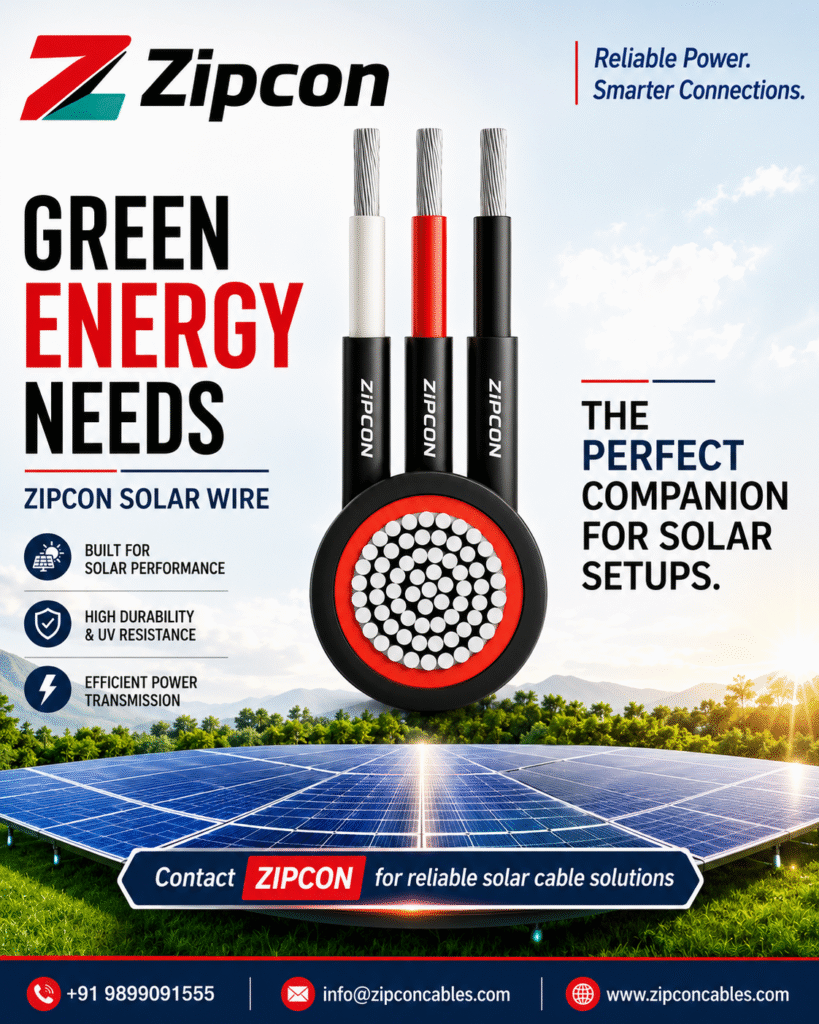
Choosing the right solar cables in Indore is essential for building a safe and dependable solar power system. Solar panels generate electricity continuously when exposed to sunlight, so the cables connecting panels, charge controllers, inverters, batteries, and other equipment must handle electrical load and outdoor conditions reliably.
A solar cable is more than an ordinary electrical wire. It needs suitable insulation, flexibility, resistance to heat and sunlight, and protection against moisture and environmental exposure. Using the right solar wiring can help reduce power losses, prevent premature cable damage, and support consistent system performance.
For homeowners, commercial properties, industries, and solar installers in Indore, Zipcon Cables offers a practical choice for solar wiring applications where durability and dependable electrical performance matter.
For inquiries or assistance, visit: 👉https://zipconcables.com/contact-us/
Why Choosing the Right Solar Cable Matters in Indore
Indore’s solar installations can be exposed to high temperatures, strong sunlight, dust, moisture, and changing weather conditions. These factors can affect cable insulation and long-term performance if unsuitable wiring is used.
A properly selected solar DC cable is designed for the conditions commonly found in photovoltaic installations. It helps maintain a secure electrical connection between solar components while providing suitable protection against environmental stress.
The right cable also supports safer installation. Correct conductor size, quality insulation, and appropriate cable construction help reduce the chances of overheating, insulation deterioration, loose connections, and unnecessary energy losses.
What Makes a Solar Cable Different from Ordinary Electrical Wire?
Solar cables are specifically intended for photovoltaic power applications. They are commonly used on the DC side of solar systems, where cables connect solar panels with other system components.
Key Characteristics of Quality Solar Wiring
A reliable solar cable should offer:
- Suitable electrical conductivity: Helps transfer generated power efficiently.
- Strong insulation: Protects the conductor from external conditions and electrical stress.
- UV resistance: Important because solar cables are frequently installed outdoors.
- Heat resistance: Helps the cable withstand elevated temperatures.
- Moisture resistance: Useful for installations exposed to rain, humidity, or water.
- Flexibility: Makes routing and installation around solar panels easier.
- Mechanical durability: Helps the cable withstand regular environmental exposure.
These characteristics make dedicated solar wiring a better choice for photovoltaic installations than using general-purpose household wire in applications where solar-rated cable is required.
Types of Solar Cables Used in Solar Installations
Different parts of a solar power system can require different cable specifications. Selecting the appropriate cable depends on factors such as current, voltage, cable length, installation environment, and system design.
Solar DC Cable
A solar DC cable connects photovoltaic panels and other DC-side components. It is one of the most important cable types in a solar installation because it carries electricity generated directly by the panels.
The cable should be selected according to the system’s electrical requirements and installation conditions. Using the correct cross-sectional area is particularly important for managing voltage drop and cable heating.
Solar Panel Cable
Solar panel cables are used to connect individual panels or panel strings within a photovoltaic array. They are generally routed across rooftops or solar structures, where exposure to sunlight and temperature variations must be considered.
Good-quality solar panel wiring should be durable enough for long-term outdoor use and flexible enough to support clean cable routing.
Solar Inverter Cable
The wiring between solar panels and an inverter needs to match the electrical specifications of the system. Cable selection should consider operating voltage, current, distance, and installation method.
Incorrect sizing can increase voltage drop and losses, affecting the overall efficiency of the system.
How to Choose Solar Cables in Indore
Buying solar cable based only on price can create problems later. Instead, evaluate the cable according to the complete installation requirement.
1. Check the Cable Size
Cable size should be selected according to current carrying capacity, voltage, cable length, installation conditions, and permissible voltage drop.
For example, a small residential rooftop system and a larger industrial solar installation may have very different cable requirements. A qualified installer should calculate the appropriate cable size rather than selecting it based only on appearance.
2. Consider Outdoor Exposure
Solar cables are often installed in open areas where they face sunlight, heat, dust, rain, and temperature changes.
For rooftop and outdoor installations, choose wiring with insulation and construction appropriate for these conditions. This is especially important for maintaining cable life over extended operation.
3. Evaluate Insulation Quality
Insulation is the protective layer around the electrical conductor. Good insulation helps prevent electrical leakage, short circuits, and damage caused by environmental exposure.
When comparing solar cables in Indore, pay attention to insulation quality instead of focusing only on conductor material and price.
4. Match the Cable to the Solar System
The cable must be compatible with the system’s voltage and current requirements. The design should also account for the distance between solar panels, combiner boxes, inverters, batteries, or other components.
Proper cable selection helps maintain electrical performance and supports safer operation.
5. Choose a Reliable Cable Manufacturer
A dependable manufacturer provides greater confidence in product consistency, insulation quality, manufacturing standards, and product specifications.
For solar installers and buyers in Indore, Zipcon Cables can be considered when sourcing solar wiring for residential, commercial, and industrial applications.
Why Zipcon Cables for Solar Wiring in Indore?
Zipcon Cables focuses on cable solutions designed for demanding electrical applications. For solar installations, the cable needs to combine electrical performance with protection against outdoor operating conditions.
Durable Construction
Solar wiring is exposed to environmental conditions for long periods. Zipcon’s solar cable range is designed with durability and reliable insulation as important considerations for photovoltaic applications.
Suitable for Solar Applications
The right solar cable helps maintain reliable connections between photovoltaic components. Zipcon solar wiring can be selected according to the electrical requirements of the installation.
Reliable Insulation
Quality insulation provides an important layer of protection around the conductor. It helps the cable withstand environmental exposure while supporting safe electrical operation.
Practical Choice for Different Installations
Solar power systems vary significantly in size. Solar wiring requirements for a home rooftop system can differ from those of a commercial or industrial installation.
Zipcon Cables can be considered for solar wiring requirements across different project types, with cable selection based on the actual electrical design.
Solar Cable vs Ordinary Electrical Wire
| Feature | Solar Cable | Ordinary Electrical Wire |
|---|---|---|
| Primary application | Solar/PV systems | General electrical applications |
| Outdoor exposure | Designed for relevant solar environments | Depends on wire type |
| UV exposure | Important design consideration | Not always suitable |
| Heat resistance | Important for solar installations | Varies by product |
| Flexibility | Generally suitable for solar routing | Depends on construction |
| Application | PV panels and DC connections | Household and general wiring |
| Selection | Based on solar system specifications | Based on general electrical requirements |
The comparison shows why cable selection should be based on application rather than simply choosing the cheapest available wire.
Examples: Selecting Solar Cables for Different Applications
Example 1: Residential Rooftop Solar
A homeowner installing a rooftop solar system needs cables connecting the panels to the inverter. The installer should consider the panel configuration, system voltage, current, cable distance, routing, and expected environmental exposure.
A properly sized solar DC cable helps maintain reliable power transfer while reducing unnecessary voltage drop.
Example 2: Commercial Solar Installation
A commercial building may have a larger solar array with longer cable routes. In this case, cable sizing and voltage-drop calculations become even more important.
The installer should select cables according to the complete system design instead of using the same cable size throughout without calculation.
Example 3: Industrial Solar Project
Industrial installations can involve higher power levels, larger arrays, longer cable runs, and more demanding operating environments.
Here, cable quality, correct sizing, installation practices, connector compatibility, and cable management all contribute to reliable solar system performance.
Expert Tips for Buying Solar Cables in Indore
1. Never select cable size by guesswork.
Determine the required conductor size based on system current, voltage, distance, installation conditions, and applicable design requirements.
2. Check the complete product specification.
Look beyond the cable’s appearance. Review conductor construction, insulation, voltage rating, temperature characteristics, and intended application.
3. Prioritize outdoor suitability.
If the cable will remain exposed to sunlight and weather, make sure its construction is suitable for the intended environment.
4. Avoid unnecessary cable length.
Longer cable runs can increase voltage drop and electrical losses. Plan cable routes carefully during installation.
5. Use compatible connectors and accessories.
A quality cable cannot compensate for poor connectors, loose terminations, or incorrect installation.
6. Buy from a dependable manufacturer.
Consistent manufacturing quality matters when cables are expected to operate continuously for years.
Common Mistakes When Choosing Solar Cables
Using Ordinary Wire Instead of Solar Cable
General electrical wire may not be suitable for permanent outdoor photovoltaic applications. Solar installations require cables appropriate for their operating environment and electrical characteristics.
Selecting a Smaller Cable to Reduce Cost
An undersized cable can increase voltage drop and heating. Saving money on cable material can therefore become an unnecessary performance and safety risk.
Ignoring Cable Length
Even when the cable size appears suitable, a long cable run can influence voltage drop. Both current and distance should be considered during cable selection.
Focusing Only on Price
The lowest-priced cable is not necessarily the most economical option over the system’s operating life. Durability, insulation, electrical performance, and application suitability should also be evaluated.
Poor Cable Routing
Cables should be routed and secured properly to reduce unnecessary mechanical stress, abrasion, sharp bends, and exposure to conditions for which the cable is not designed.
Why Solar Cable Quality Affects Long-Term Solar Performance
Solar panels can remain operational for many years, which means their connecting cables must also withstand long-term service conditions. Cable deterioration can affect electrical reliability even when the solar panels themselves are functioning properly.
Quality solar wiring supports stable electrical connections and helps protect the system against avoidable cable-related problems. For this reason, cable selection should be treated as an important part of solar system design rather than an afterthought.
Choose Reliable Solar Cables in Indore with Zipcon
A solar power system is only as dependable as the components used to connect and operate it. Choosing appropriate solar cables in Indore means considering conductor size, insulation, environmental exposure, system voltage, current, cable length, and installation requirements.
For residential rooftops, commercial buildings, and industrial solar projects, Zipcon Cables provides solar wiring solutions focused on reliable electrical performance and durable construction. Select the cable according to your system requirements and work with qualified solar professionals for correct installation.
Choose the right solar wiring today to build a safer, more dependable solar power system with Zipcon Cables.
Top 5 FAQs About Solar Cables in Indore
1. What are solar cables used for?
Solar cables are primarily used to connect photovoltaic panels and other components of a solar power system. They are commonly used for DC-side connections between solar panels, combiner equipment, inverters, and related components.
2. Can ordinary electrical wire be used for solar panels?
Ordinary electrical wire should not automatically be substituted for solar cable. Solar installations can expose wiring to sunlight, heat, moisture, and outdoor conditions, so cables should be selected according to the requirements of the specific photovoltaic application.
3. How do I choose the right solar cable size?
Cable size depends on factors such as system current, voltage, cable length, allowable voltage drop, installation conditions, and applicable electrical requirements.
4. Why is UV resistance important in solar cables?
Solar cables are frequently exposed to direct sunlight. UV-resistant construction helps the cable withstand prolonged exposure to ultraviolet radiation and supports longer-lasting insulation performance in suitable outdoor applications.
5. Why choose Zipcon Cables for solar wiring in Indore?
Zipcon Cables offers cable solutions designed around reliable electrical performance, durable construction, and application-specific requirements.