

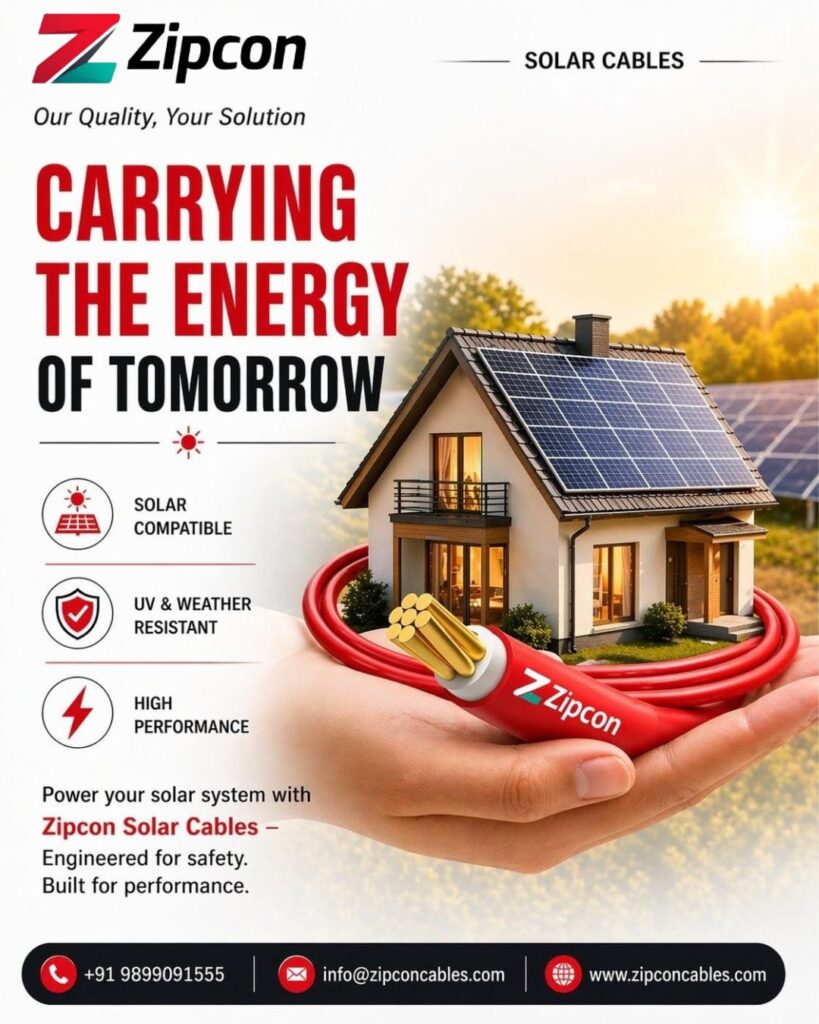
Choosing the best solar cables in Bhopal is essential for building a safe, efficient and long-lasting solar power system. Solar panels generate DC electricity continuously, and the cables connecting panels, inverters and other components must handle electrical loads while remaining reliable under heat, sunlight, moisture and changing weather conditions.
A solar cable is more than a simple electrical wire. Its conductor, insulation, flexibility, temperature resistance and protection against environmental exposure directly affect the reliability of a solar installation. Using an unsuitable cable can increase energy losses, accelerate insulation damage and create avoidable maintenance problems.
For residential rooftops, commercial buildings, agricultural installations and industrial solar plants, Zipcon Cables offers solar cable solutions designed for demanding electrical applications. Selecting the correct cable size and construction according to the system requirement helps improve safety and long-term performance.
For inquiries or assistance:– https://zipconcables.com/contact-us/
Why Choosing the Right Solar Cable Matters in Bhopal
Solar installations in Bhopal can experience high temperatures, strong sunlight, dust, rain and outdoor exposure. Solar cables installed on rooftops or open structures need insulation capable of handling these conditions without quickly becoming brittle or damaged.
The cable also carries DC power over a specific distance. If the cable is undersized or poorly selected, voltage drop and power losses can increase. A correctly specified solar PV cable helps maintain dependable power transmission between solar panels, combiner arrangements and the inverter.
For this reason, cable selection should consider more than price. Conductor material, cross-sectional area, insulation quality, installation environment and expected electrical load all need to be evaluated before installation.
What Is a Solar Cable?
A solar cable is an electrical cable specifically used to connect components of a photovoltaic power system. It commonly carries DC electricity from solar modules toward an inverter or other parts of the solar installation.
Compared with ordinary electrical wiring, a dedicated solar power cable is designed for outdoor solar applications. Its construction focuses on resistance to environmental conditions such as sunlight, heat, moisture and mechanical exposure.
Key Parts of a Solar Cable
Conductor:
The conductor carries electrical current. Copper is widely used where high conductivity and flexibility are required, while aluminium can be considered for applications where weight and cost are important factors.
Insulation:
The insulation separates the conductor from external surfaces and protects the cable against electrical and environmental stress. High-quality insulation is particularly important for outdoor solar installations.
Outer Protection:
The outer construction provides additional resistance against environmental exposure, abrasion and installation-related stress. The exact construction should be selected according to the application and applicable standards.
Key Features to Look for in Solar Cables
1. High-Quality Conductors
A reliable conductor provides efficient current transmission and helps control electrical losses. The appropriate conductor material and cross-sectional area should be selected according to current capacity, cable length and installation conditions.
For rooftop and industrial solar projects, cable sizing should be calculated rather than selected simply by visual thickness or price.
2. Heat Resistance
Solar cables are frequently exposed to direct sunlight and elevated temperatures. A cable with suitable temperature-resistant insulation is better positioned to maintain its electrical and physical properties during prolonged outdoor operation.
This becomes particularly relevant for rooftop systems where cables can remain exposed to solar radiation for many hours each day.
3. UV and Weather Resistance
Outdoor cables face continuous exposure to sunlight, rain, dust and changing temperatures. UV-resistant solar cables help reduce the risk of premature sheath and insulation degradation caused by prolonged sunlight exposure.
Weather-resistant construction is especially valuable when cables are routed across rooftops, solar structures or outdoor industrial areas.
4. Flexibility
Solar installations often require cables to follow panel layouts, mounting structures and connection routes. Flexible cable construction makes installation easier and can reduce unnecessary stress at connection points.
Good flexibility is particularly useful during rooftop installations where cable routing may involve multiple bends.
5. Suitable Current-Carrying Capacity
The cable must be capable of safely carrying the expected current. Choosing an undersized cable can result in excessive heating and higher voltage drop.
Cable size should therefore be selected based on the solar system’s electrical specifications rather than using the same size for every installation.
6. Durable Insulation
Quality insulation provides electrical separation and helps protect the conductor from external conditions. For solar applications, insulation needs to remain reliable through repeated exposure to heat, sunlight and moisture.
A durable cable can reduce the frequency of cable replacement and help maintain consistent system performance.
Solar Cables for Residential Applications in Bhopal
Residential solar systems usually include rooftop panels, DC cabling, an inverter, AC wiring and associated protection equipment. The solar cable connecting the panels to the inverter plays an important role in transferring generated DC power.
For homes, cable selection should account for the number of panels, system voltage, current, cable length and routing method. A compact rooftop system may have different cable requirements from a larger residential installation with multiple strings.
Example: A homeowner installing a rooftop solar system should not choose a cable only because it is inexpensive. The cable should match the system’s current rating and installation environment while providing appropriate protection against outdoor exposure.
Solar Cables for Industrial Applications
Industrial solar installations generally involve greater power capacity, longer cable routes and more demanding operating conditions. Cable selection therefore becomes even more important.
Industrial applications may include factories, warehouses, commercial buildings, solar farms and large rooftop systems. These installations can require carefully planned cable routing, appropriate conductor sizes and protection against mechanical and environmental stresses.
For such projects, industrial solar cables should be selected according to the complete electrical design rather than based on a single standard size.
Solar Cable vs Ordinary Electrical Cable
| Feature | Solar Cable | Ordinary Electrical Cable |
|---|---|---|
| Primary use | Photovoltaic systems | General electrical applications |
| Outdoor exposure | Designed for suitable outdoor applications | Depends on cable type |
| UV resistance | Available in solar-specific construction | Not always suitable |
| Heat resistance | Designed according to solar application requirements | Varies |
| Flexibility | Generally suited to solar installation routing | Depends on construction |
| Application | Solar panels, DC circuits and PV systems | Homes, commercial and industrial wiring |
The important point is that cables should be selected for their intended application. A general-purpose cable should not automatically be treated as a substitute for a cable specifically designed for photovoltaic installations.
How to Choose the Best Solar Cables in Bhopal
Check the Solar System Specifications
Start with system voltage, operating current and the configuration of the solar panels. These specifications determine the electrical requirements of the cable.
Select the Correct Cable Size
Cable size affects current-carrying capacity and voltage drop. Longer cable runs can make voltage-drop calculations particularly important.
Consider Installation Conditions
Determine whether the cable will be exposed to direct sunlight, installed under panels, routed through conduits or placed in another environment. The cable construction should match these conditions.
Consider Cable Quality
Look for reliable manufacturing, consistent insulation quality and appropriate testing or certification for the intended application. Lower purchase cost does not necessarily mean lower total ownership cost.
Buy From a Reliable Manufacturer
Choosing a dependable manufacturer can help ensure consistent cable construction and product quality. For solar projects, Zipcon Cables can be considered for applications requiring reliable solar cable solutions.
Zipcon Cables: A Reliable Choice for Solar Applications
Zipcon Cables focuses on cable solutions designed for residential, commercial and industrial electrical requirements. Its solar cable range can be considered for installations where dependable power transmission and durable construction are important.
For solar projects in Bhopal, Zipcon solar cables can be evaluated based on the project’s voltage, current, cable length, installation environment and required cable size.
The right product should always be selected according to the technical requirements of the specific solar system. This approach provides better results than choosing a cable based only on brand, appearance or price.
Examples: Selecting Solar Cables for Different Applications
Example 1: Residential Rooftop
A home with a rooftop solar installation may require DC cables running from several panels to the inverter. The installer should calculate the current, cable distance and voltage drop before deciding the cable size.
For this type of project, a flexible and appropriately rated solar panel cable can simplify installation while providing suitable outdoor performance.
Example 2: Commercial Building
A commercial building may have a larger rooftop array with multiple strings. Longer cable routes and higher system capacity can increase the importance of correct cable sizing and routing.
In this case, the project should use solar cables selected according to the electrical design and installation conditions.
Example 3: Industrial Solar Plant
An industrial solar installation may involve long cable runs, multiple strings and higher current levels. Cable selection must account for load, voltage drop, environmental exposure and mechanical protection.
Here, professional system design and proper cable specification are essential for maintaining reliable power transmission.
Expert Tips for Solar Cable Installation
- Select cable size according to current, voltage and cable length.
- Avoid using ordinary household wire as a replacement for purpose-designed solar cable where the application requires solar-rated construction.
- Keep cable routes organized and protected from unnecessary mechanical damage.
- Avoid excessive bending or pulling during installation.
- Use compatible connectors and termination components.
- Prevent cables from remaining in standing water or areas with avoidable moisture exposure.
- Keep DC cable runs as efficient as practical to help control voltage drop.
- Inspect exposed cables periodically for physical damage, insulation deterioration or loose connections.
- Follow the solar equipment manufacturer’s installation requirements and applicable electrical standards.
Common Mistakes to Avoid
Choosing Cable Based Only on Price
The cheapest cable may not provide the construction required for long-term outdoor solar exposure. Initial savings can become expensive if premature replacement or performance issues occur.
Using the Wrong Cable Size
An undersized cable can increase voltage drop and heating. Oversizing also has cost implications, so the correct approach is to calculate the requirement based on the system design.
Ignoring Cable Length
Longer cable runs can produce greater voltage drop. Cable length should therefore be included when determining the appropriate cable size.
Poor Cable Routing
Cables left exposed to unnecessary mechanical stress, sharp edges or excessive heat can experience premature damage. Proper routing and support are important for long-term reliability.
Mixing Incompatible Components
Solar cables, connectors and termination systems should be compatible with each other. Poor connections can increase resistance and create heating at connection points.
Why Bhopal Solar Installations Need Reliable Cable Selection
As residential, commercial and industrial solar adoption grows, reliable electrical components become increasingly important. Solar panels may generate power for decades, but the supporting electrical infrastructure also needs appropriate materials and installation practices.
In Bhopal’s climate, outdoor solar cables can experience considerable environmental exposure. Selecting a suitable solar cable in Bhopal helps protect the electrical connection and supports stable operation throughout the system’s service life.
For both small rooftop systems and larger industrial installations, cable selection should be treated as an important part of the overall solar design rather than an afterthought.
Conclusion
The best solar cables in Bhopal are not simply the ones with the lowest price or the thickest appearance. The right cable is one that matches the solar system’s electrical requirements, installation conditions and expected operating environment.
For residential rooftops, commercial buildings and industrial solar applications, prioritize suitable conductor size, durable insulation, environmental resistance, flexibility and reliable manufacturing. Zipcon Cables can be considered when selecting dependable solar cable solutions for Bhopal projects.
Before purchasing, verify the required cable size, current capacity, system voltage, cable length and installation conditions. Correct specification combined with proper installation can help create a safer and more reliable solar power system.
Top 5 FAQs
1. Which solar cable is best for residential solar systems in Bhopal?
The best solar cable depends on the system voltage, current, cable length and installation conditions. A dedicated solar PV cable with suitable insulation and environmental resistance is generally appropriate for rooftop solar applications.
2. Can ordinary electrical wire be used for solar panels?
Ordinary electrical wire should not automatically be used as a replacement for purpose-designed solar cable. Solar installations can expose cables to sunlight, heat and outdoor conditions, so the cable construction should be suitable for the specific application.
3. How do I select the correct solar cable size?
Cable size should be selected using factors such as operating current, system voltage, cable length, installation method, allowable voltage drop and applicable electrical requirements. A qualified solar installer can calculate the appropriate size for the system.
4. Are solar cables suitable for industrial applications?
Yes, solar cables can be used in industrial photovoltaic applications when their electrical ratings and construction are suitable for the project. Large installations require careful consideration of current capacity, voltage drop, cable routing and environmental conditions.
5. Why choose Zipcon Cables for solar applications in Bhopal?
Zipcon Cables offers cable solutions for different electrical applications, including solar requirements. For a Bhopal solar project, the appropriate Zipcon cable should be selected according to the system’s technical specifications and installation environment.