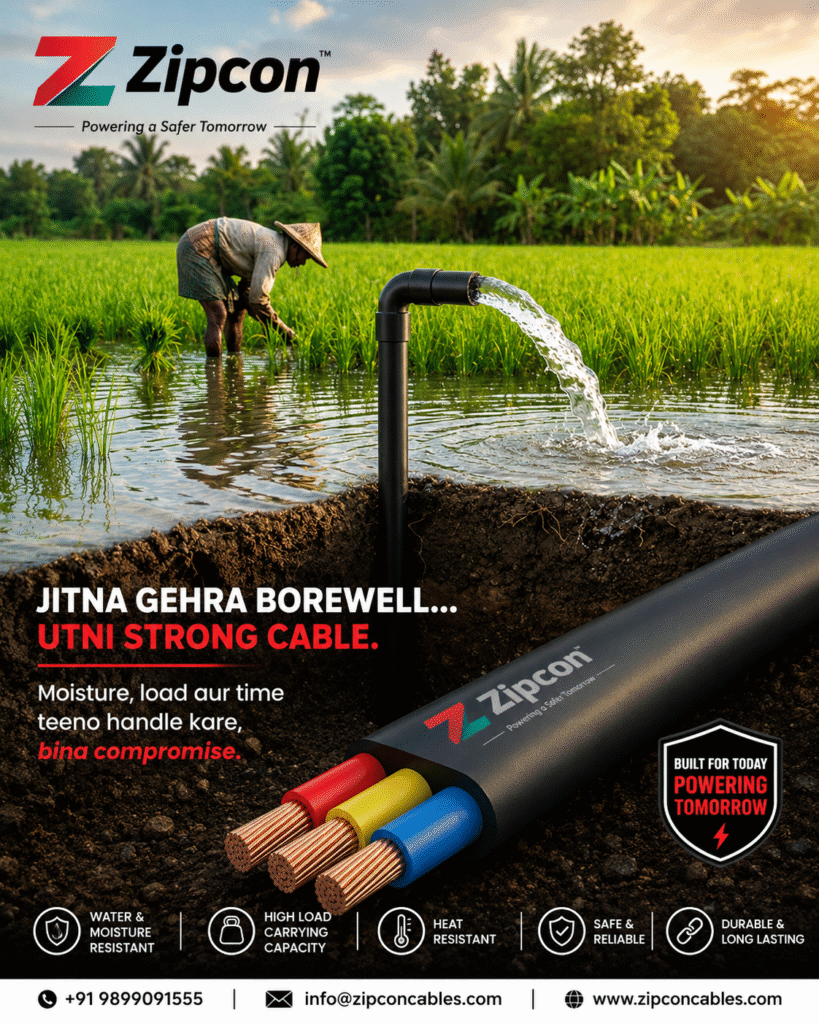
Choosing the best submersible pump cable in Kerala is essential for safe electrical power transmission and reliable water pumping. Submersible pumps operate in wet environments, often deep inside borewells, where the cable remains exposed to water, pressure, mechanical stress, and continuous electrical load.
A suitable submersible cable needs more than good conductivity. It should provide dependable insulation, water resistance, flexibility, mechanical strength, and long-term electrical performance. Using an unsuitable or undersized cable can cause voltage drop, overheating, insulation damage, motor performance issues, and premature cable failure.
Zipcon Cables provides submersible cable solutions designed for demanding water-pumping applications. Whether the requirement is for agriculture, domestic water supply, industrial pumping, or borewell systems, selecting the correct Zipcon cable specification can improve system reliability and reduce maintenance problems.
Contact us today:- https://zipconcables.com/contact-us/
Why Submersible Pump Cable Quality Matters
The cable is one of the most important electrical components connecting the power source to a submersible pump. Because it operates in or around water, its insulation must provide reliable electrical separation throughout the installation.
A poor-quality cable may deteriorate faster under continuous moisture exposure or mechanical stress. Electrical resistance can also increase when an unsuitable cable is used, potentially causing voltage drop and unnecessary heating.
A properly selected submersible pump cable in Kerala helps maintain stable power delivery while providing the protection required for wet and demanding operating conditions.
Challenges Faced by Submersible Pump Cables in Kerala
Kerala’s climate and water conditions make cable selection particularly important. Heavy rainfall, high humidity, wet soil, and extensive use of borewell and agricultural pumping systems can expose cables to demanding conditions.
High Moisture Exposure
Submersible pump cables can remain surrounded by water for long periods. The insulation must therefore be suitable for submerged environments and should resist moisture-related deterioration.
Continuous Electrical Load
Water pumps may operate for several hours during irrigation or water-supply cycles. A cable with an appropriate conductor size helps carry the required current without excessive heating.
Mechanical Stress
During installation and removal, cables may experience pulling, bending, abrasion, or contact with borewell components. Adequate flexibility and mechanical strength are therefore important.
Long Cable Runs
Deep borewells can require significant cable lengths. Longer runs increase the possibility of voltage drop, making correct cable sizing essential.
Key Features of the Best Submersible Pump Cable
1. Reliable Electrical Conductivity
The conductor must efficiently carry current from the power supply to the pump motor. Good conductivity helps reduce electrical losses and supports stable motor operation.
The conductor size should be selected according to the pump’s rated current, voltage, cable length, installation conditions, and acceptable voltage drop.
2. High-Quality Insulation
Insulation is particularly important in submersible applications because the cable operates close to or directly in water.
A durable insulation system provides electrical protection while helping the cable withstand moisture, temperature variations, handling, and installation stress.
3. Water Resistance
A submersible pump cable must be suitable for water-exposed conditions. Proper water-resistant insulation helps maintain electrical safety and cable performance during prolonged operation.
This is one of the main differences between dedicated submersible cables and ordinary electrical wires.
4. Flexibility
A flexible cable is easier to install through borewells, pipes, and narrow routes. It can also reduce mechanical stress during installation when handled correctly.
Flexibility should not come at the expense of insulation strength or conductor performance.
5. Mechanical Durability
The cable should be capable of handling normal installation and operating stresses. Durable construction can help reduce the risk of cuts, cracks, abrasion, and insulation damage.
How to Select the Right Submersible Pump Cable
Selecting the right cable involves more than choosing a cable based on its size. Several technical factors should be evaluated before purchase.
Check Pump Power and Current
Start with the pump manufacturer’s rated voltage, power, and current. The cable must be capable of continuously carrying the expected electrical load.
For example, a higher-power motor generally requires a larger conductor than a small domestic pump.
Measure the Complete Cable Length
Calculate the distance from the electrical supply point to the pump, including the vertical borewell section. A longer cable can produce greater voltage drop.
If voltage drop becomes excessive, the motor may not receive the voltage required for efficient operation.
Select the Appropriate Cross-Section
Submersible pump cables are available in different conductor sizes, including applications using 2.5 sq mm, 4 sq mm, and 6 sq mm cables.
The correct size depends on the electrical load and installation conditions. Never select a cable size only because it is commonly used for another pump.
Consider Installation Depth
A deep borewell requires a longer cable and can create greater mechanical and electrical demands. Cable selection should account for the complete installation depth and routing method.
Verify Submersible Suitability
Before purchasing, confirm that the cable is intended for submersible pump applications. Ordinary house wiring should not automatically be considered suitable for submerged installation.
Submersible Pump Cable vs Ordinary Electrical Wire
| Feature | Submersible Pump Cable | Ordinary Electrical Wire |
|---|---|---|
| Water exposure | Designed for applicable wet/submerged conditions | Usually not intended for continuous submersion |
| Insulation requirements | Suitable for demanding pump applications | Application-dependent |
| Flexibility | Designed for installation requirements | Varies |
| Borewell use | Suitable when correctly specified | Generally unsuitable without appropriate rating |
| Pump application | Specifically designed for pump systems | General electrical applications |
The major difference is application suitability. A cable designed for submersible pumping considers the electrical and environmental demands of the installation.
Applications of Submersible Pump Cables
Agricultural Irrigation
Farmers use submersible pumps to extract groundwater for irrigation. Reliable cable performance is important because pump failure can disrupt irrigation schedules.
Domestic Water Supply
Submersible pumps are widely used in homes and residential properties for borewell water extraction. A properly selected cable supports safe and consistent pump operation.
Commercial Buildings
Hotels, apartments, institutions, and commercial facilities may use borewell pumping systems to meet water requirements. Cable reliability becomes important where regular water supply is essential.
Industrial Water Pumping
Industrial facilities often operate pumps for process water, cooling, storage tanks, and other applications. The cable specification should be matched to the motor and operating environment.
Examples of Correct Cable Selection
Example 1: Domestic Borewell Pump
A residential borewell pump with a relatively short cable run may require a smaller cable size depending on its rated current and voltage. The cable must still be suitable for submerged operation.
Example 2: Agricultural Pump
An agricultural pump operating for extended periods may require careful consideration of cable size, insulation, cable length, and voltage drop to maintain dependable operation.
Example 3: Deep Borewell
A deep borewell creates a longer cable route. In such cases, voltage-drop calculations become increasingly important, and a larger conductor may be required depending on the motor load.
Why Choose Zipcon Cables?
Zipcon Cables is a suitable choice for users looking for dependable cable solutions for submersible pump applications. The brand focuses on cable construction, insulation performance, durability, and suitability for demanding electrical installations.
For applications where the cable remains exposed to moisture and operates continuously with a pump motor, selecting a product designed for the intended application is essential.
Zipcon’s submersible cable solutions can be considered for agricultural pumps, domestic borewells, commercial water systems, and other pumping applications where reliable electrical connectivity is required.
Expert Tips for Buying Submersible Pump Cable
- Check the pump’s rated voltage, current, and power before selecting the cable.
- Calculate the complete cable length from the power source to the pump.
- Consider voltage drop for long-distance installations.
- Select the conductor cross-section according to the electrical load.
- Use cable specifically designed for submersible pump applications.
- Check insulation quality and water-resistance specifications.
- Purchase from a reliable cable manufacturer or authorized supplier.
- Inspect the cable for cuts, cracks, or insulation damage before installation.
- Ensure proper cable termination and waterproof connections.
- Follow the pump manufacturer’s installation recommendations.
Common Mistakes to Avoid
Buying the Cheapest Cable
Low initial cost does not necessarily mean lower total ownership cost. An unsuitable cable may require early replacement and can contribute to pump performance problems.
Using an Undersized Cable
An undersized conductor can increase voltage drop and heating. This is particularly important in deep borewell and high-power pump installations.
Ignoring Cable Length
The cable length directly affects voltage drop. Selecting the size without considering the complete installation distance can result in poor motor performance.
Using Ordinary Wire in a Borewell
Standard electrical wire is not automatically suitable for submerged operation. Always verify that the cable is specifically appropriate for the intended environment.
Poor Termination
Water can enter through improperly sealed joints or connections. Proper termination and sealing are essential for maintaining electrical safety.
Ignoring Installation Conditions
Cable selection should consider borewell depth, water exposure, mechanical stress, temperature, pump load, and installation route.
Benefits of Choosing the Right Submersible Pump Cable
A properly selected cable can provide:
- Reliable power transmission
- Better pump operating efficiency
- Reduced voltage-drop problems
- Improved protection against moisture
- Lower risk of overheating
- Better mechanical durability
- Longer cable service life
- Reduced maintenance requirements
- Safer water-pumping operation
The right cable specification can therefore contribute to the overall reliability of the pumping system rather than functioning as merely a connecting component.
Why Zipcon Is a Practical Choice for Kerala
Kerala’s combination of high humidity, rainfall, groundwater pumping, and agricultural applications creates a strong need for reliable electrical products. Submersible pump cables must be capable of operating in demanding wet environments while carrying the required electrical load.
Zipcon Cables offers cable solutions for applications where durability, insulation protection, flexibility, and reliable electrical performance are important.
For borewell pumps, agricultural irrigation, domestic water systems, and commercial pumping requirements, choose the cable according to the actual pump specifications rather than relying on generic sizing.
Conclusion
The best submersible pump cable in Kerala should provide the right combination of electrical conductivity, water-resistant insulation, flexibility, mechanical durability, and suitability for continuous pump operation.
Before purchasing, evaluate the pump’s power, current, voltage, cable length, borewell depth, and installation environment. Correct cable sizing can help reduce voltage-drop issues, overheating, maintenance requirements, and premature failures.
For dependable submersible pumping applications, Zipcon Cables is a strong option to consider. Select the correct Zipcon cable specification for your pump and installation conditions to achieve safer, more reliable, and efficient water pumping.
Top 5 FAQs
1. Which is the best submersible pump cable in Kerala?
The best cable depends on the pump’s power, current, voltage, cable length, installation depth, and environmental conditions. A quality submersible cable should provide reliable conductivity, durable insulation, water resistance, and suitable mechanical strength. Zipcon Cables offers solutions for various submersible pumping applications.
2. Which cable size is suitable for a submersible pump?
Cable size depends on motor current, operating voltage, cable length, conductor material, and permissible voltage drop. Sizes such as 2.5 sq mm, 4 sq mm, and 6 sq mm may be suitable for different installations, but the correct size should be selected based on the pump’s technical requirements.
3. Can ordinary electrical wire be used for a submersible pump?
Ordinary electrical wire should not be used simply because it fits the required conductor size. Submersible pumps require cables with insulation and construction suitable for the intended wet or submerged operating conditions.
4. Why is voltage drop important in submersible pump cables?
Voltage drop increases as cable length and electrical load increase. Excessive voltage drop can reduce the voltage available to the pump motor and may affect its performance. Proper cable sizing helps control voltage-drop issues.
5. Why choose Zipcon Cables for submersible pump applications?
Zipcon Cables provides cable solutions designed around reliable electrical performance, durable insulation, flexibility, and demanding installation requirements. Its submersible cable range can be considered for agricultural, domestic, commercial, and borewell pumping systems.