Introduction: Why Cable Choice Matters on Indian Sites
In Indian industrial environments, cable failure is rarely a minor issue. High ambient temperatures, fluctuating electrical loads, constant vibration, dust, and long operating hours put serious stress on electrical systems. A poorly chosen flexible cable can lead to overheating, frequent breakdowns, unplanned downtime, and safety risks—especially in manufacturing plants, infrastructure projects, and automation-heavy facilities.
For engineers, EPC contractors, and procurement buyers, selecting the right industrial flexible cable is not about specifications on paper—it’s about how the cable performs on-site, day after day. This is where reliable Indian manufacturers like Zipcon Cables, focused on industrial-grade performance and compliance, become relevant for real-world applications.
For technical support or project inquiries: https://zipconcables.com/contact-us/
What Are Industrial Flexible Cables & Where They Are Used
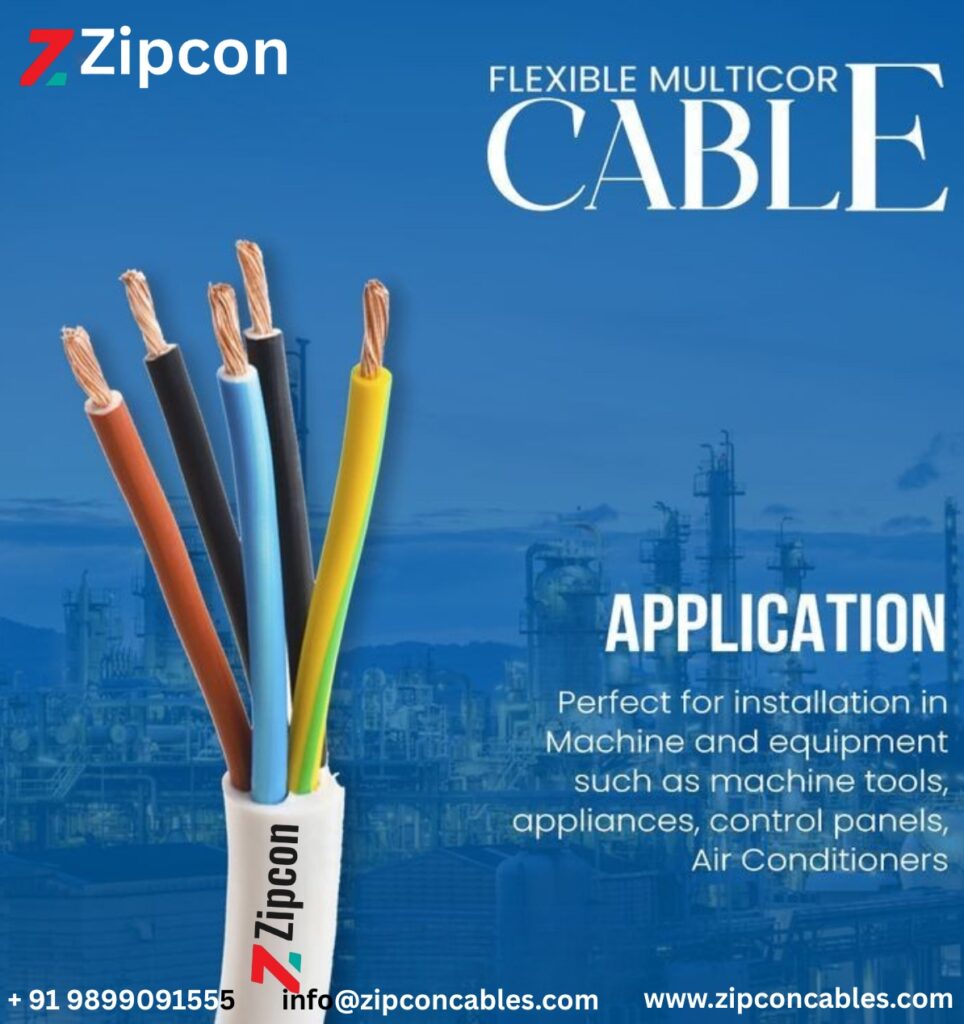
Industrial flexible cables are specially designed electrical cables that can bend, move, and withstand mechanical stress without cracking or losing conductivity. Unlike rigid cables, they are built for environments where motion, vibration, and repeated handling are unavoidable.
In Indian industries, these cables are commonly used in machinery wiring where motors and components vibrate continuously. They are essential in control panels that require compact routing and frequent maintenance access. Automation systems, conveyor belts, robotics, and moving equipment depend on flexible cables to maintain uninterrupted power and signal flow. Large manufacturing plants and infrastructure projects also rely on them for durability under heavy-duty conditions.
Key Decision Factors Engineers & Buyers Must Evaluate
Electrical Conductivity
On-site performance depends heavily on how efficiently a cable carries current. Poor conductivity leads to voltage drop and heat buildup, which is especially risky in continuous operations. In Indian factories running long shifts, this can directly affect machine life and energy efficiency.
Durability and Mechanical Strength
Flexible cables are often exposed to bending, pulling, and vibration. Weak conductor stranding or low-quality insulation results in internal breakage over time. Durable construction reduces frequent replacements and maintenance shutdowns.
Weight and Flexibility
Heavier cables are harder to route and stress termination points. A well-designed flexible cable balances strand density and insulation so it remains easy to handle without sacrificing strength—critical in crowded panels and moving assemblies.
Cost: Initial vs Long-Term
Lower upfront cost often hides higher lifetime expenses. Frequent failures, higher energy loss, and replacement labor increase total cost of ownership. Smart buyers look beyond purchase price to operating life.
Safety and Insulation Standards
In Indian industrial settings, insulation quality directly affects fire safety and worker protection. Heat resistance, flame retardance, and compliance with Indian and industrial norms are non-negotiable for critical installations.
Installation Ease
Cables that are stiff or poorly finished slow down installation and increase termination errors. Consistent flexibility reduces labor time and improves reliability at joints and connectors.
Copper vs Alternative Conductor Cables: A Practical Comparison
Copper flexible cables manufacturer in india clearly perform better in high-current and continuous-duty applications. They offer stable conductivity under load, handle heat more effectively, and are suitable for sensitive machinery where voltage stability matters. For safety-critical installations—such as heavy motors, automation systems, and process control—copper remains the safer choice.
Alternative conductor cables, on the other hand, can be suitable for cost-sensitive or low-risk applications. They work well in temporary setups, lightweight systems, or non-critical power transmission where loads are lower and operating hours are limited. The trade-off is reduced durability and higher sensitivity to heat and stress.
In short, copper prioritizes reliability and longevity, while alternatives prioritize cost savings where risk is controlled.
Real-World Use Cases from Indian Industry
In a manufacturing plant with vibrating machinery, choosing a low-grade flexible cable often results in internal conductor breakage within months. The plant faces repeated downtime and costly repairs. A higher-quality flexible cable with durable stranding and insulation avoids these failures and keeps production stable.
An EPC contractor assembling control panels for an infrastructure project must route cables through tight spaces. Stiff or inconsistent cables increase installation time and termination faults. Using a consistently flexible industrial cable simplifies routing and improves long-term reliability.
In another scenario, a procurement buyer may try to reduce costs by selecting cheaper cables for an industrial project. Over time, heat buildup and insulation degradation cause unexpected shutdowns. Choosing application-appropriate cables from the start prevents these hidden costs.
Why Zipcon Cables Fits Industrial Requirements
Zipcon Cables focuses on manufacturing industrial flexible cables designed for Indian operating conditions. Their strength lies in high-quality conductors that maintain conductivity under load, durable insulation that withstands heat and mechanical stress, and consistent flexibility that simplifies installation and long-term use.
Equally important is compliance. Zipcon’s cables are developed to meet relevant Indian and industrial standards, making them suitable for factories, EPC projects, and infrastructure installations where safety and reliability cannot be compromised.
Direct Recommendation: How to Decide
For high-load, safety-critical, and continuous-use applications, engineers and buyers should prioritize copper-based industrial flexible cables with proven durability and insulation quality. These are ideal for machinery, automation systems, and core plant operations.
For cost-controlled or low-risk installations, alternative conductor cables can be considered—but only where operating conditions are predictable and failure risk is minimal.
The key is matching the cable to the application, not the budget alone. Zipcon Cables offers solutions across both categories, allowing engineers and procurement teams to choose confidently based on real operational needs rather than assumptions.