Choosing the right submersible cable in Kozhikode for borewell pump is essential for safe electrical power transmission and dependable pump performance. A submersible pump operates inside water for long periods, so its cable must withstand moisture, pressure, heat, electrical load, and continuous operation without compromising insulation.
A poor-quality cable can lead to voltage drop, insulation damage, overheating, motor failure, or frequent maintenance. The right borewell pump cable should therefore be selected according to pump capacity, cable length, installation depth, conductor size, and operating conditions.
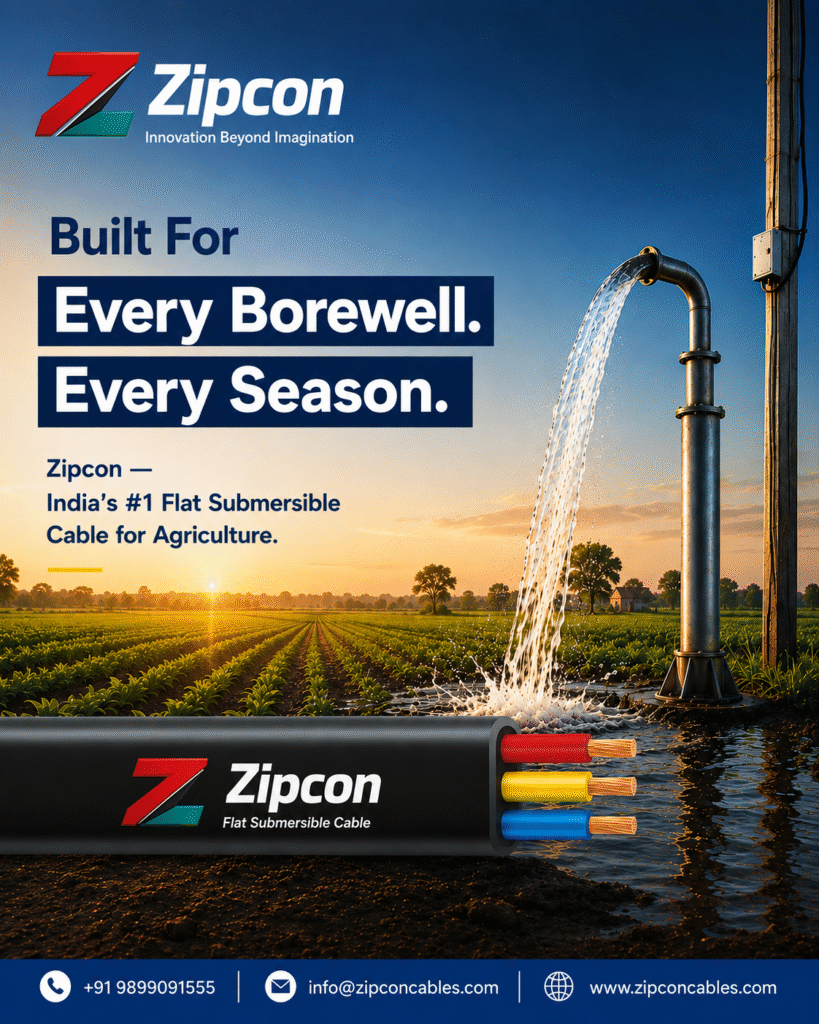
For residential water systems, agricultural borewells, commercial buildings, and irrigation applications, Zipcon Cables offers submersible cable solutions designed with durability and dependable electrical performance in mind.
Contact us today:- https://zipconcables.com/contact-us/
Why the Right Submersible Cable Matters for Borewell Pumps
A submersible pump cable has a different job from a conventional house wire. It remains exposed to moisture and may stay submerged for years, making insulation quality and mechanical durability critical.
The cable must deliver electricity efficiently from the power source to the underwater motor. If the conductor size is inadequate for the load or cable length, excessive voltage drop can affect motor performance and increase heating.
A correctly selected submersible pump wire helps maintain stable power delivery while reducing the risk of electrical faults. It also supports longer pump life when properly installed and maintained.
Key Features of a Reliable Submersible Cable in Kozhikode
1. High-Quality Insulation
Submersible cables need insulation capable of resisting continuous exposure to water and demanding installation conditions. Strong insulation helps prevent moisture penetration and electrical leakage.
For borewell applications, insulation should also maintain flexibility so the cable can be installed along the pump without unnecessary bending or mechanical stress.
2. Proper Current-Carrying Capacity
The conductor must be capable of handling the pump’s operating current. Selecting a cable only by physical thickness can be misleading because actual requirements depend on motor power, voltage, cable length, and installation conditions.
For example, a long cable run may require a larger conductor size to control voltage drop even when the pump’s rated current remains unchanged.
3. Water and Moisture Resistance
Because the cable is installed in a wet environment, moisture resistance is one of the most important characteristics of a borewell submersible cable.
A suitable cable construction helps protect the conductor and insulation system from the effects of prolonged water exposure, supporting reliable operation over time.
4. Mechanical Strength
During installation, a submersible cable may experience pulling, bending, movement, and contact with other components. Adequate mechanical strength reduces the possibility of physical damage.
The cable should be installed carefully without sharp bends, excessive tension, or abrasion against the borewell structure.
5. Heat Resistance
Pump motors can operate continuously for extended periods. The cable must therefore handle the expected operating temperature without premature deterioration of its insulation.
Quality insulation combined with the correct conductor size helps manage electrical and thermal stress more effectively.
Choosing the Correct Submersible Cable Size
Cable size is one of the most important factors when selecting a submersible cable for borewell pumps. Common sizes may include 2.5 sq mm, 4 sq mm, 6 sq mm, and larger sizes depending on the application.
However, cable selection should not be based solely on the pump’s horsepower. The following factors should be considered:
- Pump motor power
- Rated operating current
- Supply voltage
- Single-phase or three-phase system
- Total cable length
- Borewell depth
- Allowable voltage drop
- Installation conditions
- Ambient and operating temperature
Example
Suppose a borewell pump is installed at considerable depth and the distance between the electrical panel and motor is long. Using an undersized cable may result in greater voltage drop.
In such a situation, a suitably larger conductor may provide better electrical performance than simply selecting the minimum cable size based on motor horsepower.
For accurate sizing, the pump manufacturer’s specifications and an electrician’s voltage-drop calculation should be used.
Submersible Flat Cable vs Round Cable
Both flat and round submersible cables can be used in pump installations, but their construction and application characteristics differ.
| Feature | Flat Submersible Cable | Round Submersible Cable |
|---|---|---|
| Shape | Flat profile | Circular profile |
| Installation | Convenient alongside pump pipes | Flexible for various routing requirements |
| Common Use | Borewell and submersible pump systems | Pump and specialized electrical applications |
| Space Requirement | Compact profile | Circular profile |
| Selection | Based on pump and installation requirements | Based on pump and installation requirements |
For many borewell installations, 3 core flat submersible cable is a practical option for three-phase or suitable pump configurations. The exact cable construction should always match the pump’s electrical requirements.
Why Kozhikode Borewell Applications Need Durable Cables
Kozhikode has a wide range of residential, agricultural, commercial, and groundwater-based pumping applications. Borewell systems can operate for long hours, particularly where water is required for irrigation or regular domestic use.
This makes cable durability important. A cable failure deep inside a borewell can require significant time and labour to remove the pump, replace the damaged cable, and reinstall the system.
Selecting a dependable submersible cable in Kozhikode from the beginning can help reduce avoidable maintenance and installation-related problems.
Zipcon Cables for Borewell Pump Applications
Zipcon Cables is a suitable brand to consider when looking for dependable submersible cable solutions for borewell and water-pumping applications.
Zipcon focuses on cable construction designed for demanding environments, with emphasis on insulation quality, electrical performance, flexibility, and durability. Its submersible cable range can be considered for residential, agricultural, and other water-pumping requirements.
Before purchasing, match the Zipcon cable specification with the pump manufacturer’s requirements, including conductor size, number of cores, voltage, current, and installation length.
How to Select a Submersible Cable for Your Pump
Step 1: Check the Motor Rating
Start with the pump’s horsepower or kW rating and rated current. These details provide the basic information needed for cable selection.
Step 2: Measure the Cable Length
Do not calculate only the borewell depth. Consider the complete distance from the electrical supply point to the pump motor.
Step 3: Identify the Number of Cores
The cable must match the electrical configuration of the pump. Depending on the system, different core configurations may be required.
Step 4: Check Voltage Drop
Long cable runs can experience greater voltage drop. A cable size that works for a short installation may not be suitable for a longer one.
Step 5: Select a Suitable Cable Construction
Choose a cable specifically designed for submersible applications rather than using ordinary electrical wire inside the borewell.
Examples of Submersible Cable Applications
Agricultural Borewell Pumps
Farmers depend on borewell pumps for irrigation and water distribution. A durable submersible cable supports reliable power transmission during extended pumping cycles.
Residential Water Pumps
Homes using underground water sources need dependable pump wiring. A properly sized submersible cable can help provide stable electrical operation for regular water supply.
Commercial Water Systems
Hotels, apartments, institutions, and commercial buildings may operate pumps for longer periods. Cable selection becomes particularly important where pump downtime can affect daily operations.
Solar Water Pumping
Solar-powered borewell systems also require suitable pump cables. The cable should be selected according to the solar pump’s voltage, current, configuration, and installation requirements.
Expert Tips for Buying Submersible Cable in Kozhikode
- Never select cable size by horsepower alone. Consider current, length, voltage, and voltage drop.
- Choose cable designed for submersible use. Ordinary house wires are not a substitute for purpose-built pump cables.
- Buy from a reliable manufacturer or supplier. Consistent construction and insulation quality matter for underwater applications.
- Check the complete pump specification before purchase. Confirm voltage, current, phase, and motor configuration.
- Avoid unnecessary cable joints inside the borewell. If a joint is unavoidable, use an appropriate professional-grade waterproof jointing method.
- Use qualified electrical professionals for installation. Incorrect termination can damage even a high-quality cable.
- Inspect the cable during pump servicing. Early detection of cuts, abrasion, or insulation damage can prevent larger failures.
Common Mistakes to Avoid
Using an Undersized Cable
An undersized conductor can increase voltage drop and heating. Over time, this may affect motor efficiency and cable life.
Using Ordinary Electrical Wire
Standard house wiring is not automatically suitable for continuous underwater installation. Submersible pump applications require appropriate cable construction.
Ignoring Cable Length
Two identical pumps may require different cable sizes if their installation distances differ significantly.
Choosing Only on Price
The cheapest cable may not provide the durability required for a difficult-to-access borewell installation. Consider the complete cost of ownership, including replacement and pump removal.
Poor Installation
Sharp bends, excessive pulling force, improper cable support, and poor termination can cause premature cable damage.
Submersible Cable Buying Checklist
Before purchasing a submersible cable for borewell pumps in Kozhikode, verify:
- Pump horsepower or kW
- Rated current
- Supply voltage
- Single-phase or three-phase configuration
- Cable length
- Borewell depth
- Required number of cores
- Conductor cross-sectional area
- Insulation suitability
- Manufacturer specifications
- Installation requirements
This simple checklist can prevent many common cable-selection errors.
Why Choose Zipcon Cables?
For borewell and water-pumping installations, the cable should be treated as a critical part of the complete pumping system rather than as an inexpensive accessory.
Zipcon Cables can be considered when you need a dependable submersible cable solution with attention to insulation, flexibility, electrical performance, and durability. Selecting the correct Zipcon specification according to the pump’s electrical requirements can help create a more reliable pumping installation.
For customers in Kozhikode, the best approach is to identify the pump specification and cable length first, then choose the appropriate Zipcon submersible cable size and construction.
Conclusion
A trusted submersible cable in Kozhikode for borewell pumps should provide reliable electrical performance while handling moisture, mechanical stress, heat, and continuous operation. The correct cable size, suitable insulation, proper installation, and dependable manufacturing quality all contribute to a longer-lasting pumping system.
Whether the application is residential water supply, agricultural irrigation, commercial pumping, or solar-powered water systems, avoid choosing a cable based only on price or motor horsepower. Evaluate the complete installation requirements and select a cable designed specifically for submersible use.
For a reliable option, consider Zipcon Cables and select the appropriate submersible cable specification based on your pump’s voltage, current, core configuration, cable length, and installation conditions.
Top 5 FAQs
1. Which cable is best for a borewell submersible pump?
The best cable depends on the pump’s voltage, current, motor power, cable length, number of cores, and installation conditions. A purpose-built submersible cable with suitable insulation and conductor size should be selected rather than ordinary electrical wire.
2. Which submersible cable is suitable for borewell pumps in Kozhikode?
A suitable cable is one specifically designed for underwater pump applications and correctly sized for the pump and cable run. Zipcon submersible cables can be considered for residential, agricultural, commercial, and water-pumping applications.
3. How do I choose the right submersible cable size?
Consider motor current, voltage, cable length, phase configuration, allowable voltage drop, and installation conditions. The pump manufacturer’s specifications and an appropriate electrical calculation should be used to determine the correct conductor size.
4. Is a flat cable good for a borewell pump?
A flat submersible cable can be a practical choice for many borewell pump installations because of its compact profile and suitability for routing alongside pump pipes. The exact cable type must match the motor and electrical system.
5. Why is cable quality important for submersible pumps?
The cable remains exposed to moisture and demanding operating conditions for extended periods. Poor insulation, incorrect sizing, or weak construction can contribute to electrical faults, overheating, voltage drop, and premature failure. A properly specified submersible cable helps support safer and more reliable pump operation.