Choosing the best electric cables in Kerala is essential for safe wiring, efficient electricity transmission, and dependable long-term performance. Kerala’s humid weather, heavy monsoons, residential development, commercial projects, and industrial applications demand electrical cables that can perform reliably under different operating conditions.
A good electrical cable must have the right conductor size, suitable insulation, adequate current-carrying capacity, mechanical strength, and application-specific performance. Selecting an undersized or unsuitable cable can increase the risk of overheating, voltage drop, insulation deterioration, electrical faults, and premature replacement.
For homeowners, electricians, contractors, builders, and industrial buyers, Zipcon Cables provides cable solutions for different electrical applications. The key is to select the right cable specification based on the load, installation environment, and intended use.
Contact us today:- https://zipconcables.com/contact-us/
Why the Right Electric Cable Matters in Kerala
An electrical cable is not simply a conductor covered with insulation. Its overall construction determines how safely and efficiently it performs throughout its service life. Conductor material, cross-sectional area, insulation quality, flexibility, temperature resistance, and cable construction all influence performance.
Kerala’s climate makes cable insulation particularly important. Humidity, moisture, heat, and challenging installation conditions can affect unsuitable cables over time. Selecting a properly designed cable helps support electrical safety, reduce unnecessary losses, and improve overall system reliability.
A residential lighting circuit, for example, does not have the same requirements as an industrial motor connection. Cable selection should therefore be based on the actual application rather than simply choosing the cheapest or most commonly available option.
Important Factors to Check
- Conductor material and quality
- Correct conductor size
- Current-carrying capacity
- Insulation quality
- Voltage rating
- Temperature resistance
- Flexibility
- Moisture and environmental resistance
- Mechanical strength
- Application suitability
- Applicable electrical standards
Types of Electric Cables for Home Wiring in Kerala
Modern homes use different types and sizes of electrical wires depending on the circuit and connected appliances. Lighting, fans, sockets, kitchen appliances, air conditioners, water heaters, and pumps can have different electrical loads.
The correct cable size helps manage current safely and reduce excessive heating and voltage drop. Final cable selection should consider load, cable length, installation method, ambient temperature, grouping, and applicable electrical requirements.
1. FR House Wires
FR stands for Flame Retardant. FR house wires are designed to resist the spread of flame and are widely considered for residential and commercial wiring applications where flame-retardant characteristics are required.
For homeowners and builders looking for dependable house wiring solutions, Zipcon FR wires can be evaluated according to the project’s electrical and safety requirements.
2. FRLS House Wires
FRLS stands for Flame Retardant Low Smoke. These wires are designed to provide flame-retardant performance while limiting smoke generation under fire conditions.
FRLS wires can be particularly useful in residential complexes, offices, commercial buildings, and other locations where controlling smoke during a fire is an important safety consideration.
3. HRFR House Wires
HRFR house wires are designed for applications requiring improved heat and flame resistance. They can be considered for electrical installations where thermal performance and safety are important.
When selecting HRFR wires, buyers should look beyond price and evaluate conductor quality, insulation construction, available sizes, product specifications, and applicable certifications.
4. Multistrand House Wires
Multistrand cables use several fine conductor strands instead of a single solid conductor. This construction provides greater flexibility and makes installation easier around bends, conduits, electrical boxes, and distribution boards.
For residential projects with complex wiring routes, multistrand house wires can provide convenient installation while maintaining reliable electrical performance when correctly sized and installed.
Electric Cables for Industrial Wiring in Kerala
Industrial electrical installations have different requirements from residential wiring. Manufacturing units, warehouses, machinery, motors, pumps, control panels, and commercial facilities may involve higher electrical loads and longer cable runs.
Industrial cables must be selected according to voltage, current, temperature, installation environment, mechanical exposure, cable length, and connected equipment. Correct specification is particularly important for systems operating continuously or under demanding conditions.
Common Industrial Applications
- Manufacturing plants
- Industrial machinery
- Warehouses
- Commercial buildings
- Motors and pumps
- Water pumping systems
- Agricultural installations
- Control panels
- Construction projects
- Solar power systems
For high-load applications, cable sizing should be based on an electrical load calculation and installation conditions. Professional electrical design and installation are recommended.
How to Choose the Best Electric Cables in Kerala
The best cable is not necessarily the most expensive cable. It is the cable that correctly matches the electrical load, installation environment, and intended application.
1. Identify the Application
First determine where the cable will be installed. Common applications include:
- Residential wiring
- Commercial wiring
- Industrial power supply
- Motor connections
- Water pumps
- Solar systems
- Control panels
- Permanent installations
Identifying the application helps narrow down the appropriate cable category.
2. Select the Correct Cable Size
Electrical cable sizes are commonly specified in square millimetres, such as 1.5 sq mm, 2.5 sq mm, 4 sq mm, and 6 sq mm.
A larger conductor can generally carry more current, but size alone should not determine cable selection. Load current, cable length, permissible voltage drop, installation conditions, ambient temperature, grouping, and applicable standards must also be considered.
3. Check Conductor Quality
Copper and aluminium are commonly used for electrical conductors. Copper offers high conductivity and good flexibility, while aluminium can provide a lighter and economical solution for suitable power applications.
The conductor should have consistent dimensions and quality throughout the cable. Poor conductor quality can increase resistance, heat generation, and electrical losses.
4. Evaluate Insulation Quality
Insulation separates the conductor from external contact and helps protect it from environmental and mechanical factors.
Look for consistent insulation, appropriate thickness, good surface finish, and a material suitable for the intended application. In Kerala, moisture and humidity resistance can be particularly important for cables exposed to challenging environments.
5. Consider Cable Flexibility
Flexible cables are easier to route through conduits, bends, electrical boxes, and confined spaces. Multistrand construction can be particularly useful where installation involves frequent bends or complex routing.
However, flexibility should always be considered alongside electrical ratings. A flexible cable still needs to be correctly rated for the intended load.
Home Wiring Cable Selection: Practical Example
Consider a new home with separate circuits for lighting, sockets, an air conditioner, and a water heater.
Each circuit has a different electrical requirement, so using one cable size throughout the entire installation may not be appropriate. The cable should be selected according to the expected load and electrical design.
For instance, a lighting circuit may require a smaller conductor than a dedicated high-load appliance circuit. The exact cable size should be determined through proper load calculations and consideration of installation conditions.
The basic rule is simple: select the cable according to the circuit requirement, not simply according to price or availability.
Key Features of Quality Electric Cables
A quality electrical cable should provide a balance of electrical performance, insulation protection, flexibility, mechanical strength, and durability.
What to Look For
Good Conductivity: A suitable conductor allows electrical current to flow efficiently and helps control unnecessary electrical losses.
Reliable Insulation: Proper insulation helps protect the conductor from electrical contact, moisture, heat, and mechanical exposure according to the cable’s design.
Consistent Construction: Uniform conductor and insulation dimensions support predictable cable performance.
Flexibility: Flexible construction can make installation easier, particularly in residential wiring and restricted spaces.
Heat Resistance: Appropriate thermal performance is important when cables operate continuously under electrical load.
Flame-Retardant Performance: Where specified, flame-retardant construction can provide an additional safety characteristic.
Durability: Quality materials and controlled manufacturing can help reduce premature deterioration and replacement requirements.
Why Choose Zipcon Cables for Electrical Wiring?
For customers searching for electric cables in Kerala, Zipcon Cables can be considered for residential, commercial, agricultural, and specialized electrical applications.
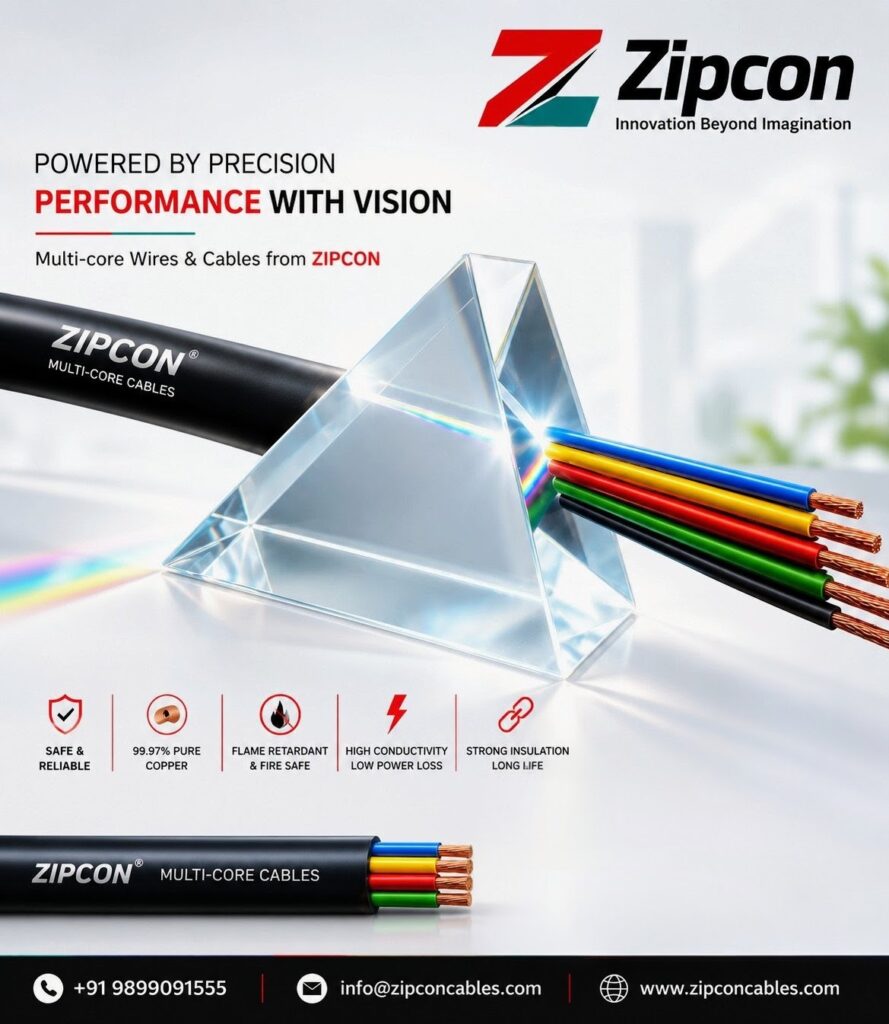
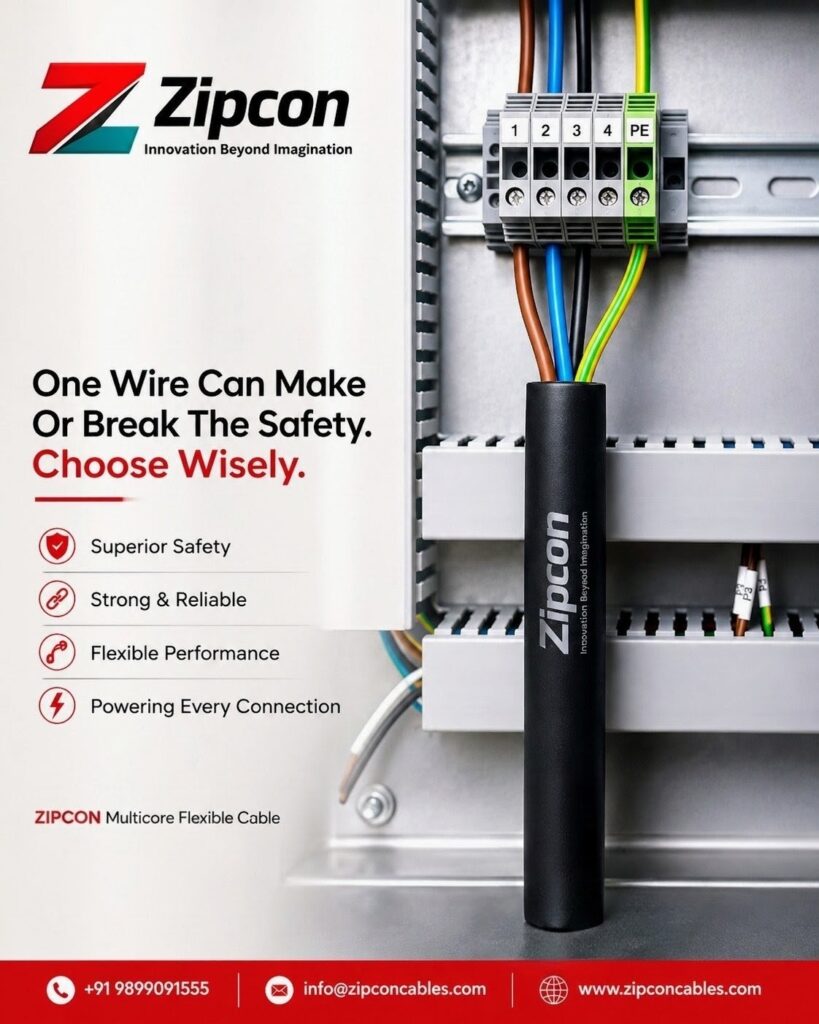
Zipcon’s cable range includes house wiring cables, multistrand cables, submersible cables, and other electrical cable solutions designed for different application requirements.
The important advantage is not simply choosing a recognizable cable brand. Buyers should select the correct Zipcon product based on conductor size, insulation type, electrical load, installation environment, and required performance.
Zipcon Cable Solutions by Application
| Application | Cable Category |
|---|---|
| Home lighting | House wiring cables |
| Residential wiring | FR / FRLS / HRFR wires |
| Flexible wiring | Multistrand cables |
| Borewell and water pumps | Submersible cables |
| Industrial applications | Suitable power/industrial cables |
| Solar applications | Solar-compatible cable solutions |
| Motor connections | Application-specific power cables |
The exact cable size and specification should always be selected according to the electrical load and installation requirements.
Quality Electric Cables vs Low-Quality Cables
The difference between a reliable cable and a poor-quality alternative may not be visible during installation. Problems often appear after the electrical system operates under continuous or heavy loads.
| Factor | Quality Cable | Low-Quality Cable |
| Conductor consistency | Controlled construction | May vary |
| Insulation | Application-specific | May be inconsistent |
| Flexibility | Designed for installation | May be difficult to handle |
| Thermal performance | Properly specified | May be inadequate |
| Electrical losses | Better controlled | Potentially higher |
| Service reliability | More predictable | Less predictable |
| Safety | Designed for intended application | Higher risk if unsuitable |
Choosing a cable solely because it has a lower purchase price can increase long-term costs. Premature cable failure may lead to rewiring, repairs, downtime, troubleshooting, and additional labour expenses.
Electric Cable Applications Across Kerala
Electrical cables are required throughout Kerala for residential construction, commercial properties, agriculture, infrastructure, and industrial projects.
Major markets include Kochi, Thiruvananthapuram, Kozhikode, Thrissur, Kollam, Kannur, Alappuzha, Kottayam, Palakkad, and Malappuram, along with smaller towns and rural areas.
Residential projects commonly require house wires and flexible cables, while agricultural and water-pumping applications may need specialized submersible cables. Industrial projects require cable specifications based on machinery, motors, power distribution, operating conditions, and installation methods.
Expert Tips for Buying Electric Cables in Kerala
1. Compare Specifications, Not Just Prices
A cheaper cable may not provide the same conductor quality, insulation characteristics, or durability as a properly manufactured product. Compare complete technical specifications before making a purchase.
2. Match the Cable to the Electrical Load
Cable sizing should be based on actual electrical requirements. Both undersizing and unnecessary oversizing can affect system cost and performance.
3. Choose a Reliable Manufacturer or Supplier
Purchase cables from established manufacturers or trusted suppliers. Check product markings, specifications, packaging, and applicable certification information before installation.
4. Consider the Installation Environment
Indoor, outdoor, underground, water-pump, solar, and industrial installations may require different cable constructions. Always match the cable to the environment.
5. Use Professional Installation
Cable quality alone cannot guarantee a safe electrical system. Proper routing, termination, joints, protection, and installation practices are equally important.
6. Review the Complete Cable Specification
Check the voltage rating, conductor material, conductor size, insulation type, number of cores, temperature characteristics, and intended application rather than evaluating the product only by brand name.
Common Mistakes to Avoid When Buying Electric Cables
Choosing an Undersized Cable
A cable with insufficient current capacity can overheat and contribute to excessive voltage drop. Cable sizing should be based on the electrical load and installation design.
Using One Cable Type for Every Application
A lighting circuit, air conditioner, water pump, and industrial motor have different requirements. The same cable should not automatically be used across all applications.
Ignoring Installation Conditions
Temperature, moisture, conduit arrangement, cable grouping, mechanical exposure, and installation length can affect cable selection and performance.
Buying Only on Price
Price matters, but it should be evaluated alongside conductor quality, insulation performance, durability, safety characteristics, and application suitability.
Ignoring Cable Terminations
Poorly tightened or improperly installed connections can generate heat and cause electrical faults. Correct terminals, lugs, joints, and termination methods are essential.
Mixing Unsuitable Cable Specifications
Different cable types and ratings should not be combined without considering their electrical and installation requirements. Maintain compatible specifications throughout the electrical system.
Examples of Electric Cable Selection
Example 1: New Residential House
A new house may require separate circuits for lighting, fans, sockets, kitchen appliances, and air conditioners.
The correct approach is to divide the installation into suitable circuits and determine the cable size for each based on its expected load. Zipcon FR, FRLS, HRFR, or suitable multistrand house wires can then be evaluated according to the project’s requirements.
Example 2: Borewell Water Pump
A farm or residential property may require a cable for a borewell submersible pump. A conventional indoor house wire should not automatically be used for this application.
A purpose-designed submersible cable should be selected according to pump capacity, voltage, cable length, installation depth, and operating conditions. Zipcon submersible cable solutions can be considered for suitable pump applications.
Example 3: Industrial Motor
Industrial motors can require significantly higher current than ordinary household appliances. Cable selection should therefore consider motor power, starting current, cable length, voltage drop, operating conditions, and installation method.
An appropriate industrial or power cable should be selected based on the electrical design rather than using a standard residential house wire.
Why Correct Cable Selection Saves Money Over Time
The purpose of selecting a quality electrical cable is not simply to complete the wiring. It is to create an electrical system capable of reliable operation over its intended service life.
Correct cable selection can help reduce overheating, unnecessary voltage drop, premature insulation deterioration, and avoidable maintenance. When combined with suitable circuit protection and professional installation, the right cable contributes to a more dependable electrical system.
For residential, commercial, agricultural, and industrial projects in Kerala, choosing the correct cable specification from the beginning can help avoid unnecessary repair and replacement costs.
Conclusion
Selecting the best electric cables in Kerala for home and industrial wiring requires a practical evaluation of cable size, conductor quality, insulation, current capacity, flexibility, installation environment, and application.
For residential projects, FR, FRLS, HRFR, and multistrand house wires can be considered according to specific wiring requirements. Industrial, solar, motor, and pump applications require cables selected specifically for their operating conditions.
Zipcon Cables offers a range of electrical cable solutions for different applications, including house wiring, multistrand, and submersible cables. Choose the appropriate Zipcon cable according to your electrical load and installation requirements, and ensure installation is carried out by qualified electrical professionals.
Top 5 FAQs
1. Which are the best electric cables in Kerala for home wiring?
The right cable depends on the circuit load, installation conditions, required safety characteristics, and applicable electrical requirements. FR, FRLS, HRFR, and multistrand house wires can be considered for different residential applications.
2. Which cable size is suitable for home wiring?
There is no single cable size suitable for every home circuit. The correct size depends on load current, cable length, voltage drop, installation method, ambient conditions, and other electrical design factors. A qualified electrician should determine the final specification.
3. Are FRLS wires suitable for residential buildings?
FRLS wires offer flame-retardant and low-smoke characteristics and can be considered for residential and commercial applications where these properties are required. Their suitability depends on the building design and applicable electrical requirements.
4. Which cable is suitable for a borewell pump in Kerala?
Borewell pumps generally require purpose-designed submersible cables suitable for the installation environment. Cable selection should consider pump capacity, voltage, cable length, installation depth, and manufacturer specifications. Zipcon submersible cables can be evaluated for suitable applications.
5. Why should I consider Zipcon Cables for electrical wiring?
Zipcon Cables provides different cable solutions for residential and specialized applications, including house wires, multistrand cables, and submersible cables. The appropriate product should be selected based on conductor size, insulation type, electrical load, installation environment, and application requirements.