
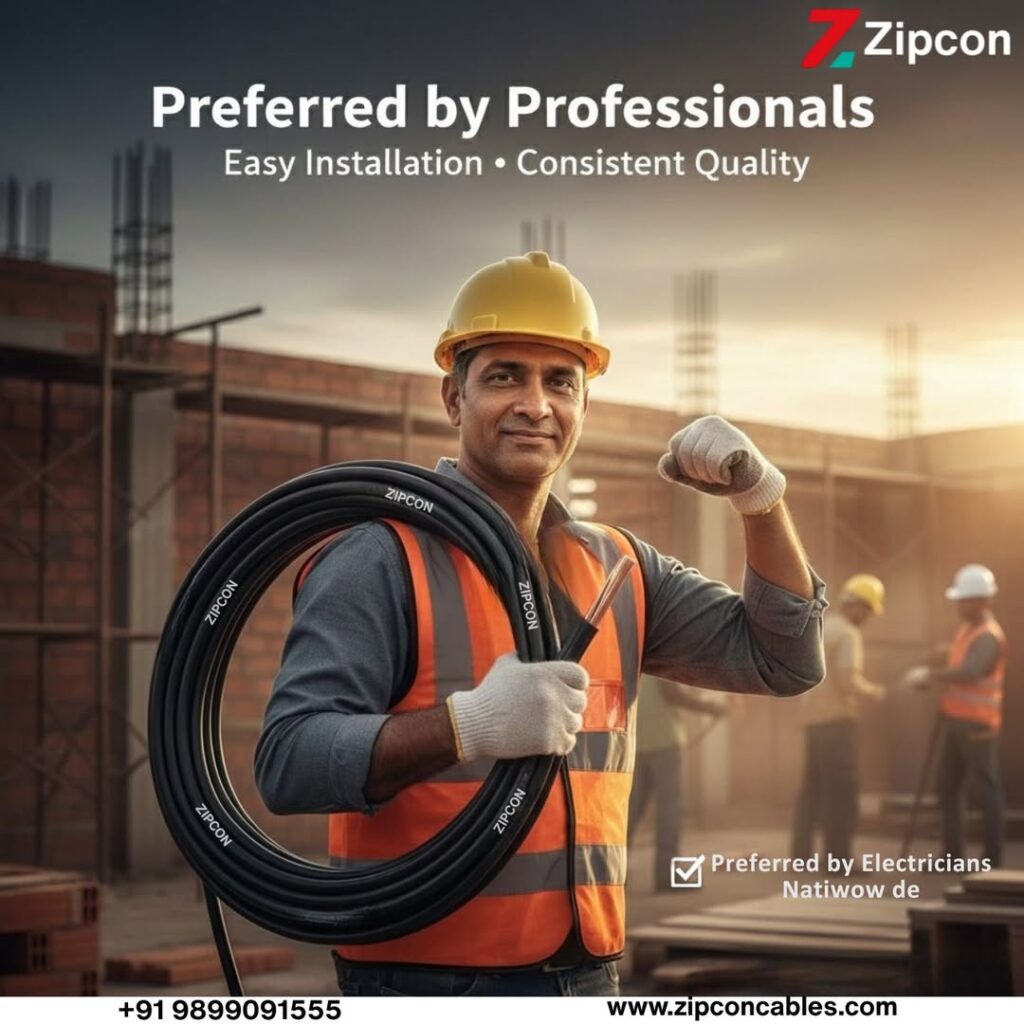
Choosing the best wires and cables for projects in India is an important part of any electrical installation. The right cable affects electrical safety, energy efficiency, equipment performance, maintenance requirements and the overall life of the installation. A cable that is unsuitable for the load or environment can lead to overheating, insulation damage, voltage drop and frequent electrical problems.
Different projects require different cable characteristics. Residential buildings may need dependable house wiring cables, while industrial facilities often require cables capable of handling higher loads and demanding operating conditions. Commercial buildings, agricultural applications, solar installations and infrastructure projects also have their own electrical requirements.
Zipcon Cables provides a range of electrical cable solutions designed around practical project requirements. From house wiring and power connections to specialized applications, selecting the right cable starts with understanding load, installation conditions, insulation requirements and expected service life.
For inquiries or assistance:👉 https://zipconcables.com/contact-us/
Why Choosing the Right Wire and Cable Matters
Electrical cables are responsible for safely carrying current from one point to another. Their conductor size, insulation material, construction and application suitability determine how effectively they perform under operating conditions.
Using an undersized cable can increase resistance and heat generation. On the other hand, selecting a cable without considering the installation environment can result in premature insulation deterioration. For this reason, cable selection should be based on engineering requirements rather than price alone.
For project owners, contractors and electrical professionals, a quality cable can provide more predictable performance and reduce the possibility of repeated repairs. This becomes particularly important in large projects where cable replacement can involve significant labour, downtime and additional material costs.
Key Factors to Consider When Selecting Project Wires and Cables
1. Electrical Load and Current Capacity
The first consideration is the expected electrical load. Cable size should be appropriate for the current it needs to carry under the actual installation conditions.
For example, a small lighting circuit and a heavy industrial motor cannot use the same cable specification simply because both require electrical connections. The conductor size and cable construction must correspond to the application.
2. Conductor Material
Copper and aluminium are commonly used conductor materials, with each offering different characteristics.
Copper provides high electrical conductivity and is widely used for residential, commercial and specialized electrical applications. Aluminium is lighter and can be advantageous for certain power-distribution applications where weight and project economics are important.
The correct choice depends on the project’s electrical design, installation method and performance requirements.
3. Insulation Quality
Insulation protects the conductor and helps prevent unwanted contact, leakage and short circuits. The insulation material should be suitable for the expected temperature, mechanical conditions and installation environment.
For building wiring, quality PVC insulation is commonly used because it provides protection around the conductor while supporting reliable everyday electrical operation.
4. Voltage Drop
Voltage drop becomes increasingly important when cables run over longer distances. Excessive voltage drop can affect the performance of electrical equipment and increase energy losses.
Cable size, conductor material, circuit length, current and installation conditions all influence voltage drop. A proper electrical design should therefore account for the complete cable route rather than looking only at the connected load.
5. Installation Environment
The location where a cable will be installed can significantly influence cable selection.
A cable installed inside a residential wall has different requirements from one exposed to moisture, heat, mechanical stress or outdoor conditions. Agricultural, industrial and solar applications may require additional consideration for environmental exposure and operating conditions.
Types of Wires and Cables Used in Different Projects
House Wiring Cables
Residential electrical systems require wires that provide dependable performance for lighting, fans, sockets, appliances and other household loads.
For house wiring, important factors include conductor quality, insulation performance, flexibility, current-carrying capacity and installation convenience. Zipcon Cables can be considered for residential wiring projects where reliable electrical connections and consistent cable quality are important.
Flexible Cables
Flexible cables are useful where the cable needs to bend or move during installation or operation. They can be suitable for equipment connections, control applications, machinery and other installations where flexibility is an important requirement.
The appropriate construction depends on the application, voltage level and mechanical movement involved.
Submersible Pump Cables
Submersible pump systems operate in environments where moisture and water exposure are major considerations. Cable construction and insulation therefore become critical factors.
Submersible cables are designed for electrical connections associated with submersible pumps and water systems. Zipcon offers submersible cable solutions for applications where reliable electrical performance is required in demanding wet environments.
Solar Pump Cables
Solar-powered pumping systems combine photovoltaic power generation with water-pumping equipment. Their cable selection needs to consider the electrical characteristics of the system as well as the installation environment.
A suitable solar pump cable can help establish a dependable connection between the electrical system and pumping equipment. Proper sizing and installation remain essential for long-term performance.
Solar DC Cables
Solar DC cables are used in photovoltaic systems for carrying direct-current power between components such as solar modules, junction points and other system equipment.
Because these cables may be exposed to outdoor conditions, the selection process should consider insulation, temperature exposure, mechanical protection and the specific requirements of the solar installation.
Wires and Cables for Residential, Commercial and Industrial Projects
The “best” cable is not necessarily the same for every project. Cable selection should match the project’s electrical requirements.
| Project Type | Common Cable Requirements | Key Considerations |
|---|---|---|
| Residential | House wiring cables | Safety, flexibility, insulation, load capacity |
| Commercial | Power and wiring cables | Continuous operation, load diversity, installation method |
| Industrial | Power, flexible and specialized cables | High loads, mechanical conditions, environment |
| Agricultural | Submersible and pump cables | Moisture resistance, installation conditions |
| Solar | Solar DC and pump cables | Outdoor exposure, DC performance, insulation |
| Infrastructure | Power and control cables | Distance, load, environment and reliability |
This comparison highlights why choosing a cable based only on its name or price can be misleading. The cable should be selected according to its intended application and electrical design.
Why Cable Quality Matters in Indian Conditions
India has diverse operating environments, ranging from hot and dry regions to areas with high humidity and heavy rainfall. Electrical installations may also face dust, moisture, temperature fluctuations and demanding operating schedules.
These conditions make insulation and cable construction important considerations. A cable selected for a controlled indoor environment may not be appropriate for an exposed outdoor or industrial installation.
For project contractors, choosing cables designed for the intended application can help create more dependable electrical installations. Zipcon Cables focuses on providing cable solutions for a variety of electrical and project applications.
Example: Selecting Cable for a Residential Project
Consider a multi-floor residential building with lighting circuits, fans, sockets, air-conditioning points and other household loads.
The contractor should first divide the electrical installation into appropriate circuits. Cable sizes can then be selected according to the expected load, circuit length, installation method and applicable electrical requirements.
For example, lighting circuits generally have different load characteristics from high-power appliance circuits. Using the same cable specification throughout the building without considering circuit requirements is not an effective approach.
This is where proper electrical planning combined with suitable house wiring cables becomes important.
Example: Cable Selection for an Industrial Project
An industrial facility may contain motors, control panels, machinery and other electrical equipment operating for extended periods.
Here, cable selection needs to consider continuous load, starting current where applicable, ambient temperature, installation arrangement, mechanical exposure and voltage drop.
A cable suitable for a small residential circuit should not automatically be considered suitable for industrial equipment. Industrial cable selection should follow the project’s electrical design and equipment specifications.
Example: Cable Selection for a Borewell Pump
A borewell pump installation presents a different challenge because the cable may operate in a wet environment and remain connected to equipment installed below ground level.
A suitable submersible cable should be selected according to the pump’s electrical requirements, installation depth, cable length and environmental conditions.
Using an inappropriate cable can create insulation and reliability problems. Therefore, cable selection should be completed before installation rather than after electrical issues appear.
Benefits of Choosing Quality Cables for Projects
Better Electrical Reliability
A properly selected cable provides a dependable path for electrical current. Good conductor quality and suitable insulation contribute to stable electrical operation.
Improved Installation Performance
Cables designed for their intended application can make installation more predictable. Flexibility, construction and insulation characteristics can be particularly important during routing and termination.
Reduced Maintenance Problems
Cable-related failures can be expensive because they may require troubleshooting, replacement and equipment downtime. Selecting an appropriate cable from the beginning can reduce avoidable installation issues.
Better Long-Term Value
The cheapest cable is not always the most economical choice. A project should consider service requirements, expected operating conditions, maintenance and replacement costs when evaluating cable options.
Why Consider Zipcon Cables for Project Requirements?
Zipcon Cables offers electrical cable solutions for different applications, including residential wiring, flexible connections, submersible pump systems and solar-related applications.
The right Zipcon cable should be selected based on the specific electrical design and application rather than using one cable type for every requirement. This approach helps contractors and project owners match the cable construction with the actual operating environment.
For projects where quality, safety and performance are priorities, Zipcon Cables can be considered as a reliable cable solution provider for a variety of electrical applications.
Expert Tips for Choosing Wires and Cables
- Calculate the expected electrical load before selecting the cable size.
- Consider cable length because longer cable runs can increase voltage drop.
- Check the installation environment, especially for outdoor, underground, wet or industrial applications.
- Select appropriate insulation based on temperature and environmental conditions.
- Do not select cables only by price. Consider quality, application suitability and long-term performance.
- Use the correct cable for the application. House wiring, solar, submersible and industrial cables have different requirements.
- Follow applicable electrical standards and project specifications during cable selection and installation.
- Buy from a reliable manufacturer or supplier to improve consistency in cable quality and documentation.
- Ensure proper termination and installation because even a quality cable can perform poorly when incorrectly installed.
- Consult a qualified electrical professional for projects involving significant loads or specialized electrical systems.
Common Mistakes to Avoid When Selecting Project Cables
Choosing Cable Size Only by Price
Selecting a smaller or cheaper cable to reduce the initial project cost can create problems if the cable is not suitable for the required load.
Ignoring Voltage Drop
For long cable runs, voltage drop can become an important design consideration. Ignoring it may affect equipment performance.
Using One Cable Type for Every Application
Residential wiring, industrial machinery, solar systems and submersible pumps have different operating conditions. One cable specification should not be assumed to work for every application.
Ignoring Environmental Conditions
Moisture, heat, chemicals, sunlight and mechanical stress can influence cable performance. Environmental exposure should be considered before finalizing the cable.
Poor Installation and Termination
Cable quality alone cannot guarantee reliable performance. Incorrect stripping, loose terminals, improper routing or excessive bending can damage the cable and create electrical problems.
How to Choose the Best Wires and Cables for Your Project
Start by identifying the project’s application and electrical load. Next, consider voltage, current, cable length, installation method, environmental exposure and the type of equipment being connected.
After establishing these requirements, compare suitable cable constructions from a dependable manufacturer. Check technical specifications, conductor size, insulation type and applicable project requirements before placing the order.
For residential, commercial, industrial, agricultural and solar projects, Zipcon Cables can be considered for application-specific cable requirements. Selecting the appropriate product for each circuit or system is more important than simply choosing the same cable throughout the project.
Conclusion
The best wires and cables for projects in India are those that match the electrical load, installation environment and specific application. Quality conductors, suitable insulation, correct sizing and proper installation all contribute to electrical safety and dependable performance.
Whether the requirement is for house wiring, flexible cables, submersible pump cables or solar applications, cable selection should be treated as an important part of project planning—not as a last-minute material purchase.
Zipcon Cables provides a range of cable solutions for different electrical applications. For your next project, evaluate the technical requirements first and choose a cable that delivers the right combination of quality, safety, durability and performance.
Frequently Asked Questions
1. Which wires and cables are best for projects in India?
The best cable depends on the project’s electrical load, voltage, installation environment and application. House wiring, industrial equipment, solar systems and submersible pumps require different cable solutions.
2. How do I choose the right cable size for a project?
Cable size should be selected based on current load, voltage, cable length, installation conditions, allowable voltage drop and applicable electrical requirements. A qualified electrical professional should verify the final selection for project installations.
3. Are Zipcon Cables suitable for house wiring projects?
Zipcon Cables offers cable solutions for residential electrical applications. The appropriate house wiring cable should be selected according to the circuit load, installation method and project requirements.
4. What cables are used for submersible pumps?
Submersible pump cables are specifically designed for electrical connections associated with submersible pumping systems. Selection should consider pump rating, cable length, installation conditions and the manufacturer’s requirements.
5. Why should project owners choose quality electrical cables?
Quality and application-appropriate cables can support safer and more reliable electrical installations. Proper cable selection can also help reduce avoidable maintenance, replacement and downtime costs over the project’s service life.