

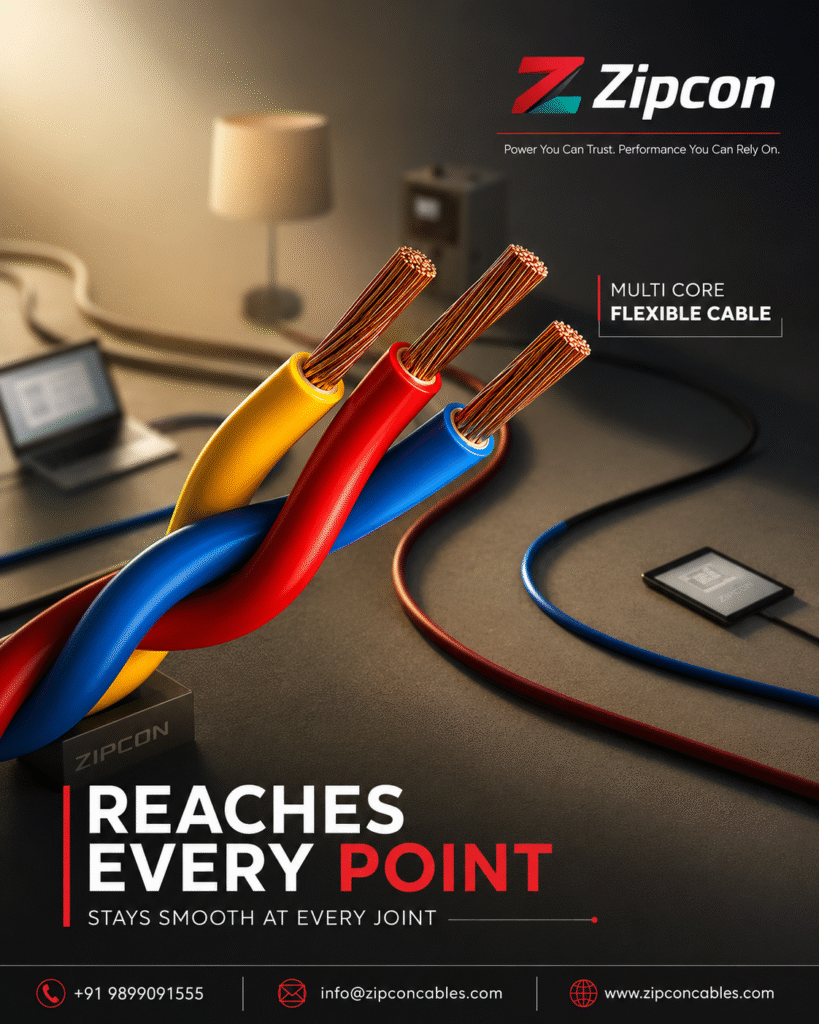
Choosing the right flexible cable in Jabalpur is important for electrical installations where wires need to bend, move, or fit into compact spaces. A cable with good flexibility makes installation easier while maintaining dependable electrical performance and insulation protection.
Zipcon Cables offers quality-focused cable solutions designed for residential, commercial, and electrical applications. With suitable conductor quality, flexible construction, and reliable insulation, Zipcon cables can support safer and cleaner wiring installations.
Whether you are wiring a house, office, shop, control panel, appliance, or other electrical setup, selecting the right flexible cable should depend on conductor material, size, insulation, current requirement, installation conditions, and overall cable quality.
For inquiries or assistance:– https://zipconcables.com/contact-us/
What Is a Flexible Cable?
A flexible cable is an electrical cable designed to bend more easily than conventional rigid wiring. It generally uses fine or multiple strands of conductor instead of one solid conductor, allowing the cable to handle repeated bending during installation or use.
Flexible cables are useful where wiring routes contain curves, tight spaces, movable equipment, or connections that require easier handling. Their flexibility can also make installation faster because the cable can be routed around corners without excessive force.
For electrical safety, flexibility alone is not enough. The cable should also have an appropriately sized conductor, quality insulation, suitable voltage rating, and construction appropriate for the intended application.
Why Choose Flexible Cable for Electrical Wiring in Jabalpur?
Electrical installations in homes, shops, offices, workshops, and industrial locations often require wires to pass through corners, conduits, panels, and confined spaces. A flexible cable can make these installations easier while reducing unnecessary bending stress during fitting.
A good-quality flexible electrical cable also provides practical benefits during maintenance. Electricians can route and reposition the cable more easily, particularly inside electrical panels, equipment connections, and areas with limited installation space.
For reliable results, the cable should always be selected according to the actual electrical load and installation requirements rather than choosing only on the basis of price.
Key Features to Look for in a Flexible Cable
1. High-Quality Conductors
The conductor is responsible for carrying electrical current, so its quality directly affects electrical performance. Copper conductors are widely preferred for applications requiring good conductivity and flexibility.
A properly manufactured multi-strand conductor can provide the flexibility needed for easier routing while maintaining a dependable electrical connection.
2. Reliable PVC Insulation
Quality insulation protects the conductor from accidental contact, moisture, abrasion, and other installation-related stresses. PVC insulation is commonly used in many electrical cable applications because it provides a practical combination of insulation performance, durability, and flexibility.
For Zipcon flexible cables, selecting the appropriate insulation specification for the intended application is essential to achieving dependable long-term performance.
3. Good Flexibility
A flexible cable should bend without unnecessary resistance or damage to its insulation. This is especially useful when wiring must pass through corners, conduits, junction boxes, or compact electrical spaces.
However, flexibility should not be confused with unrestricted bending. Every cable has installation limits, and sharp bends should be avoided.
4. Appropriate Cable Size
Cable size should be selected according to the expected current, circuit length, installation method, and applicable electrical requirements. Using an undersized cable can cause excessive heating and voltage drop.
For example, a circuit supplying a high-load appliance may require a larger conductor than a low-load lighting circuit. The correct size should be determined by a qualified electrician or electrical professional.
5. Strong Insulation and Construction
A cable used in everyday electrical installations needs insulation capable of handling the expected environmental and mechanical conditions. Good construction can help protect the cable during installation and regular operation.
This becomes particularly important in locations where cables may experience movement, heat, friction, or confined routing.
Flexible Cable vs. Solid Wire
| Feature | Flexible Cable | Solid Wire |
|---|---|---|
| Conductor | Multiple/fine strands | Usually single solid conductor |
| Flexibility | High | Lower |
| Installation around corners | Easier | More difficult |
| Suitable for movement | Better suited | Generally less suitable |
| Panel/equipment connections | Convenient | Can be less convenient |
| Tight routing | Easier | Requires more careful handling |
Flexible cable is generally advantageous where installation requires bending or movement. Solid wire can be suitable for fixed wiring applications where flexibility is not a major requirement.
The correct choice depends on the installation design, electrical load, local standards, and equipment requirements.
Applications of Flexible Electrical Cable
Residential Wiring
Flexible cables can be used for suitable household electrical connections where their construction and size meet the circuit requirements. They are particularly convenient for connections requiring easier routing.
Commercial Wiring
Shops, offices, showrooms, and other commercial spaces often have wiring routes that pass through compact electrical areas. Flexible cables can simplify installation around panels, equipment, and fixtures.
Electrical Panels
Inside control panels and distribution equipment, wires frequently need to follow short, curved routes. Flexible multi-strand cables can make termination and routing more manageable.
Machinery and Equipment
Some equipment connections experience vibration or movement. A suitable flexible cable can accommodate this movement better than a rigid conductor, provided the cable is specifically rated for the application.
Temporary and Movable Connections
Where electrical equipment is frequently moved or repositioned, the appropriate flexible cable can provide greater practicality than rigid wiring.
How to Select the Best Flexible Cable in Jabalpur
Selecting the best flexible cable in Jabalpur requires more than comparing prices between products. Consider these factors before purchasing:
1. Determine the electrical load: Identify the expected current before selecting the conductor size.
2. Select the correct conductor: Choose a conductor material and construction appropriate for the required conductivity and flexibility.
3. Check insulation requirements: Consider temperature, moisture, mechanical exposure, and installation environment.
4. Consider cable length: Longer cable runs can experience greater voltage drop, making correct sizing important.
5. Check application compatibility: A cable intended for fixed indoor wiring may not be suitable for continuous movement or outdoor exposure.
6. Choose a reliable manufacturer: Consistent manufacturing quality is important for insulation, conductor dimensions, flexibility, and overall cable performance.
Example: Choosing Cable for Different Applications
Suppose an electrician is wiring a residential property in Jabalpur. Lighting circuits, socket circuits, and high-load appliances may have different current requirements.
Using the same cable size for every circuit simply because it is flexible is not good practice. Each circuit should be evaluated independently, and the cable should be selected according to its load, installation method, length, and applicable electrical requirements.
For a control panel, the priority may instead be easy routing and termination. For equipment exposed to movement, flexibility and mechanical suitability become more important.
Why Consider Zipcon Cables?
Zipcon Cables can be considered when you are looking for dependable cable solutions for residential, commercial, and electrical applications. The focus should be on selecting the appropriate Zipcon cable specification for the particular circuit and installation environment.
A quality cable should provide a practical balance between electrical conductivity, flexibility, insulation protection, mechanical strength, and installation convenience. Choosing the correct Zipcon product according to cable size and application can help create a more reliable wiring system.
For projects in Jabalpur, buyers should also verify the required cable specification, conductor size, insulation type, and intended application before finalizing their purchase.
Expert Tips for Buying Flexible Cable
- Never select cable size only by price. Electrical load should be the starting point.
- Avoid excessive bending. Even flexible cables have minimum bending requirements.
- Use proper terminals and connectors. Poor termination can compromise an otherwise good cable.
- Inspect insulation before installation. Do not install cables with visible cuts, cracks, or damage.
- Consider voltage drop on long runs. Cable length can affect circuit performance.
- Use application-appropriate cables. Indoor fixed wiring and moving equipment may require different cable constructions.
- Buy from a reliable source. Product authenticity and consistent manufacturing quality matter.
- Have installation performed by a qualified electrician. Correct installation is as important as cable selection.
Common Mistakes When Choosing Flexible Cable
Choosing an Undersized Cable
One of the most serious mistakes is selecting a smaller conductor to reduce cost. An undersized cable may experience excessive heating when subjected to a load beyond its suitable capacity.
Focusing Only on Flexibility
A cable can be highly flexible but still be unsuitable for a particular electrical application. Conductor size, insulation, voltage rating, temperature rating, and installation conditions must also be considered.
Ignoring Installation Conditions
A cable installed near heat sources, in damp areas, inside machinery, or in locations exposed to mechanical stress may require specific construction. Always match the cable to its environment.
Poor Termination
Loose or inappropriate connections can create resistance and localized heating. Proper stripping, terminals, connectors, and tightening practices are essential.
Buying Without Checking Specifications
Before purchasing a flexible cable in Jabalpur, verify the cable size, conductor material, insulation specifications, voltage rating, and intended application.
Conclusion
The right flexible cable in Jabalpur can make electrical wiring easier to install while providing reliable current transmission and insulation protection. But flexibility should never be the only selection criterion. Conductor quality, cable size, insulation, installation environment, electrical load, and application must all be considered.
For a dependable cable solution, Zipcon Cables is a brand worth considering. Select the appropriate Zipcon cable specification for your electrical requirement and have it installed according to applicable electrical practices. A properly selected and correctly installed cable is the foundation of safer, more durable wiring.
Top 5 FAQs
1. Which is the best flexible cable in Jabalpur?
The best flexible cable depends on the electrical load, conductor size, insulation requirements, installation environment, and application. Zipcon Cables offers cable solutions that can be selected according to specific wiring requirements.
2. Why are flexible cables used in electrical wiring?
Flexible cables are used where wiring needs to bend, follow curved routes, fit into confined spaces, or connect to equipment that may move or vibrate. Their stranded construction generally provides easier handling than solid conductors.
3. Is a flexible cable suitable for house wiring?
A suitable flexible cable can be used for certain residential wiring applications when its specifications meet the circuit requirements and applicable electrical standards. Cable size and construction should always be selected according to the specific application.
4. How do I choose the correct flexible cable size?
Choose the cable size based on factors such as current load, circuit length, installation method, voltage drop, ambient conditions, and applicable electrical requirements. A qualified electrician should confirm the final selection.
5. Why choose Zipcon Cables for electrical wiring?
Zipcon Cables can be considered for electrical applications where dependable conductor performance, suitable insulation, and practical cable flexibility are required. The correct Zipcon cable should be selected based on the application’s technical requirements.