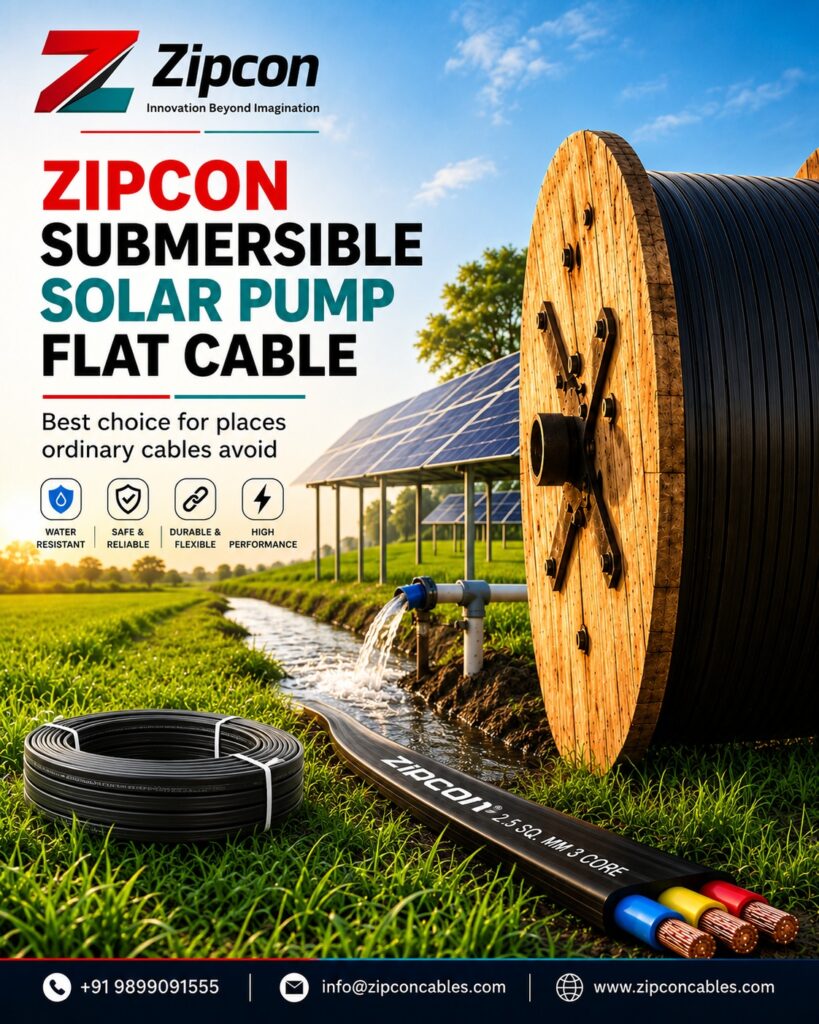
Choosing the right solar pump submersible cable in Kozhikode is essential for maintaining efficient, safe, and reliable solar water pumping. A solar pump cable operates in demanding conditions where moisture, heat, continuous electrical load, and mechanical stress can affect cable performance.
For agricultural irrigation, borewell pumping, water supply, and solar-powered pumping systems, the cable must provide dependable electrical connectivity from the solar pumping system to the submersible motor. Poor-quality cables can contribute to voltage drop, insulation damage, power loss, and premature motor problems.
Zipcon Cables offers durable solar pump and submersible cable solutions designed for applications where reliable performance and protection against demanding operating conditions are important. Selecting the correct cable size, construction, insulation, and installation method can significantly improve the overall performance of a solar pumping system.
Contact us today:- https://zipconcables.com/contact-us/
Why Solar Pump Submersible Cable Quality Matters
A solar water pump depends on consistent electrical power to operate efficiently. The cable connecting the electrical system to the submersible pump must carry current safely without excessive losses or insulation deterioration.
In Kozhikode, cable selection becomes particularly important because pumping systems may operate in wet environments and agricultural areas. A suitable cable should withstand moisture exposure, temperature variations, continuous operation, and installation conditions inside or around borewells.
A high-quality submersible cable helps maintain stable power transmission while reducing the possibility of insulation failure, electrical leakage, and unnecessary maintenance.
Key Performance Requirements
A reliable solar pump submersible cable should provide:
- Strong electrical conductivity
- Durable insulation
- Resistance to moisture and water exposure
- Good flexibility for installation
- Resistance to heat and environmental stress
- Mechanical strength for demanding installations
- Long service life
- Suitable current-carrying capacity
- Low electrical losses when correctly sized
Why Kozhikode Requires Reliable Solar Pump Cables
Kozhikode has extensive agricultural and residential water-pumping requirements, making solar-powered pumping an increasingly useful solution for locations where dependable water extraction is required.
Solar pump installations may be exposed to humid conditions, groundwater, agricultural environments, and temperature changes. The cable therefore needs insulation and construction suitable for continuous exposure to demanding conditions.
For borewell and submersible applications, the cable is not simply an electrical connection. It becomes an important part of the complete pumping system. Incorrect cable selection can affect motor performance even when the solar panels and pump are properly selected.
What Is a Solar Pump Submersible Cable?
A solar pump submersible cable is an electrical cable designed to supply power to submersible pump motors used in solar water pumping systems. It connects the pumping equipment with the motor while operating in environments where water and moisture may be present.
Unlike ordinary house wiring, submersible pump cables require construction that can withstand challenging installation conditions. The cable may remain submerged for extended periods, making insulation quality particularly important.
Solar pumping systems can also involve long cable runs. Therefore, the cable’s conductor size must be selected according to the motor’s power requirements, operating current, installation distance, and system voltage.
Important Features to Look for in a Solar Pump Cable
1. High-Quality Conductors
The conductor directly affects electrical performance. A properly manufactured conductor provides efficient current transmission and helps minimise avoidable electrical losses.
Cable size should be selected based on the pump’s electrical requirements rather than choosing a size simply because it is commonly available.
2. Durable PVC Insulation
Strong insulation is essential for submersible applications. The insulation should protect the conductor against moisture, mechanical stress, and environmental exposure.
Zipcon Cables focuses on durable cable construction suitable for demanding electrical and pumping applications.
3. Water and Moisture Resistance
Submersible cables operate in environments where water exposure is unavoidable. Proper insulation helps prevent moisture from reaching the conductor and compromising electrical safety.
For borewell applications, selecting a cable specifically designed for submersible use is preferable to using conventional electrical wiring.
4. Flexibility
Installation often requires the cable to follow the pump and borewell configuration. A flexible cable makes handling and installation easier while reducing unnecessary mechanical stress.
Flexibility is particularly useful when the cable must be positioned alongside the pump assembly.
5. Heat Resistance
Solar pumping equipment can operate for extended periods, especially during periods of high sunlight and agricultural demand. Cable insulation must therefore tolerate the expected operating temperature.
Good thermal performance helps maintain insulation integrity during continuous operation.
6. Appropriate Cable Size
Cable size directly affects voltage drop and current-carrying capability. A cable that is too small for the application can experience higher losses and excessive heating.
The appropriate size should be calculated based on:
- Motor power
- Operating voltage
- Current
- Cable length
- Installation conditions
- Allowable voltage drop
- Pump manufacturer’s requirements
Solar Pump Cable Size: Why Correct Selection Matters
One of the most important decisions when installing a solar submersible pump is choosing the correct cable cross-sectional area.
For example, a small pump installed close to the electrical source may require a different cable size from a higher-powered pump installed deep inside a borewell with a long cable run.
Using an undersized cable can increase voltage drop and heating. An oversized cable may increase installation cost without providing a meaningful benefit if the additional capacity is unnecessary.
Therefore, cable sizing should always be based on actual system parameters rather than guesswork.
Simple Example
Consider two solar pump installations:
Installation A:
A relatively small motor with a short cable run may work efficiently with a properly selected smaller cross-section cable.
Installation B:
A higher-power motor installed at significant depth with a longer cable run may require a larger conductor to maintain acceptable voltage levels.
The correct choice depends on the complete electrical calculation, not only the motor rating.
Benefits of Using a Quality Solar Pump Submersible Cable
Improved Power Transmission
A properly sized and manufactured cable helps deliver electrical power efficiently to the submersible motor.
Better Motor Performance
Stable electrical supply supports consistent pump operation and helps the motor operate according to its intended electrical specifications.
Reduced Risk of Insulation Failure
Quality insulation provides better protection against moisture and environmental exposure, which is especially important in submerged installations.
Longer Service Life
A cable manufactured for demanding applications can provide better durability than ordinary wiring when used within its specified operating conditions.
Lower Maintenance Requirements
Reliable cable construction reduces the likelihood of frequent cable-related problems, helping minimise interruptions to pumping operations.
Solar Pump Cable vs Ordinary Electrical Cable
| Feature | Solar Pump Submersible Cable | Ordinary Electrical Cable |
|---|---|---|
| Submersible application | Designed for suitable applications | Generally not intended |
| Water exposure | Requires appropriate water-resistant insulation | Depends on cable type |
| Flexibility | Important for pump installation | Varies |
| Mechanical stress | Designed according to application | Varies |
| Borewell use | Suitable cable types available | Generally unsuitable |
| Motor connection | Designed for pump applications | Not necessarily suitable |
The important point is that cable selection should follow the application. A cable suitable for indoor house wiring should not automatically be used for a submersible solar pump.
Why Choose Zipcon Cables for Solar Pump Applications?
Zipcon Cables provides cable solutions focused on dependable electrical performance, durable insulation, and applications requiring reliable operation.
For solar pump and submersible installations, the right cable should combine suitable conductor construction with durable insulation and application-specific performance.
Zipcon’s solar pump cable solutions can be considered for agricultural pumping, borewell systems, solar water pumping projects, and other applications where reliable electrical connectivity is required.
The advantage of choosing an application-focused cable is that selection can be based on the actual requirements of the pumping system rather than treating a submersible installation like ordinary electrical wiring.
Applications of Solar Pump Submersible Cables in Kozhikode
Agricultural Irrigation
Solar-powered pumps can provide water for agricultural fields without relying entirely on conventional grid electricity. A reliable submersible cable helps transfer electrical power to the pump motor.
Borewell Water Pumping
Submersible pumps installed inside borewells require cables specifically suitable for the installation environment. Proper insulation and mechanical durability are essential.
Farm Water Supply
Farms can use solar pumping systems for water storage tanks, irrigation networks, and other water-management requirements.
Residential Water Systems
Solar pumping can also support water transfer applications in homes and properties where suitable water sources and solar systems are available.
Commercial and Institutional Projects
Larger water-pumping projects require careful selection of cable size and construction based on motor capacity, cable length, installation depth, and electrical system design.
Examples: Selecting the Right Cable
Example 1: Agricultural Borewell
A farmer installs a solar-powered submersible pump in a borewell for field irrigation. The pump is installed at considerable depth, and the cable must travel from the control equipment to the motor.
In this situation, the cable should be selected based on motor current, cable length, system voltage, installation depth, and permissible voltage drop.
Example 2: Solar Pump for Water Storage
A solar pump is used to move groundwater into an elevated storage tank. Because the system operates for several hours during suitable sunlight conditions, cable durability and electrical efficiency are important.
A properly sized Zipcon solar pump cable can help create a dependable connection between the pumping equipment and motor when installed according to manufacturer specifications.
Example 3: Long Cable Run
A pump may be located far from the solar control equipment. As cable length increases, voltage drop becomes more important.
In such cases, calculating the required conductor size before installation can help prevent unnecessary power losses and performance issues.
Expert Tips for Choosing Solar Pump Submersible Cable
Check the Motor Rating
Always start with the pump manufacturer’s electrical specifications. Motor power and operating current are fundamental factors in cable selection.
Calculate Cable Length
Measure the actual cable route rather than estimating the distance. Longer cable runs can increase voltage drop and may require a larger conductor.
Consider Installation Depth
For borewell applications, determine the complete vertical and horizontal cable route. The cable should have adequate mechanical characteristics for the installation.
Use Application-Specific Cable
Avoid replacing a dedicated submersible cable with ordinary house wiring. Submersible environments require suitable insulation and construction.
Follow Electrical Standards
Cable selection and installation should comply with applicable electrical requirements and the pump manufacturer’s recommendations.
Inspect the Cable Before Installation
Check the cable for cuts, crushed sections, damaged insulation, or manufacturing defects before placing it into the installation.
Use Proper Termination
Even a high-quality cable can fail if connections are poorly made. Proper termination, sealing, and insulation are critical in wet environments.
Common Mistakes to Avoid
Choosing Cable Only by Price
The cheapest cable may not provide the required construction or service life. Compare conductor quality, insulation, size, application suitability, and manufacturer reliability.
Using the Wrong Cable Size
Incorrect sizing can result in voltage drop, heating, and inefficient motor operation. Cable sizing should be calculated from actual system parameters.
Ignoring Cable Length
A cable specification that works for a short installation may not be suitable for a much longer run. Distance must be included in the selection process.
Using Ordinary House Wire for a Submersible Pump
House wiring and submersible pump cables serve different applications. Water exposure requires appropriate insulation and cable construction.
Poor Cable Jointing
Improper joints can allow moisture penetration and create electrical problems. Connections should be completed using appropriate methods and materials.
Ignoring Manufacturer Recommendations
The pump manufacturer provides important information about current, voltage, cable size, and installation requirements. These specifications should form the basis of cable selection.
How Zipcon Cables Can Support Solar Pump Installations
Selecting the right cable is an important part of building a dependable solar pumping system. Zipcon Cables offers solar pump and submersible cable options intended for applications where durability, reliable power transmission, and suitable insulation are important.
For customers in Kozhikode, the selection should be based on the pump rating, cable length, installation depth, system voltage, environmental conditions, and project requirements.
A technically correct cable choice can help improve system reliability while reducing avoidable electrical losses and maintenance problems.
Conclusion
The right solar pump submersible cable in Kozhikode can make a significant difference to the reliability and efficiency of a solar water pumping system. The cable must be selected according to motor capacity, voltage, cable length, installation depth, environmental exposure, and allowable voltage drop.
Choosing an application-specific cable with durable insulation and appropriate conductor size is a better approach than selecting a cable based only on price or availability.
For reliable solar pumping and borewell applications, consider Zipcon Cables for durable solar pump and submersible cable solutions. Select the correct cable specification, follow proper installation practices, and ensure the complete system is designed according to the pump manufacturer’s electrical requirements.
Top 5 FAQs
1. Which cable is best for a solar submersible pump?
A cable specifically designed for solar pump and submersible applications is generally the appropriate choice. It should have suitable conductor size, durable insulation, flexibility, and resistance to the environmental conditions of the installation. Zipcon Cables offers solar pump and submersible cable solutions for such applications.
2. Can ordinary electrical wire be used for a borewell pump?
Ordinary electrical wire should not be used simply because it can carry the required current. Borewell pumps require cables with construction and insulation suitable for submerged and moisture-exposed conditions.
3. How do I select the correct solar pump cable size?
Cable size should be selected based on motor power, operating current, system voltage, total cable length, installation conditions, and permissible voltage drop. The pump manufacturer’s recommendations and applicable electrical standards should also be considered.
4. Why is cable insulation important in a submersible pump?
The cable can be exposed to water and moisture for extended periods. Proper insulation protects the conductor and helps maintain electrical safety and reliable performance throughout the installation.
5. Why choose Zipcon Cables for solar pump applications in Kozhikode?
Zipcon Cables focuses on durable electrical cable solutions for demanding applications. Its solar pump and submersible cable range can be considered for agricultural irrigation, borewell pumping, solar water systems, and other applications requiring dependable power transmission.