

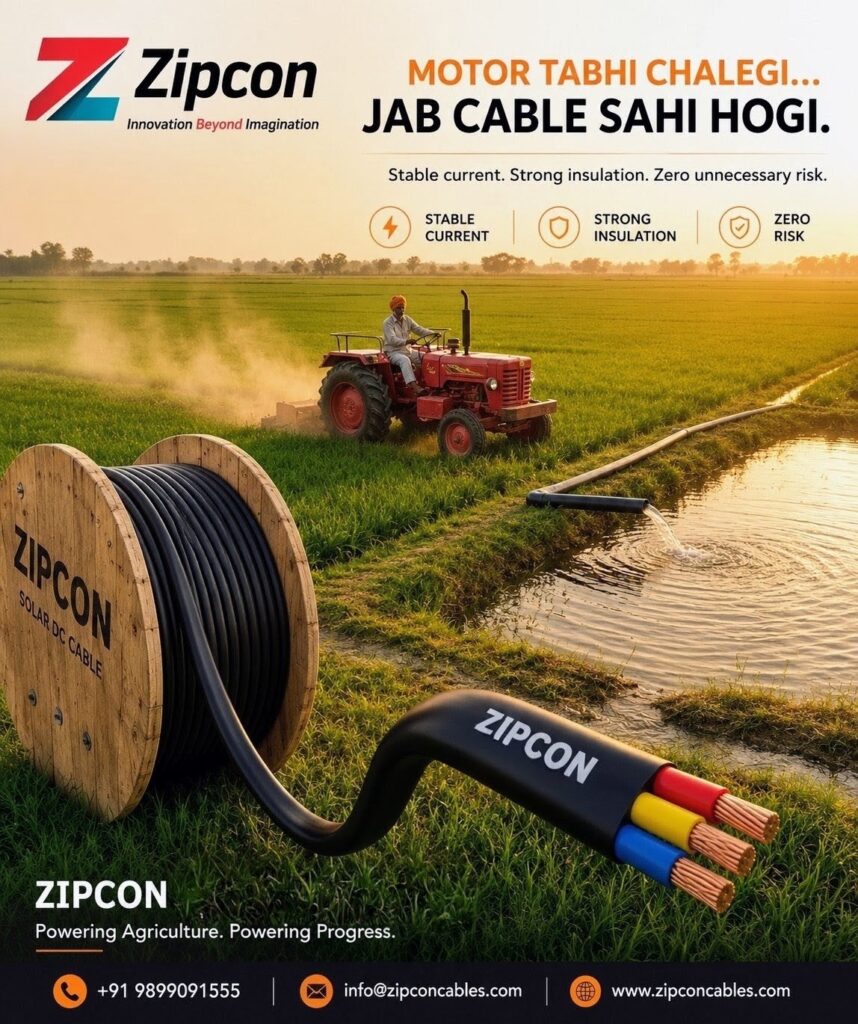
A submersible pump operates in a demanding environment where the electrical cable is exposed to moisture, water, pressure and continuous operating conditions. Choosing the right Submersible Cable in Gwalior is therefore essential for maintaining a dependable connection between the power supply and the pump.
A suitable submersible cable should have appropriate insulation, conductor construction, flexibility and electrical capacity for the installation. Poor-quality or incorrectly sized cable can contribute to voltage drop, overheating, insulation damage and unreliable pump operation.
For homeowners, farmers, borewell operators and electrical contractors, Zipcon Cables offers submersible cable solutions designed for applications where reliable electrical performance and durable cable construction are important.
For inquiries or assistance:– https://zipconcables.com/contact-us/
What Is a Submersible Cable?
A submersible cable is specifically designed for electrical connections involving submersible pumps and equipment installed in or around water. Unlike ordinary electrical wires, these cables require construction that is suitable for wet and demanding environments.
The cable’s conductor carries electrical power to the motor, while the insulation and outer construction help protect the conductors from moisture and environmental exposure. The exact cable design varies according to the application, number of cores, conductor material and electrical rating.
For borewell and water-pumping systems, selecting a cable according to the pump’s specifications is critical. Cable selection should never be based only on thickness or price.
Why Quality Submersible Cable Matters for Pump Performance
Protection Against Moisture
Submersible pumps operate in environments where water exposure is unavoidable. The cable therefore needs insulation and construction appropriate for wet conditions.
A cable designed for the intended application helps maintain electrical separation and reduces the possibility of insulation-related problems during service.
Stable Electrical Supply
The pump motor requires an appropriate electrical supply to operate correctly. Cable resistance and voltage drop can become important, particularly with long cable runs.
Selecting the appropriate conductor size helps ensure that the cable is suitable for the expected electrical load and installation distance.
Mechanical Durability
During installation and operation, a pump cable may experience handling, bending and mechanical stress. A suitably constructed cable can provide better durability for these conditions.
Long-Term Reliability
The cable is an integral part of the pump installation. Even when the pump itself is high quality, poor cable selection can affect the overall reliability of the system.
Key Features to Look for in a Submersible Cable
When selecting a Submersible Cable in Gwalior, consider the following factors.
1. Suitable Conductor Size
The conductor size should match the pump’s current requirement and cable length. Larger cable is not automatically better, while an undersized cable can result in excessive voltage drop and heating.
2. Quality Insulation
Good insulation is essential for electrical safety in wet environments. It should be appropriate for the cable’s intended operating conditions and voltage rating.
3. Correct Number of Cores
The number of cores should correspond to the pump and electrical system. For example, certain pump configurations may require a 3 core submersible cable, while other systems may have different requirements.
4. Flexibility
Submersible pump cables often need to be routed and installed with the pump assembly. Suitable flexibility makes handling and installation easier without compromising cable integrity.
5. Water-Resistant Construction
Because the cable operates in a moisture-intensive environment, its construction should be suitable for the intended submersible application.
Submersible Flat Cable vs Round Cable
Both flat and round cable constructions are available for electrical applications, but their suitability depends on the installation.
| Feature | Submersible Flat Cable | Round Submersible Cable |
|---|---|---|
| Profile | Flat construction | Circular construction |
| Routing | Useful in specific borewell installations | Suitable for various cable-routing requirements |
| Handling | Can be convenient for certain pump setups | Convenient for applications requiring round geometry |
| Application | Depends on pump and installation | Depends on pump and installation |
| Selection | Based on system requirements | Based on system requirements |
The correct choice depends on pump design, borewell conditions, installation method and manufacturer specifications.
Why Gwalior Conditions Require Reliable Cable Selection
Electrical installations in Gwalior can experience high ambient temperatures, dust and varying site conditions. For agricultural and residential pumping systems, the cable may also be installed through long borewell sections or exposed to challenging handling conditions.
These factors make cable selection important. The correct cable should be capable of meeting the electrical and environmental requirements of the specific pump installation.
Rather than selecting a cable only because it is inexpensive, buyers should compare conductor size, insulation, core configuration, voltage rating and manufacturer specifications.
Submersible Cable Applications
A suitable submersible cable may be used for:
- Borewell submersible pumps
- Agricultural water pumps
- Residential water supply systems
- Underground water pumping
- Irrigation systems
- Farm water systems
- Domestic pump installations
- Commercial water pumping applications
The exact cable type and size should be selected according to the pump manufacturer’s requirements and the installation conditions.
Example: Selecting a Cable for a Borewell Pump
Suppose a farmer installs a submersible pump at considerable depth and needs a long cable run between the electrical supply and the motor. Simply selecting a cable based on its physical thickness may not provide the right solution.
The electrician should consider the pump’s rated current, operating voltage, cable length, conductor material, voltage drop, installation conditions and applicable safety requirements. The appropriate Zipcon submersible cable can then be selected according to those specifications.
This approach improves the chances of achieving reliable pump operation and avoiding cable-related electrical problems.
Why Choose Zipcon Cables for Submersible Applications?
Zipcon Cables is a suitable brand to consider when looking for quality-focused submersible cable solutions in Gwalior. Its submersible cable range is positioned for applications where dependable electrical connections and durable cable construction are important.
For different pump requirements, cable selection should be based on the correct core configuration, conductor size, insulation and electrical rating. Choosing the right Zipcon cable specification for the pump is more important than simply selecting the largest available cable.
Expert Tips for Choosing Submersible Cable in Gwalior
1. Match the Cable With the Pump
Check the pump’s rated voltage, current and power before selecting the cable. The cable should be suitable for the pump’s electrical requirements.
2. Consider Cable Length
Long cable runs can increase voltage drop. Calculate the installation requirements rather than selecting a cable solely by its nominal size.
3. Choose the Correct Core Configuration
A 2-core, 3-core or other configuration should be selected according to the pump and electrical system.
4. Check Insulation and Cable Construction
Look for cable construction appropriate for submersible and wet conditions. Insulation quality is particularly important for underwater applications.
5. Purchase From a Reliable Brand
Choose cables from an established manufacturer and verify the technical specifications before installation.
6. Use Professional Installation
Correct cable routing, joints, terminations and electrical protection are essential. Professional installation helps prevent avoidable cable and pump problems.
Common Mistakes to Avoid
Buying Only on Price
A low purchase price does not necessarily mean lower overall cost. Cable failure can result in replacement expenses, downtime and potential pump problems.
Selecting an Undersized Cable
An undersized cable may experience excessive heating and voltage drop under the intended load. Cable size should be determined using proper electrical calculations.
Using Ordinary Wire for Submersible Applications
Standard house wiring is not automatically suitable for underwater pump applications. Submersible systems require cables designed for their specific environment.
Ignoring Cable Length
Voltage drop becomes increasingly important as the cable run becomes longer. Always consider the complete installation distance.
Making Poor Cable Joints
Improperly made joints can allow moisture to reach the conductors and create electrical problems. Cable joints should use appropriate methods and materials for the application.
Conclusion
A reliable pump system depends on more than the quality of the motor alone. The Submersible Cable in Gwalior must also be selected according to the pump’s electrical requirements, cable length, environmental conditions and installation method.
For homeowners, farmers and contractors, Zipcon Cables can be considered for dependable submersible cable requirements. Choose the correct conductor size, core configuration and insulation specification, and ensure professional installation for safer and more reliable pump performance.
For long-lasting pump performance, choose the right cable—not simply the cheapest cable. Choose the right Zipcon specification for your application.
Top 5 FAQs
1. What is a submersible cable used for?
A submersible cable is designed for electrical connections involving submersible pumps and equipment operating in wet or underwater environments. It provides electrical power while its construction is designed for the intended installation conditions.
2. Which submersible cable is best for a borewell pump?
The best cable depends on the pump’s voltage, current, power, cable length, number of cores and installation conditions. The manufacturer’s recommended cable specification should always be followed.
3. Is a 3 core submersible cable suitable for pumps?
A 3 core submersible cable can be suitable for certain pump configurations, but compatibility depends on the pump’s electrical system. Always verify the required core configuration before purchasing.
4. How does cable size affect pump performance?
Cable size affects current-carrying capacity and voltage drop. An incorrectly sized cable can cause excessive heating or inadequate voltage at the motor, particularly over long cable runs.
5. Why choose Zipcon Cables for submersible pumps?
Zipcon Cables can be considered for submersible pump applications where reliable cable construction and suitable insulation are required. The correct Zipcon cable should be selected according to the specific pump and installation requirements.