Solar projects in Gurgaon are growing fast — from warehouse rooftops to large industrial plants and institutional campuses. While modules and inverters get most of the attention, cable selection directly affects efficiency, safety, and long-term performance. For engineers, electricians, and procurement teams, choosing the right solar cable is a technical decision — not just a price comparison.
This guide breaks down conductivity, durability, weight, cost, safety, installation needs, and where copper or alternative cables make more sense in real-world commercial and industrial projects.
For technical support or project inquiries: https://zipconcables.com/contact-us/
Why Solar Cable Selection Matters
In commercial and industrial solar systems, cables handle continuous DC current under high temperature, UV exposure, and outdoor conditions. Poor cable choice can lead to:
- Voltage drop and energy loss
- Overheating and insulation failure
- Frequent maintenance
- Reduced system lifespan
In Gurgaon’s climate — high summer heat, dust, and occasional moisture — cable durability and thermal stability are critical.
Key Performance Factors
Conductivity
Copper offers higher electrical conductivity than aluminium. This means:
- Lower resistance
- Reduced voltage drop over distance
- Better efficiency in high-current applications
For long cable runs between strings and inverters, copper performs better when space is limited and conductor size must stay compact.
Aluminium has lower conductivity, so a larger cross-sectional area is needed to carry the same current.
Practical takeaway: For compact commercial rooftops where voltage drop control is critical, copper is often the safer choice.
Durability & Environmental Resistance
Solar DC cables must resist:
- UV radiation
- High temperatures (up to 90–120°C rating depending on insulation)
- Moisture and dust
- Mechanical stress during installation
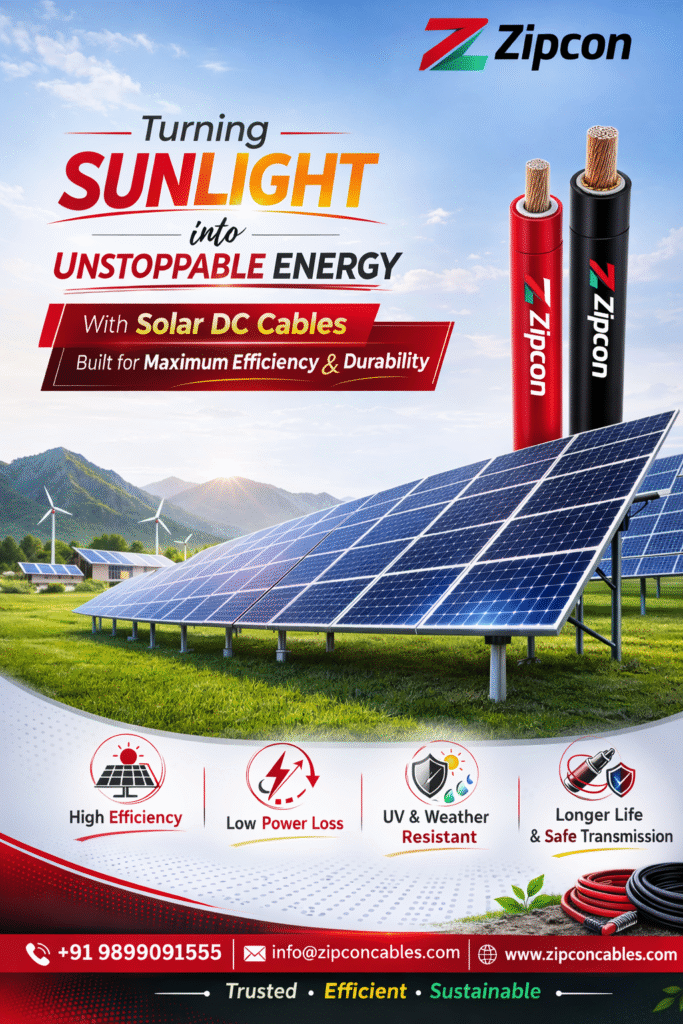
Quality solar cables from reliable manufacturers like Zipcon Cables are typically:
- UV stabilized
- XLPO or cross-linked insulated
- Flame retardant
- Weather resistant
Copper conductors generally offer better mechanical strength under repeated thermal cycling. Aluminium requires careful termination to prevent loosening over time.
Weight
Weight becomes important in:
- Large rooftop projects
- Elevated cable trays
- Long suspended runs
Aluminium is significantly lighter than copper. In large industrial ground-mounted plants, this reduces structural load and makes handling easier.
For high-rise commercial rooftops in Gurgaon, lighter cable can reduce installation strain.
Cost
Copper is more expensive than aluminium. For large-scale industrial solar farms, material cost difference becomes substantial.
However, cost evaluation should include:
- Cable size needed
- Installation hardware
- Long-term energy loss
- Maintenance risk
Sometimes cheaper cable leads to higher lifetime loss due to increased resistance or frequent termination issues.
Safety
Safety factors include:
- Flame retardancy
- Short-circuit resistance
- Thermal stability
- Insulation quality
Copper has better short-circuit withstand capacity. It handles fault current more reliably in high-load industrial systems.
For commercial buildings with strict fire compliance requirements, copper cables provide added reliability.
Zipcon Cables focuses on compliance with Indian and international standards, ensuring safer operation under demanding conditions.
Installation Requirements
Copper:
- Easier to terminate
- Less prone to connection loosening
- Smaller conductor size for same load
Aluminium:
- Requires proper lugs and anti-oxidation treatment
- Needs larger cross-section
- Slightly more care during crimping
For projects with tight commissioning timelines, copper can reduce installation complexity.
Copper vs Aluminium: Quick Comparison
Copper Solar Cable
- Higher conductivity
- Smaller size for same current
- Higher cost
- Better mechanical strength
- Ideal for compact or high-load systems
Aluminium Solar Cable
- Lower cost
- Lightweight
- Requires larger size
- Suitable for large ground-mounted projects
- Needs proper termination handling
Real-World Scenarios in Gurgaon
Scenario 1: Commercial Rooftop (100 kW – 500 kW)
Example: A warehouse rooftop in Manesar.
Challenges:
- Limited cable tray space
- Long daytime load
- High summer temperature
Best option:
Copper solar cable for DC string connections and inverter runs. It minimizes voltage drop and improves system efficiency over 25 years.
Here, efficiency matters more than minor material savings.
Scenario 2: Industrial Ground-Mounted Plant (2 MW+)
Example: A manufacturing unit in IMT Gurgaon installing a captive solar plant.
Challenges:
- Long cable runs
- Large cable quantities
- Budget sensitivity
Best option:
Aluminium cables for long-distance main runs where size flexibility is available. Copper can still be used in critical connections near inverters.
This hybrid approach balances cost and performance.
Scenario 3: High-Temperature Industrial Zone
Example: Solar plant near heavy machinery areas with heat exposure.
Best option:
Copper cables with high-temperature rated insulation. They handle thermal cycling better and reduce risk of conductor expansion-related loosening.
Where Copper Clearly Performs Better
- High-current inverter connections
- Limited tray space
- Rooftop commercial buildings
- Projects requiring minimal voltage drop
- Installations with strict fire safety norms
Where Aluminium Makes More Sense
- Large-scale industrial solar farms
- Long-distance cable routing
- Budget-sensitive projects
- Where weight reduction is important
Choosing the Right Solar Cable: Practical Recommendation
Instead of asking “Which is better?” ask:
- What is the load current?
- How long are the cable runs?
- Is tray space limited?
- What is the budget constraint?
- What are the environmental conditions?
For commercial rooftop projects in Gurgaon, copper solar cables are generally the safer and more efficient choice.
For large industrial installations where cost and quantity dominate, aluminium can be practical — provided proper installation practices are followed.
A reliable manufacturer like Zipcon Cables ensures:
- Consistent conductor quality
- Proper insulation standards
- UV and heat resistance
- Compliance with safety norms
- Long-term durability in Indian climate conditions
This reduces risk during commissioning and operation.
Final Advice for Engineers & Buyers
Don’t choose solar cable based on price per meter alone.
Calculate:
- Total voltage drop
- Long-term energy loss
- Installation complexity
- Maintenance risk
- 25-year lifecycle cost
In commercial systems where downtime is expensive, copper is usually worth the investment. In large industrial setups, a well-planned aluminium deployment can optimize budget without compromising safety.
The best solar cable in Gurgaon is not just about metal choice — it’s about matching conductor type, insulation quality, and installation method to the project’s technical requirements.
Make the decision based on application, not assumption.