

When choosing electrical wiring for a home, most people focus on price, brand, or gauge size, but the insulation type matters just as much. The difference between FRLS house wire and HRFR house wire can directly affect fire safety, smoke generation, durability, and long-term performance. If you are planning new wiring, renovation, or rewiring work, knowing which wire suits your home can help you make a safer and smarter decision.
FRLS and HRFR wires may sound similar, and many buyers assume they do the same job. They do not. Both are designed to offer better protection than ordinary PVC house wires, but they differ in how they respond to heat, fire, and operating conditions. For homeowners, electricians, contractors, and builders, this comparison is important because the wrong choice can lead to reduced protection where it matters most.
Choosing a reliable brand also plays a key role in ensuring consistent quality and safety. Wires from trusted manufacturers like Zipcon Cables are designed with a focus on performance, durability, and compliance with safety standards, making them a dependable option for modern residential wiring needs.
Contact us today: https://zipconcables.com/contact-us/
What Is FRLS House Wire?
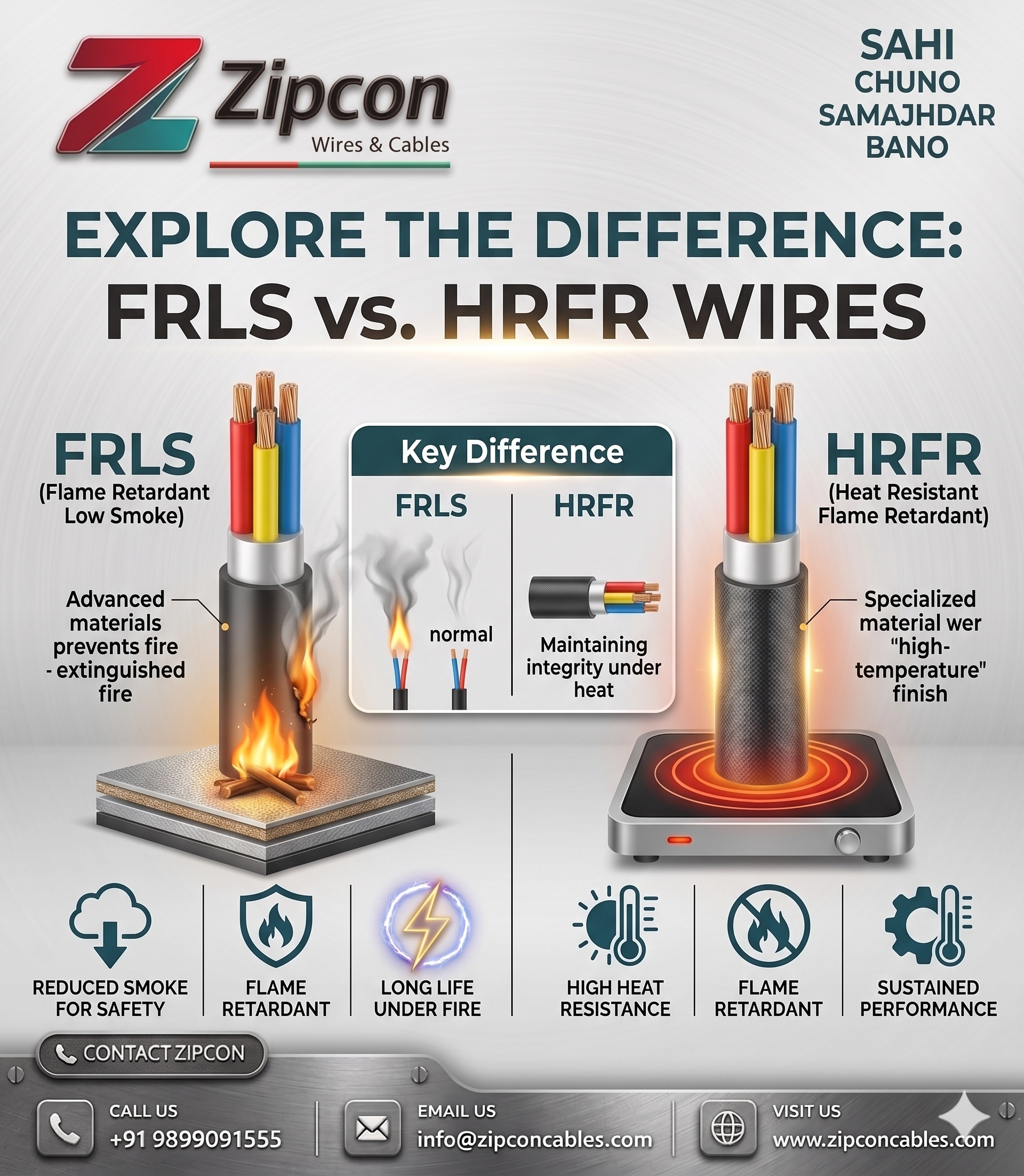
FRLS stands for Flame Retardant Low Smoke. This type of house wire is designed to slow the spread of fire and produce lower smoke levels if exposed to flames. In residential wiring, this is a major advantage because smoke is often a bigger danger than fire itself during an electrical emergency. Dense smoke can reduce visibility, create panic, and make evacuation difficult.
FRLS wire is commonly used in homes, apartments, offices, schools, and small commercial buildings where fire safety is a priority. Its insulation is made to resist ignition and reduce the emission of toxic smoke compared to standard wires. This makes FRLS wiring a preferred choice for indoor applications, especially in enclosed spaces where people live or work for long hours.
What Is HRFR House Wire?
HRFR stands for Heat Resistant Flame Retardant. This wire is built to handle higher operating temperatures while also offering flame retardant properties. The key focus here is heat resistance. HRFR wires are useful in places where wires are likely to face higher thermal loads due to heavy electrical appliances, long operating hours, or warm installation environments.
In simple terms, HRFR wire is meant to perform better under heat stress. It helps maintain insulation integrity when the wire temperature rises during use. This makes it suitable for circuits connected to air conditioners, heaters, kitchen appliances, geysers, and other power-hungry loads. It still offers flame retardant performance, but its main strength is better endurance under higher temperatures.
FRLS vs HRFR House Wire: Core Difference
The main difference between FRLS and HRFR house wire lies in what each type is specially designed to do. FRLS focuses more on reducing smoke and slowing flame spread during a fire event. HRFR focuses more on handling higher temperatures during regular electrical operation while also resisting flames.
This means FRLS is often the better choice where evacuation safety and smoke control matter more. HRFR becomes more useful where electrical heat buildup is a real concern due to heavy load conditions. A homeowner choosing between them should think about where the wire will be used, what appliances it will support, and how much importance they place on low smoke performance during emergencies.
FRLS vs HRFR: Meaning in Practical Home Use
In practical home wiring, FRLS is usually preferred for general internal wiring in bedrooms, living rooms, hallways, study rooms, and enclosed spaces. These are areas where low smoke insulation can add an extra layer of safety. During a short circuit or fire, wires with low smoke properties can make a real difference in reducing smoke spread.
HRFR is more relevant in load-intensive circuits. If a wire is serving an appliance that runs hot or consumes more power over time, heat resistance becomes important. In these cases, HRFR wire can handle thermal stress better. This does not mean FRLS is weak. It means each wire has a stronger advantage in different situations.
FRLS vs HRFR House Wire Comparison
1. Fire Performance
FRLS wires are designed to resist the spread of flame and keep smoke emission lower. This makes them especially useful in homes where the focus is on limiting fire-related hazards indoors. Their low smoke feature gives them an edge in enclosed buildings, flats, and apartments.
HRFR wires are also flame retardant, so they do not easily catch or spread fire. Their flame resistance is reliable, but they are not primarily known for low smoke behavior in the same way FRLS wires are. Their design priority is to manage heat better during operation.
2. Heat Resistance
HRFR wires perform better in environments where electrical heat builds up over time. They are engineered to tolerate higher conductor temperatures and maintain safety under long-duration load. This makes them a suitable option for circuits with continuous or heavy power demand.
FRLS wires may also perform well in standard residential settings, but their defining advantage is not high thermal endurance. They are better viewed as fire-safe low-smoke wires rather than heat-specialized wires. For normal home use, that may still be more than enough in many rooms.
3. Smoke Emission
Smoke is one of the biggest reasons FRLS wiring is chosen for homes. During combustion or electrical fire conditions, FRLS insulation produces lower smoke than conventional wires. This helps reduce suffocation risk and supports better visibility during evacuation.
HRFR wires may not offer the same level of low smoke performance as FRLS variants. They are safer than ordinary wire because of their flame retardant nature, but if smoke suppression is your priority, FRLS generally has the stronger advantage.
4. Best Application Area
FRLS wires are ideal for standard residential wiring, concealed wiring, housing societies, offices, schools, and indoor installations where human safety is central. They are often recommended for modern homes because they improve safety without affecting normal usage.
HRFR wires are a better fit for high-load points and heat-prone circuits. This includes kitchens, power sockets for heavy appliances, air conditioning circuits, water heaters, and equipment that runs for long periods. They work well when heat buildup is part of the operating environment.
5. Overall Safety Focus
FRLS offers more fire-safety reassurance in terms of smoke control and flame spread. It is usually the preferred choice when the goal is safer indoor wiring for family living spaces. It supports a more safety-oriented wiring setup in residential construction.
HRFR offers more durability under higher thermal operating conditions. Its safety value comes from stable performance under heat and reduced risk of insulation stress over time. It is especially useful where electrical loads are not light or occasional.
Which Is Better: FRLS or HRFR House Wire?
There is no single winner because the better wire depends on use. If your priority is safer indoor wiring with low smoke and improved fire response, FRLS house wire is usually the better option. It is widely considered suitable for general home wiring where comfort, occupancy, and indoor evacuation safety matter.
If your concern is higher temperature handling in load-heavy circuits, HRFR house wire can be the better choice. It works well in electrical points where thermal stress is more likely. Many well-planned homes actually use a combination approach, where general lighting and room circuits may use FRLS and heavy appliance circuits may benefit from HRFR, depending on the brand specifications and installation plan.
Why Wire Type Matters More Than Many Buyers Think
A lot of homeowners compare only price per coil or brand visibility, but wire insulation quality affects long-term safety, not just current flow. A house wire is hidden behind walls, ceilings, and conduits. Once installed, replacing it is expensive and disruptive. That is why the right choice should be made before installation, not after a problem appears.
The cost difference between a basic wire and a more advanced wire like FRLS or HRFR is often small when compared with the cost of the full electrical system, appliances, wall finishing, and labor. Spending slightly more for better fire or heat protection is usually a practical decision, especially in homes with children, elderly residents, or high appliance usage.
FRLS House Wire: Where It Makes the Most Sense
FRLS is a strong fit for modern residential projects where safety expectations are higher than before. Apartments, duplex homes, villas, and builder floors all benefit from wiring that reduces flame spread and lowers smoke density during a fault event. This is especially useful in stair-connected homes, compact flats, and spaces with limited natural ventilation.
It also makes sense in areas where multiple wires run through the same conduits. In those cases, if an electrical fault occurs, any reduction in smoke and flame spread becomes valuable. For general room circuits, concealed wiring, and living spaces, FRLS remains one of the more balanced and safety-focused options available.
HRFR House Wire: Where It Delivers Better Value
HRFR wire becomes highly relevant when a circuit is expected to operate closer to its load limit or remain active for long periods. Heavy-duty appliances put more thermal demand on the conductor and insulation. In such situations, a heat-resistant wire helps reduce the risk of insulation weakening over time.
This is why HRFR is often preferred for kitchen circuits, inverter lines, geyser points, washing machine sockets, microwave connections, and air conditioner supply lines. It adds confidence in places where the electrical demand is not occasional but frequent and consistent.
Examples Section
Example 1: Standard Apartment Wiring
A 2BHK apartment with regular fans, lights, chargers, television, and moderate appliance use can benefit greatly from FRLS house wire for most internal circuits. Since the home is enclosed and often occupied for long hours, low smoke wiring improves safety in case of a fire incident.
Example 2: Kitchen and Utility Area
A kitchen running a microwave, mixer, chimney, refrigerator, and water purifier creates more heat and electrical demand. In such a space, HRFR wire may be more suitable for specific power circuits because it is better equipped to handle thermal stress during repeated use.
Example 3: Family Home with Elderly Residents
In a home with children or elderly family members, evacuation speed during emergencies may be slower. FRLS wire adds a safety advantage because lower smoke generation can improve visibility and reduce panic during an electrical fire.
Example 4: High Appliance Bedroom Setup
A bedroom with air conditioning, heater, television, charging stations, and attached bathroom geyser may place more strain on connected circuits. HRFR wire can be a practical choice for those appliance-heavy points, while FRLS can still be used for general lighting and standard plug circuits.
Expert Tips
Choose the wire based on the circuit, not just the room
A kitchen light point and a microwave point do not need to be judged the same way. Look at the actual electrical load and usage pattern before selecting FRLS or HRFR wire.
Always verify the product specification sheet
Different brands may position their wires differently. Read the technical details instead of relying only on packaging claims. The terms FRLS and HRFR should be backed by proper performance standards.
Pair good wire with proper installation
Even the best house wire can underperform if the conductor size is wrong, joints are poor, or installation is sloppy. Wire quality and electrician quality must go together.
Think long term, not short term
House wiring is not something you want to redo every few years. A slightly better wire today can save repair costs, risk, and inconvenience later.
Prefer trusted brands with quality consistency
If you are selecting wiring for a home or project, it is better to go with a brand that offers reliable insulation quality, conductor purity, and clear product labeling. Zipcon Cables can be considered if you are looking for house wire options with a focus on dependable performance and safer residential applications.
Common Mistakes
Treating FRLS and HRFR as the same thing
Many buyers assume both terms mean premium wire and stop there. That leads to poor selection. FRLS is more about low smoke fire safety, while HRFR is more about heat endurance with flame retardant properties.
Buying wire only on price
A cheaper wire may save money at the billing counter but create bigger problems later. Poor insulation performance, lower durability, or unsuitable wire type can lead to higher risk and higher replacement cost.
Ignoring the load on the circuit
Not every electrical point should be wired the same way. Heavy appliance circuits need more careful planning. Matching the wire type to the load is a basic but often ignored step.
Skipping brand verification
Counterfeit or low-grade wires are a real market issue. Always check for proper markings, packaging quality, brand reputation, and product certification before buying.
Assuming wire type can compensate for poor workmanship
No insulation type can fix loose connections, poor routing, undersized conductor selection, or overloaded circuits. Installation discipline is just as important as material quality.
FRLS or HRFR: Which One Should You Choose for Your Home?
If you want a simple rule, go with FRLS house wire for general home wiring where low smoke and indoor fire safety matter most. Go with HRFR house wire for circuits exposed to higher temperatures and heavier electrical loads. In many homes, the best answer is not choosing one over the other everywhere. It is choosing each where it fits best.
A smart home wiring plan is never about buying the most expensive option blindly. It is about understanding risk, usage, and long-term performance. When you align wire selection with actual application, the whole electrical system becomes safer and more reliable.
Conclusion
The difference between FRLS house wire and HRFR house wire comes down to purpose. FRLS is the better choice when you want lower smoke and stronger indoor fire safety. HRFR is the better choice when heat resistance under heavier load matters more. Both are better than ordinary wiring in the right context, but they should not be treated as interchangeable.
If you are wiring a new home, renovating an old one, or advising a client, choose wire based on safety need, appliance load, and installation area. A careful decision now can protect the home for years. For those exploring dependable residential wiring solutions, Zipcon Cables is worth considering as part of a safety-focused selection process.
Top 5 SEO FAQs
1. What is the main difference between FRLS and HRFR house wire?
FRLS house wire is designed to reduce flame spread and produce lower smoke during a fire. HRFR house wire is designed to handle higher operating temperatures while also offering flame retardant properties. FRLS is more focused on smoke safety, while HRFR is more focused on heat resistance.
2. Which is better for home wiring, FRLS or HRFR?
For general indoor residential wiring, FRLS is often preferred because of its low smoke feature. For heavy-load circuits and appliance points, HRFR can be a better option due to its stronger heat resistance. The better choice depends on where the wire will be used.
3. Is FRLS wire safer than HRFR wire?
FRLS wire can be considered safer in enclosed indoor spaces where smoke during a fire is a major concern. HRFR is also safe, but its strength is better performance under higher temperature conditions. Safety depends on the application, not just the label.
4. Can HRFR wire be used in houses?
Yes, HRFR wire can be used in houses, especially for circuits connected to heavy appliances like air conditioners, geysers, microwaves, and heaters. It is suitable where thermal load is higher than normal.
5. Should I use FRLS wire for all rooms in my house?
FRLS wire is a very good option for most rooms in a home, especially for general wiring. Still, for certain high-load circuits, HRFR wire may be more suitable. A balanced approach based on usage is often the best solution.