

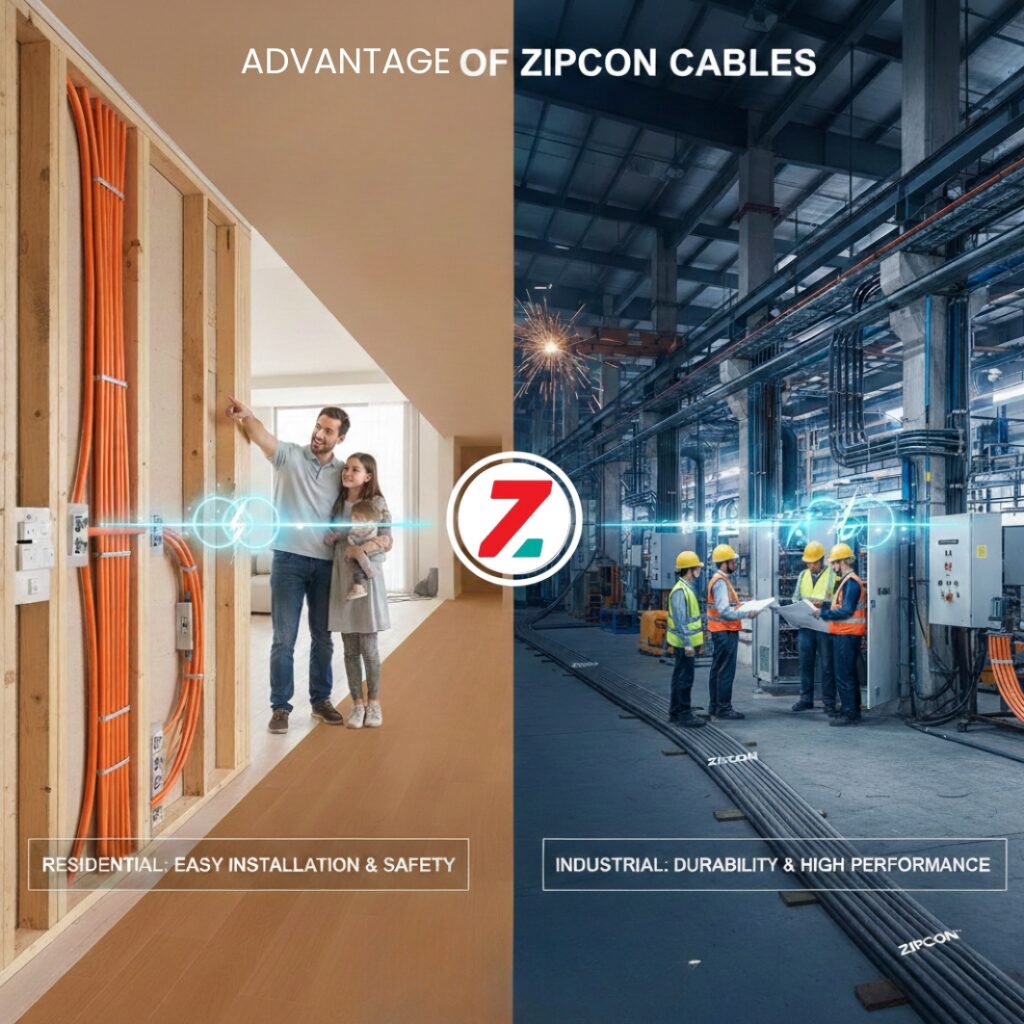
Zipcon cables Manufacturer in delhi have gained significant traction in both residential and industrial wiring due to their superior durability, cost-effectiveness, and versatility. While copper cables have long been a standard in the industry, Zipcon cables present a strong alternative for various applications. In this article, we’ll explore the advantages of Zipcon cables, particularly in comparison to copper cables, across key technical areas such as conductivity, durability, weight, cost, safety, installation, and typical use cases.
For inquiries or assistance, visit: 👉https://zipconcables.com/contact-us/
Conductivity
Copper cables are known for their high conductivity, making them the preferred choice in applications where efficient power transmission is critical, such as in high-voltage and heavy-duty systems. However, Zipcon cables, while not as conductive as copper, still offer adequate conductivity for many residential and light industrial applications.
Zipcon cables use advanced materials and insulation that enhance their performance in various environments, ensuring that the electrical current flows efficiently for most residential wiring and industrial setups. In scenarios where extreme conductivity is not a priority—such as in lower power systems or residential buildings—Zipcon cables provide sufficient performance at a more affordable price.
However, for high-power, high-performance applications, copper remains the better choice due to its superior conductivity.
Durability
Zipcon cables manufacturer in india are designed to perform well in challenging environments, making them a great option for both residential and industrial installations. These cables can withstand extreme temperature variations, humidity, and mechanical wear, which are common in industrial settings like factories, warehouses, and outdoor installations.
Compared to copper, Zipcon cables offer superior resistance to environmental stresses, reducing the risk of failure over time. They are often coated with durable insulation materials that protect them from corrosion, abrasion, and other forms of degradation, which can be a concern with copper cables when exposed to harsh conditions.
In residential settings, Zipcon cables have proven to be highly reliable, requiring minimal maintenance and offering long-lasting performance. Copper cables, on the other hand, tend to have a slightly longer lifespan in optimal conditions but may require more regular maintenance due to their vulnerability to corrosion and wear over time.
Weight
One significant advantage of Zipcon cables is their lighter weight compared to copper cables. This makes them easier to handle and install, especially in large-scale projects where long cable runs are required. The reduced weight can also contribute to cost savings in terms of transportation and handling.
In contrast, copper cables are relatively heavier and may pose installation challenges, especially in tight spaces or when long distances need to be covered. The lighter weight of Zipcon cables, however, makes them a preferred choice in residential applications, where ease of installation is important.
Cost
Cost is a major factor when deciding between Zipcon and copper cables. Zipcon cables are more affordable than copper cables, making them a more cost-effective solution for many residential and industrial projects. For budget-sensitive applications, Zipcon offers a great balance between performance and price, without compromising safety or durability.
Copper cables, while more expensive, are still the go-to choice for high-performance applications that demand superior conductivity. In large-scale or budget-sensitive projects, Zipcon cables may provide significant savings without sacrificing the necessary performance.
Safety
Safety is a paramount consideration in any wiring project, and Zipcon cables excel in this area. They are equipped with advanced insulation materials that make them resistant to fire and provide protection against electrical shocks. Zipcon cables are also designed to meet various international safety standards and certifications, ensuring that they can be used safely in both residential and industrial settings.
Copper cables, on the other hand, can be more prone to overheating in certain conditions, especially if they are not properly insulated or if they carry a heavy electrical load. While copper is a highly conductive material, it requires careful installation and maintenance to avoid safety risks. Zipcon cables, with their robust insulation, provide an added layer of security, particularly in high-risk environments.
Installation Needs
The installation process for Zipcon cables is straightforward and requires minimal tools and specialized skills. Their lighter weight, flexible design, and easier handling make Zipcon cables easier and faster to install compared to copper cables. This can reduce labor costs and installation time, particularly in residential and commercial wiring projects.
In contrast, copper cables often require more careful handling and specialized tools for cutting, stripping, and installation. The installation process can also be more time-consuming due to the heavier weight and more rigid nature of copper cables.
Typical Use Cases
Zipcon cables are ideal for a wide range of applications. In residential settings, they are commonly used for wiring in homes, apartments, and offices, where high conductivity is not as critical. Their durability and cost-effectiveness make them a great choice for projects that require reliable performance without the high price tag of copper cables.
In industrial settings, Zipcon cables are used for a variety of applications, from lighting systems in factories to powering machinery in warehouses. The cables’ ability to withstand harsh conditions makes them suitable for industrial environments where temperature fluctuations and exposure to moisture are common.
Copper cables are still the preferred choice for high-performance applications, such as heavy-duty power transmission, high-voltage systems, and situations that demand the highest possible conductivity.
Copper vs. Zipcon Cables
While Zipcon cables offer several advantages, particularly in terms of cost, durability, and ease of installation, there are still scenarios where copper cables may outperform them. For applications that require superior conductivity, such as heavy-duty power systems or high-voltage installations, copper cables are the better option.
However, Zipcon cables are well-suited for most residential and many industrial applications, where cost savings, durability, and ease of installation are more important than maximum conductivity.
Recommendation
For most residential and light industrial applications, Zipcon cables provide a reliable, cost-effective, and durable solution. They perform well in a wide range of environments, offering ease of installation and lower overall costs. Copper cables should still be considered for applications that demand high conductivity, such as heavy-duty power systems or specialized high-voltage installations.
Ultimately, the choice between Zipcon and copper cables should be based on the specific needs of the project—whether it’s cost, durability, or performance that matters most. For most applications, Zipcon cables will deliver excellent results while staying within budget.